p.27 抽出テキスト
性ショックと診断された1,591 例において,qSOFA を満たしたのは1,139 例(約71.6%),qSOFA およびSOFA によるSepsis-3 3)の敗血症診断を満たしたものは1,010 例(約63.4%),さらにSepsis-3 の敗血症性ショックの診断基準を満たしたものは203 例(約12.8%)と解析されている。フロリダの救急部門を対象とした2 つの研究からなる敗血症データベース470例の解析 20)においては,Sepsis-3 の診断で敗血症性ショックが評価されたのは200 例(42.5%),Sepsis-1およびSepsis-2 による診断で敗血症性ショックが評価されたのは270 例(57.4%)であり,Sepsis-3 の敗血症性ショックはSOFA スコアと死亡率が統計学的に有意に高かった。このように,Sepsis-3 による敗血症性ショックの診断は,重症度の高い敗血症性ショックを診断していることに注意して対応することになる。

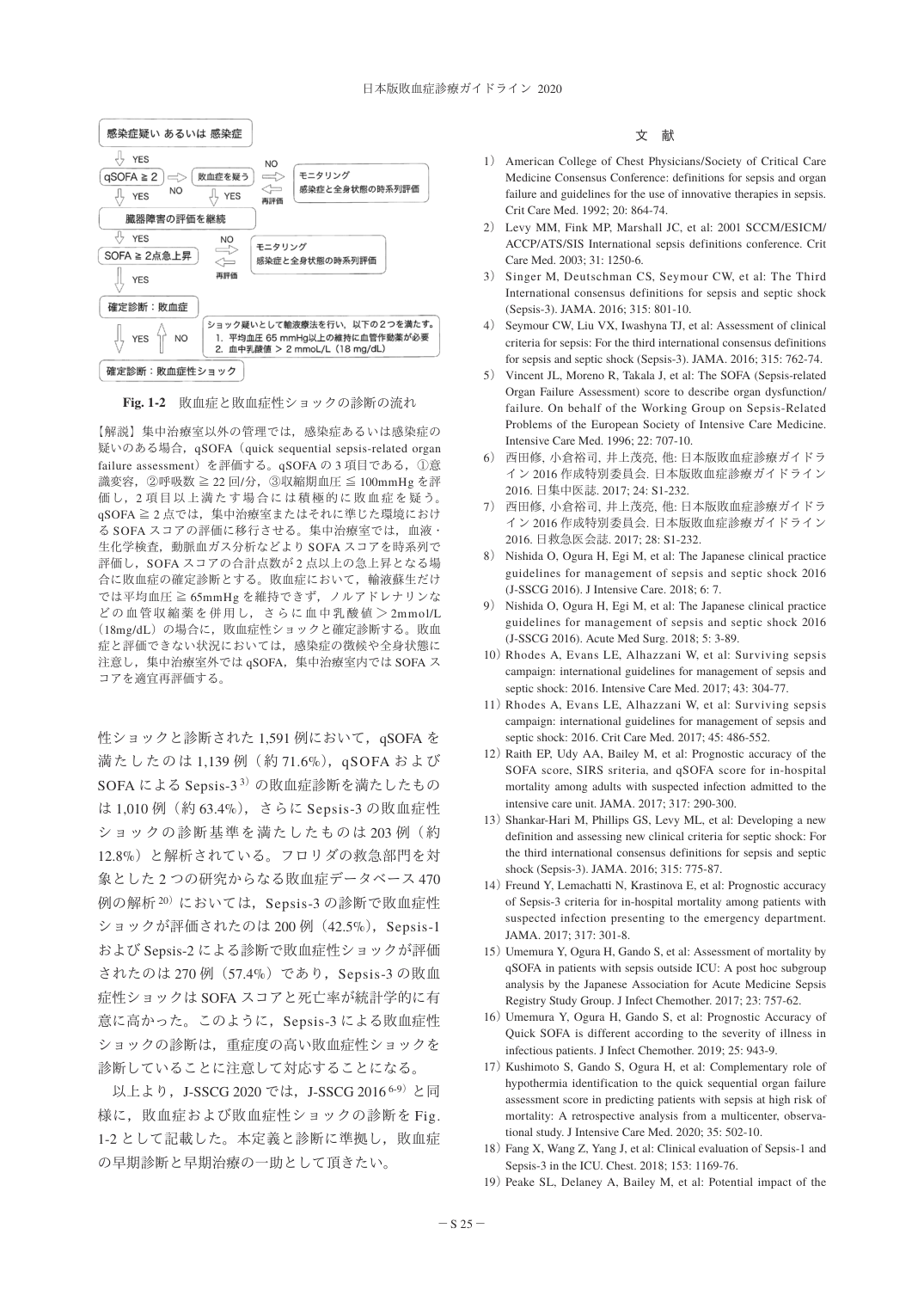
以上より,J-SSCG 2020 では,J-SSCG 2016 6-9)と同様に,敗血症および敗血症性ショックの診断をFig. 1-2 として記載した。本定義と診断に準拠し,敗血症の早期診断と早期治療の一助として頂きたい。文 献

1) American College of Chest Physicians / Society of Critical Care Medicine Consensus Conference: definitions for sepsis and organ failure and guidelines for the use of innovative therapies in sepsis. Crit Care Med. 1992; 20: 864-74. 2) Levy MM, Fink MP, Marshall JC, et al: 2001 SCCM / ESICM / ACCP / ATS / SIS International sepsis definitions conference. Crit Care Med. 2003; 31: 1250-6. 3) Singer M, Deutschman CS, Seymour CW, et al: The Third International consensus definitions for sepsis and septic shock (Sepsis-3). JAMA. 2016; 315: 801-10. 4) Seymour CW, Liu VX, Iwashyna TJ, et al: Assessment of clinical criteria for sepsis: For the third international consensus definitions for sepsis and septic shock (Sepsis-3). JAMA. 2016; 315: 762-74. 5) Vincent JL, Moreno R, Takala J, et al: The SOFA (Sepsis-related Organ Failure Assessment) score to describe organ dysfunction / failure. On behalf of the Working Group on Sepsis-Related Problems of the European Society of Intensive Care Medicine. Intensive Care Med. 1996; 22: 707-10. 6) 西田修, 小倉裕司, 井上茂亮, 他: 日本版敗血症診療ガイドライン2016 作成特別委員会. 日本版敗血症診療ガイドライン2016. 日集中医誌. 2017; 24: S1-232. 7) 西田修, 小倉裕司, 井上茂亮, 他: 日本版敗血症診療ガイドライン2016 作成特別委員会. 日本版敗血症診療ガイドライン2016. 日救急医会誌. 2017; 28: S1-232. 8) Nishida O, Ogura H, Egi M, et al: The Japanese clinical practice guidelines for management of sepsis and septic shock 2016 (J-SSCG 2016). J Intensive Care. 2018; 6: 7. 9) Nishida O, Ogura H, Egi M, et al: The Japanese clinical practice guidelines for management of sepsis and septic shock 2016 (J-SSCG 2016). Acute Med Surg. 2018; 5: 3-89. 10) Rhodes A, Evans LE, Alhazzani W, et al: Surviving sepsis campaign: international guidelines for management of sepsis and septic shock: 2016. Intensive Care Med. 2017; 43: 304-77. 11) Rhodes A, Evans LE, Alhazzani W, et al: Surviving sepsis campaign: international guidelines for management of sepsis and septic shock: 2016. Crit Care Med. 2017; 45: 486-552. 12) Raith EP, Udy AA, Bailey M, et al: Prognostic accuracy of the SOFA score, SIRS sriteria, and qSOFA score for in-hospital mortality among adults with suspected infection admitted to the intensive care unit. JAMA. 2017; 317: 290-300. 13) Shankar-Hari M, Phillips GS, Levy ML, et al: Developing a new definition and assessing new clinical criteria for septic shock: For the third international consensus definitions for sepsis and septic shock (Sepsis-3). JAMA. 2016; 315: 775-87. 14) Freund Y, Lemachatti N, Krastinova E, et al: Prognostic accuracy of Sepsis-3 criteria for in-hospital mortality among patients with suspected infection presenting to the emergency department. JAMA. 2017; 317: 301-8. 15) Umemura Y, Ogura H, Gando S, et al: Assessment of mortality by qSOFA in patients with sepsis outside ICU: A post hoc subgroup analysis by the Japanese Association for Acute Medicine Sepsis Registry Study Group. J Infect Chemother. 2017; 23: 757-62. 16) Umemura Y, Ogura H, Gando S, et al: Prognostic Accuracy of Quick SOFA is different according to the severity of illness in infectious patients. J Infect Chemother. 2019; 25: 943-9. 17) Kushimoto S, Gando S, Ogura H, et al: Complementary role of hypothermia identification to the quick sequential organ failure assessment score in predicting patients with sepsis at high risk of mortality: A retrospective analysis from a multicenter, observational study. J Intensive Care Med. 2020; 35: 502-10. 18) Fang X, Wang Z, Yang J, et al: Clinical evaluation of Sepsis-1 and Sepsis-3 in the ICU. Chest. 2018; 153: 1169-76. 19) Peake SL, Delaney A, Bailey M, et al: Potential impact of the

Fig. 1-2 敗血症と敗血症性ショックの診断の流れ【解説】集中治療室以外の管理では,感染症あるいは感染症の疑いのある場合,qSOFA(quick sequential sepsis-related organ failure assessment)を評価する。qSOFA の3 項目である,1意識変容,2呼吸数≧22 回 / 分,3収縮期血圧≦100mmHg を評価し,2 項目以上満たす場合には積極的に敗血症を疑う。qSOFA ≧2 点では,集中治療室またはそれに準じた環境におけるSOFA スコアの評価に移行させる。集中治療室では,血液・生化学検査,動脈血ガス分析などよりSOFA スコアを時系列で評価し,SOFA スコアの合計点数が2 点以上の急上昇となる場合に敗血症の確定診断とする。敗血症において,輸液蘇生だけでは平均血圧≧65mmHg を維持できず,ノルアドレナリンなどの血管収縮薬を併用し,さらに血中乳酸値>2mmol / L (18mg / dL)の場合に,敗血症性ショックと確定診断する。敗血症と評価できない状況においては,感染症の徴候や全身状態に注意し,集中治療室外ではqSOFA,集中治療室内ではSOFA スコアを適宜再評価する。

-S 25-