p.8 抽出テキスト
Patient-Reported Outcome Measures (PROMs) and Patient-Reported Experience Measures (PREMs) are also evaluated when available as the basis for recommendations and/or discussion in these guidelines. Evidence tables summarizing key information from relevant studies are generated to facilitate the formulation of recommendations, to enhance comprehension of recommendations after publication, and to reinforce transparency in the guidelines development process. The tables are published in their own section of ESC Guidelines and reference specific recommendation tables. After an iterative process of deliberations, a first Task Force vote on all recommendations is conducted prior to the initiation of rounds of review. A second Task Force vote on all recommendations is conducted after the final round of review and revision. For each vote, the Task Force follows ESC voting procedures: to achieve quorum, at least two-thirds of the Task Force must vote agree or disagree, and to be approved all recommendations require at least 75% of votes in favour, excluding abstentions. Restrictions on voting and on participation in task force deliberations are applied as needed based on declarations of interest. The writing and reviewing panels provide declaration of interest forms for all relationships that might be perceived as real or potential sources of conflicts of interest. Their declarations of interest are reviewed according to the ESC declaration of interest rules, which can be found on the ESC website (http://www.escardio.org/doi) and are compiled in a report published in a supplementary document with the guidelines. Funding for the development of ESC Guidelines is derived entirely from the ESC with no involvement of the healthcare industry.

The CPG Committee supervises and coordinates the preparation of new guidelines and approves their publication. In addition to review by the CPG Committee, ESC Guidelines undergo multiple rounds of double-blind peer review on a dedicated online review platform. The review is conducted by a panel of 70 or more topic experts including members from ESC National Cardiac Societies and from relevant ESC Subspecialty Communities. Reviewers critically assess and comment on the content of the Guidelines and grade their comments as major and minor. Guideline Task Forces consider all review comments and are required to respond on the online platform to all those classified as major. The review comments inform revisions after each round. After the final review round and the second Task Force vote on all recommendations, the Task Force and the CPG Committee members approve the final document for publication in the European Heart Journal. Unless otherwise stated, ESC Guidelines content refers to sex, understood as the biological condition of being male or female, defined by genes, hormones, and sexual organs. Off-label use of medication may be presented in this guideline if a sufficient level of evidence shows that it can be considered medically appropriate for a given condition. However, decisions on off-label use must be made by the responsible health professional giving special consideration to ethical rules concerning healthcare, the specific situation of the patient, patient consent, and country-specific health regulation.

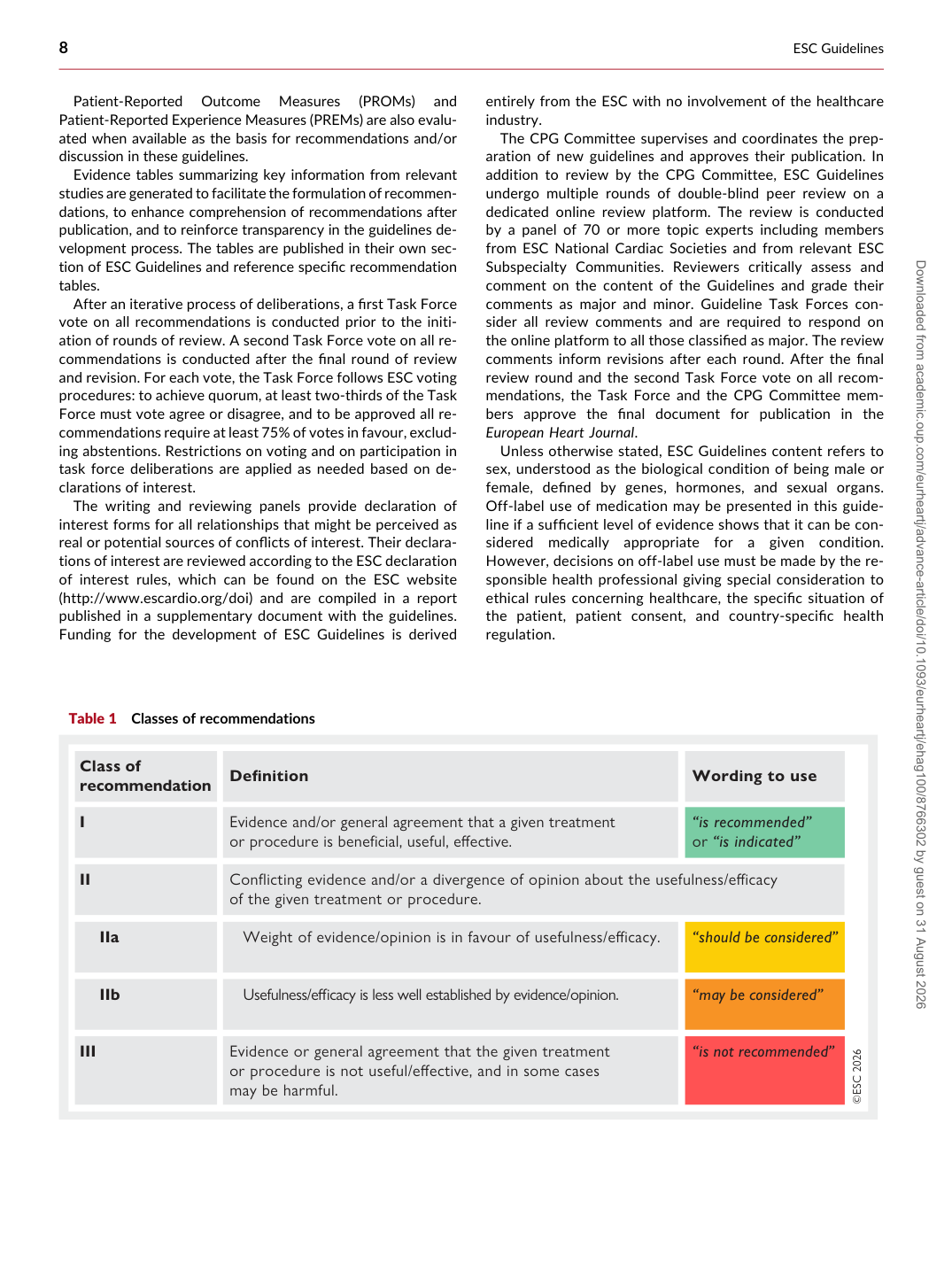
Table 1 Classes of recommendations

©ESC 2026

Class of recommendation I

IIa

IIb

III Weight of evidence/opinion is in favour of usefulness/efficacy.

Definition

Evidence and/or general agreement that a given treatment or procedure is beneficial, useful, effective.

Usefulness/efficacy is less well established by evidence/opinion.

Evidence or general agreement that the given treatment or procedure is not useful/effective, and in some cases may be harmful. Wording to use

“should be considered”

“is recommended” or “is indicated”

“may be considered”

“is not recommended”

II Conflicting evidence and/or a divergence of opinion about the usefulness/efficacy of the given treatment or procedure. Downloaded from academic.oup.com/eurheartj/advance-article/doi/10.1093/eurheartj/ehag100/8766302 by guest on 31 August 2026