p.77 抽出テキスト
Beta-blockers and ACE-I/ARNI/ARB use requires caution, individualized decisions, and close monitoring. In patients with CA and AF, anticoagulation is indicated regardless of CHA2DS2-VA score, due to high thromboembolic risk.1077,1095–1097 Transoesophageal echocardiography is necessary before cardioversion to exclude intracardiac thrombus, regardless of the duration of anticoagulation before the procedure.1098 The use of digoxin is generally discouraged due to high risk of toxicity. Few patients with CA and advanced symptoms may be eligible for heart transplantation in line with international criteria.580

12.4 Myocarditis

12.4.1. Epidemiology and diagnosis The contribution of myocarditis as a cause of HF is estimated to be less than 5%.1099 When patients with myocarditis present with DHF, LVEF <40%, life-threatening arrhythmias (ventricular tachycardia/fibrillation, third-degree atrioventricular block), and/or extensive LGE on CMR, they should be viewed as high risk.1100,1101 High-risk patients may require an endomyocardial biopsy in order to tailor treatment,8 whereas lower-risk patients may be examined with CMR imaging. The clinical presentation ranges from impaired LV function to refractory HF, CS (fulminant myocarditis), or sudden cardiac arrest. Some patients present primarily with arrhythmias. Prognosis depends on initial presentation.1100,1101 Patients with fulminant myocarditis should be transferred or discussed with a center that has the possibility to perform endomyocardial biopsy and provide MCS support. High-risk patients have a high mortality and may need temporary MCS and/or in the long term heart transplantation or durable MCS.1102–1104

12.4.2 Treatment

The treatment algorithm is reported in the 2025 ESC Guidelines for the management of myocarditis and pericarditis.8 Patients with myocarditis and HFrEF should be empirically treated with FMT for HFrEF (see Section 7). Routine immunosuppression is not recommended in patients with preserved LVEF and should be reserved for fulminant, non-infectious forms of myocarditis to stabilize the patients.8

12.5 Adult congenital heart disease

Adult congenital heart disease is a heterogeneous group of structural heart abnormalities varying in complexity. There has been an improvement in survival with contemporary care.1105 Consequently, HF in ACHD is increasingly common,1106,1107 and represents a major contributor to morbidity and mortality, accounting for 26%–46% of deaths, with higher rates seen in more complex lesions.1108–1110 Managing HF in ACHD poses specific challenges related to original anatomy, presence of haemodynamic lesions, previous interventions, and extracardiac complications such as kidney and liver dysfunction.1111,1112 Specific indications on the management of these patients are reported in the 2020 ESC Guidelines for the management of adult congenital heart disease1111 and in a recent ESC clinical consensus statement.1113

13 Key messages

New classifications • Heart failure has been redefined with two distinct phenotypes: ⚬HFrEF: LVEF <50% + symptoms and/or signs of HF. ⚬HFpEF: LVEF ≥50% + symptoms and/or signs of HF + objective evidence of cardiac structural and/or functional abnormalities. • Stages of HF (A–D) have been adopted: ⚬Stage A: individuals at risk for HF but without signs, symp-

toms, and cardiac abnormalities. ⚬Stage B: pre-HF, defined as the presence of cardiac abnormalities without signs and symptoms of HF. ⚬Stage C: symptomatic HF, defined as the presence of cardiac abnormalities and current or prior signs and/or symptoms of HF. ⚬Stage D: advanced HF. • New classifications for medical and interventional HF therapies have been introduced. The terms are designed to be dynamic and may therefore remain contemporary over time: ⚬FMT—Foundational medical therapy: medical therapies for

unselected patients with HF with Class I recommendation for reducing HFH and/or death. ⚬AMT—Additional medical therapy: medical therapies with Class IIa/IIb recommendations or Class I recommendations for improving symptoms/QoL or reducing morbidity or mortality in specific subsets of patients with HF. ⚬GDIT—Guideline-directed interventional therapy: all guideline-recommended implantable devices or interventional therapies.

Prevention of heart failure • A strict control of HF risk factors is recommended to prevent HF.

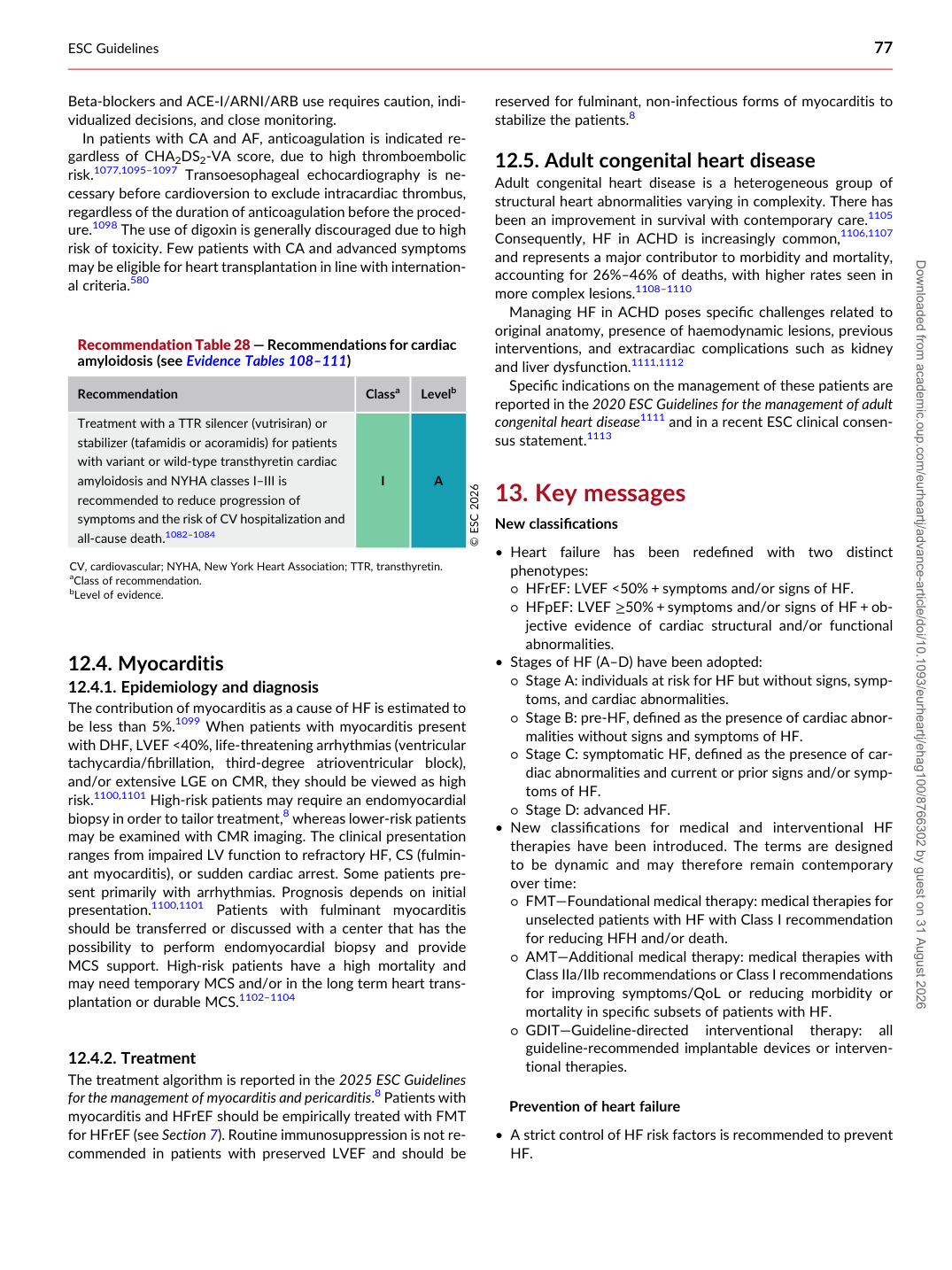
Recommendation Table 28 — Recommendations for cardiac amyloidosis (see Evidence Tables 108–111)

Recommendation Classa Levelb Treatment with a TTR silencer (vutrisiran) or stabilizer (tafamidis or acoramidis) for patients with variant or wild-type transthyretin cardiac amyloidosis and NYHA classes I–III is recommended to reduce progression of symptoms and the risk of CV hospitalization and all-cause death.1082–1084 I A © ESC 2026 CV, cardiovascular; NYHA, New York Heart Association; TTR, transthyretin. aClass of recommendation. bLevel of evidence. Downloaded from academic.oup.com/eurheartj/advance-article/doi/10.1093/eurheartj/ehag100/8766302 by guest on 31 August 2026