p.72 抽出テキスト
time, type) for aerobic training, resistance training, and inspiratory muscle training1010,1011 (see Supplementary data online, Section S8.4).998,1012–1016 Adherence to the prescribed exercise regimen is crucial (see Supplementary data online, Section S8.4).1017–1020

11.5 Telemonitoring

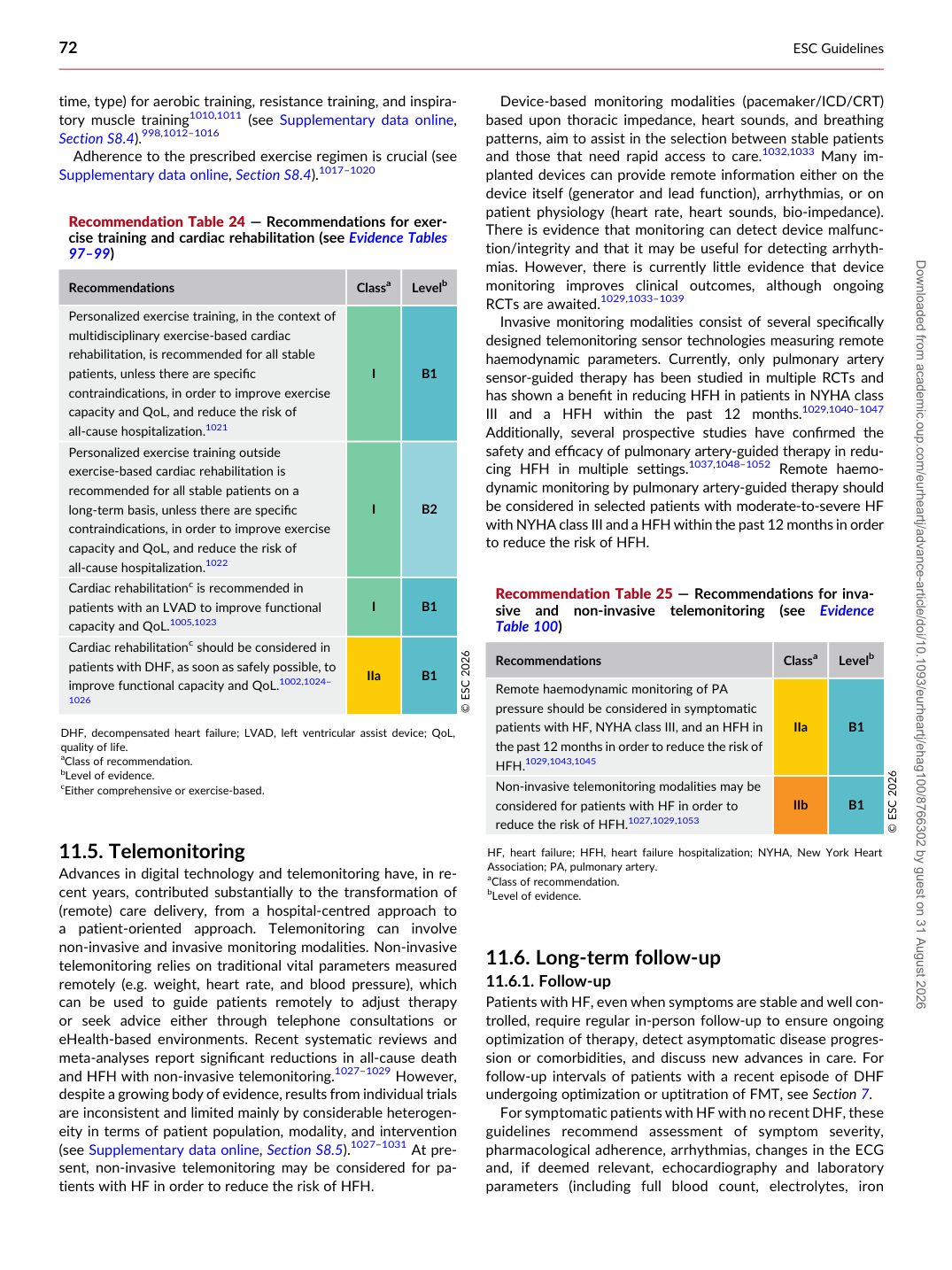
Advances in digital technology and telemonitoring have, in recent years, contributed substantially to the transformation of (remote) care delivery, from a hospital-centred approach to a patient-oriented approach. Telemonitoring can involve non-invasive and invasive monitoring modalities. Non-invasive telemonitoring relies on traditional vital parameters measured remotely (e.g. weight, heart rate, and blood pressure), which can be used to guide patients remotely to adjust therapy or seek advice either through telephone consultations or eHealth-based environments. Recent systematic reviews and meta-analyses report significant reductions in all-cause death and HFH with non-invasive telemonitoring.1027–1029 However, despite a growing body of evidence, results from individual trials are inconsistent and limited mainly by considerable heterogeneity in terms of patient population, modality, and intervention (see Supplementary data online, Section S8.5).1027–1031 At present, non-invasive telemonitoring may be considered for patients with HF in order to reduce the risk of HFH. Device-based monitoring modalities (pacemaker/ICD/CRT) based upon thoracic impedance, heart sounds, and breathing patterns, aim to assist in the selection between stable patients and those that need rapid access to care.1032,1033 Many implanted devices can provide remote information either on the device itself (generator and lead function), arrhythmias, or on patient physiology (heart rate, heart sounds, bio-impedance). There is evidence that monitoring can detect device malfunction/integrity and that it may be useful for detecting arrhythmias. However, there is currently little evidence that device monitoring improves clinical outcomes, although ongoing RCTs are awaited.1029,1033–1039

Invasive monitoring modalities consist of several specifically designed telemonitoring sensor technologies measuring remote haemodynamic parameters. Currently, only pulmonary artery sensor-guided therapy has been studied in multiple RCTs and has shown a benefit in reducing HFH in patients in NYHA class III and a HFH within the past 12 months.1029,1040–1047 Additionally, several prospective studies have confirmed the safety and efficacy of pulmonary artery-guided therapy in reducing HFH in multiple settings.1037,1048–1052 Remote haemodynamic monitoring by pulmonary artery-guided therapy should be considered in selected patients with moderate-to-severe HF with NYHA class III and a HFH within the past 12 months in order to reduce the risk of HFH.

11.6 Long-term follow-up

11.6.1. Follow-up Patients with HF, even when symptoms are stable and well controlled, require regular in-person follow-up to ensure ongoing optimization of therapy, detect asymptomatic disease progression or comorbidities, and discuss new advances in care. For follow-up intervals of patients with a recent episode of DHF undergoing optimization or uptitration of FMT, see Section 7. For symptomatic patients with HF with no recent DHF, these guidelines recommend assessment of symptom severity, pharmacological adherence, arrhythmias, changes in the ECG and, if deemed relevant, echocardiography and laboratory parameters (including full blood count, electrolytes, iron

Recommendation Table 24 — Recommendations for exercise training and cardiac rehabilitation (see Evidence Tables 97–99)

Recommendations Classa Levelb Personalized exercise training, in the context of multidisciplinary exercise-based cardiac rehabilitation, is recommended for all stable patients, unless there are specific contraindications, in order to improve exercise capacity and QoL, and reduce the risk of all-cause hospitalization.1021 I B1 Personalized exercise training outside exercise-based cardiac rehabilitation is recommended for all stable patients on a long-term basis, unless there are specific contraindications, in order to improve exercise capacity and QoL, and reduce the risk of all-cause hospitalization.1022 I B2 Cardiac rehabilitationc is recommended in patients with an LVAD to improve functional capacity and QoL.1005,1023 I B1 Cardiac rehabilitationc should be considered in patients with DHF, as soon as safely possible, to improve functional capacity and QoL.1002,1024–

1026 IIa B1 © ESC 2026 DHF, decompensated heart failure; LVAD, left ventricular assist device; QoL, quality of life. aClass of recommendation. bLevel of evidence. cEither comprehensive or exercise-based. Recommendation Table 25 — Recommendations for invasive and non-invasive telemonitoring (see Evidence Table 100)

Recommendations Classa Levelb Remote haemodynamic monitoring of PA pressure should be considered in symptomatic patients with HF, NYHA class III, and an HFH in the past 12 months in order to reduce the risk of HFH.1029,1043,1045 IIa B1 Non-invasive telemonitoring modalities may be considered for patients with HF in order to reduce the risk of HFH.1027,1029,1053 IIb B1 © ESC 2026 HF, heart failure; HFH, heart failure hospitalization; NYHA, New York Heart Association; PA, pulmonary artery. aClass of recommendation. bLevel of evidence. Downloaded from academic.oup.com/eurheartj/advance-article/doi/10.1093/eurheartj/ehag100/8766302 by guest on 31 August 2026