p.69 抽出テキスト
10.9 Other non-cardiovascular

comorbidities Infections may cause WHF and can precipitate HFH.925,926 Infections should ideally be prevented or, if present, promptly recognized and treated to avoid disease progression.927–930 Influenza vaccination is associated with a reduced risk of pneumonia and all-cause death in patients with HF.931–936 Thus, influenza and pneumococcal vaccination should be considered in all patients with HF in order to reduce the risk of infection-related complications.935 Thyroid dysfunction can cause changes in cardiac function and structure and may precipitate DHF.937,938 Assessment of thyroid function is recommended in patients with de novo HF or DHF and should be regularly assessed during follow-up of patients with HF. Treatment of thyroid dysfunction should be guided by endocrine guidelines.939–942 Hyperuricaemia and consequent gout attacks can be frequent in patients with HF, mainly caused or precipitated by diuretic treatment.943,944 Allopurinol is recommended as the first choice to chronically reduce uric acid levels in patients with HF,945 whereas colchicine can be used for acute gout attacks. Non-steroidal antiinflammatory drugs and selective cyclooxygenase-2 inhibitors are not recommended in patients with HF because they may precipitate decompensation and worsen kidney function.942,946–948

Heart failure and erectile dysfunction frequently coexist.949,950 Cardioselective beta-blockers should be preferred in patients with HF and erectile dysfunction, mainly bisoprolol and nebivolol, started at the lowest doses.897 In the presence of erectile dysfunction symptoms, phosphodiesterase-V inhibitors are generally safe and can be considered in patients who are compensated,951 avoiding their concomitant use with nitrates.952

11 Multidisciplinary team

management, long-term follow-up, and patient care

11.1 Multidisciplinary management of heart

failure Multidisciplinary care for HF combines the expertise of various professionals to provide integrated, patient-centred care that improves both clinical outcomes and QoL for patients (Figure 21).

Access to healthcare professionals with awareness of HF and expertise in its diagnosis and management is essential for early detection and better outcomes. Multidisciplinary HF care involves generalist and specialist healthcare professionals,955 including cardiologists, cardiothoracic surgeons, specialist nurses, pharmacists, and physiologists (Figure 21) (see Supplementary data online, Section S8.1).17,956–963 Management by an HF multidisciplinary team (HF-MDT) across outpatient and inpatient settings improves outcomes for people with HF.962,964–967 The literature evaluates various methods of delivering HF management programmes enabling local HF services to design services tailored to their HF-MDT and the structure of their healthcare system. A meta-analysis of 16 RCTs with 3999 eligible patients evaluating the benefits of multidisciplinary HF clinics compared with usual care demonstrated a reduction in HFH.967 A meta-analysis of eight RCTs with 1764 patients indicated that multidisciplinary teams may have the potential to reduce death, although a definitive RCT is needed.964 The benefits were more evident in patients with a recent emergency department presentation or HFH.966 Other methods of delivery, including home visits and transitional care models, are given in Supplementary data online, Section S8.1.145,962,965,968–972 Healthcare professionals involved in the management of HF, whether specialist or generalist, should be equipped with the knowledge required to effectively assess and manage HF through appropriate education and training.958,973,974 Malnutrition has been associated with worse prognosis in patients with HF.738 Thus, nutritional assessment and dietary interventions can be useful.588,589 No evidence supports fluid restriction in chronic HF.975,976

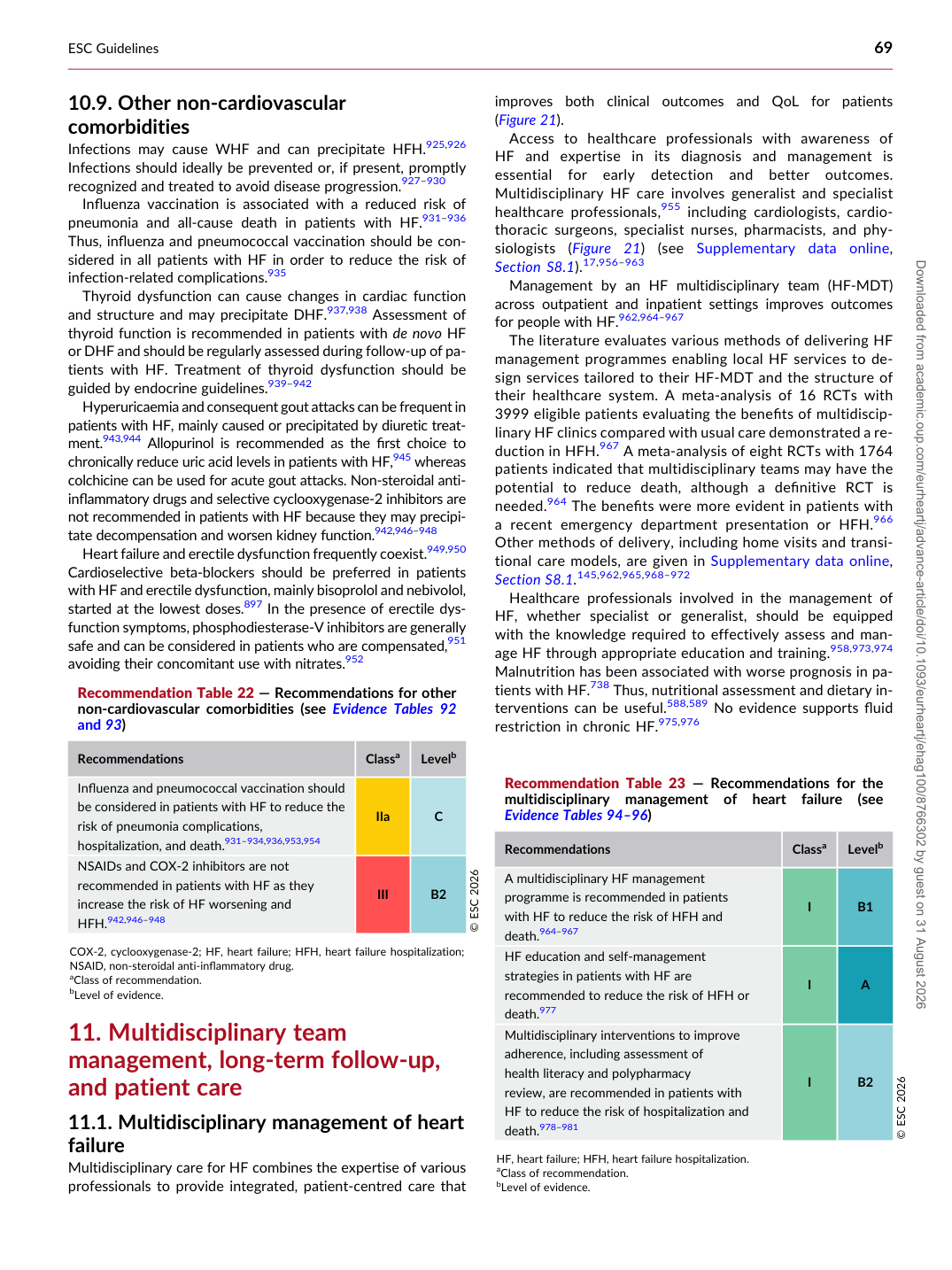
Recommendation Table 22 — Recommendations for other non-cardiovascular comorbidities (see Evidence Tables 92 and 93)

Recommendations Classa Levelb Influenza and pneumococcal vaccination should be considered in patients with HF to reduce the risk of pneumonia complications, hospitalization, and death.931–934,936,953,954 IIa C NSAIDs and COX-2 inhibitors are not recommended in patients with HF as they increase the risk of HF worsening and HFH.942,946–948 III B2 © ESC 2026 COX-2, cyclooxygenase-2; HF, heart failure; HFH, heart failure hospitalization; NSAID, non-steroidal anti-inflammatory drug. aClass of recommendation. bLevel of evidence. Recommendation Table 23 — Recommendations for the multidisciplinary management of heart failure (see Evidence Tables 94–96)

Recommendations Classa Levelb A multidisciplinary HF management programme is recommended in patients with HF to reduce the risk of HFH and death.964–967 I B1 HF education and self-management strategies in patients with HF are recommended to reduce the risk of HFH or death.977 I A Multidisciplinary interventions to improve adherence, including assessment of health literacy and polypharmacy review, are recommended in patients with HF to reduce the risk of hospitalization and death.978–981 I B2 © ESC 2026 HF, heart failure; HFH, heart failure hospitalization. aClass of recommendation. bLevel of evidence. Downloaded from academic.oup.com/eurheartj/advance-article/doi/10.1093/eurheartj/ehag100/8766302 by guest on 31 August 2026