p.68 抽出テキスト
these medications require more caution and should be started at low doses after consideration of the risks and benefits, with close monitoring for signs of airway obstruction, and appropriate supervision.897 Chronic obstructive pulmonary disease exacerbations should not be a cause of beta-blocker discontinuation.898 Inhaled corticosteroids and beta-adrenergic agonists have not been specifically studied in patients with HF; however, they do not seem to increase CV risk.899,900 In addition, appropriate management of COPD can improve cardiac function.901 Sleep-disordered breathing is found in over one-third of patients with HF and is even more prevalent in DHF. Sleepdisordered breathing includes OSA, central sleep apnoea (CSA), and mixed disease. SDB negatively impacts disease progression and prognosis.902,903 Patients with a suspicion of SDB should be referred for overnight polysomnography to definitively diagnose SDB, and to document the predominant type of sleep apnoea (central vs obstructive).902 The therapeutic approach to SDB includes the correction of underlying causes, when identified. The use of adaptive servo-ventilation (ASV) in patients with HFrEF and predominantly CSA is not recommended, based on the results of the SERVE-HF trial,904 which showed an increase in both all-cause and CV death in patients with chronic HF, LVEF ≤45%, and SDB with predominant CSA.904 The ADVENT-HF trial randomized 731 patients with HF, LVEF ≤45%, and coexisting SDB, mostly OSA (73%) to standard optimal treatment alone or standard optimal treatment and ASV (1:1). Over a mean follow-up period of 3.6 years, ASV had a neutral effect on the primary composite outcome (the cumulative incidence of all-cause death, first CV hospitalization, new-onset AF/flutter, and delivery of an appropriate ICD shock).905 However, ASV improved sleep quality and structure, health-related QoL, and symptoms of patients with SDB.905 Thus, in patients with SDB and predominant OSA, nocturnal hypoxaemia can be treated with nocturnal oxygen supplementation, continuous positive airway pressure (CPAP), bilevel positive airway pressure, and ASV. When SDB is caused by CSA, implantable phrenic nerve stimulation was found to be safe and effective in reducing the apnoea–hypopnoea index in a small RCT.906–908 10.7 Anxiety, depression, and cognitive

impairment Anxiety and depression are common findings in patients affected by chronic and disabling conditions, such as HF, and need to be promptly identified to minimize psychological distress and its negative consequences.909 Depression affects 20% of patients with HF, and it may affect adherence to FMT. Its prevalence is higher in women, and it is associated with worse clinical status and poorer prognosis.910–912 The diagnosis of depression typically relies on standardized questionnaires and clinical interviews. Symptom overlap between HF and depression can complicate diagnosis, as both conditions may present with cognitive issues (e.g. difficulty concentrating) and physical symptoms (e.g. fatigue). Several validated questionnaires are available for screening clinically significant depressive symptoms911 (see Supplementary data online, Section S7.4, Table S23). Cognitive impairment in these patients has been reported.911,913 However, there is still no consensus on the best therapy for patients with HF and depression. Cognitive behavioural therapy has demonstrated significant favourable long-term (4–9 months) reduction of anxiety and depression and improvement in QoL compared with nontreated patients.914,915 The safety of sertraline and escitalopram has been demonstrated, although without a significant reduction in depression compared with placebo.916,917 Tricyclic antidepressants should be avoided for the treatment of depression in HF as they may cause hypotension, WHF, and arrhythmias.911,912

10.8 Frailty

Frailty is defined as a multidimensional, dynamic, and potentially reversible state, related to, but independent of, age, that makes individuals more vulnerable to the effects of stressors and at increased risk of poor outcomes. A score assessing frailty including four domains (clinical, functional, psychocognitive, and social) has recently been proposed.918 The presence of frailty might have an impact on disease management and is associated with higher rates of death and hospitalizations, and reduced health-related QoL, regardless of which tool was used to assess frailty.919–923 In patients with HF, frailty is particularly prevalent in older adults. When frailty is suspected or identified, a multidisciplinary approach to facilitate an individualized management is warranted.918,922,924

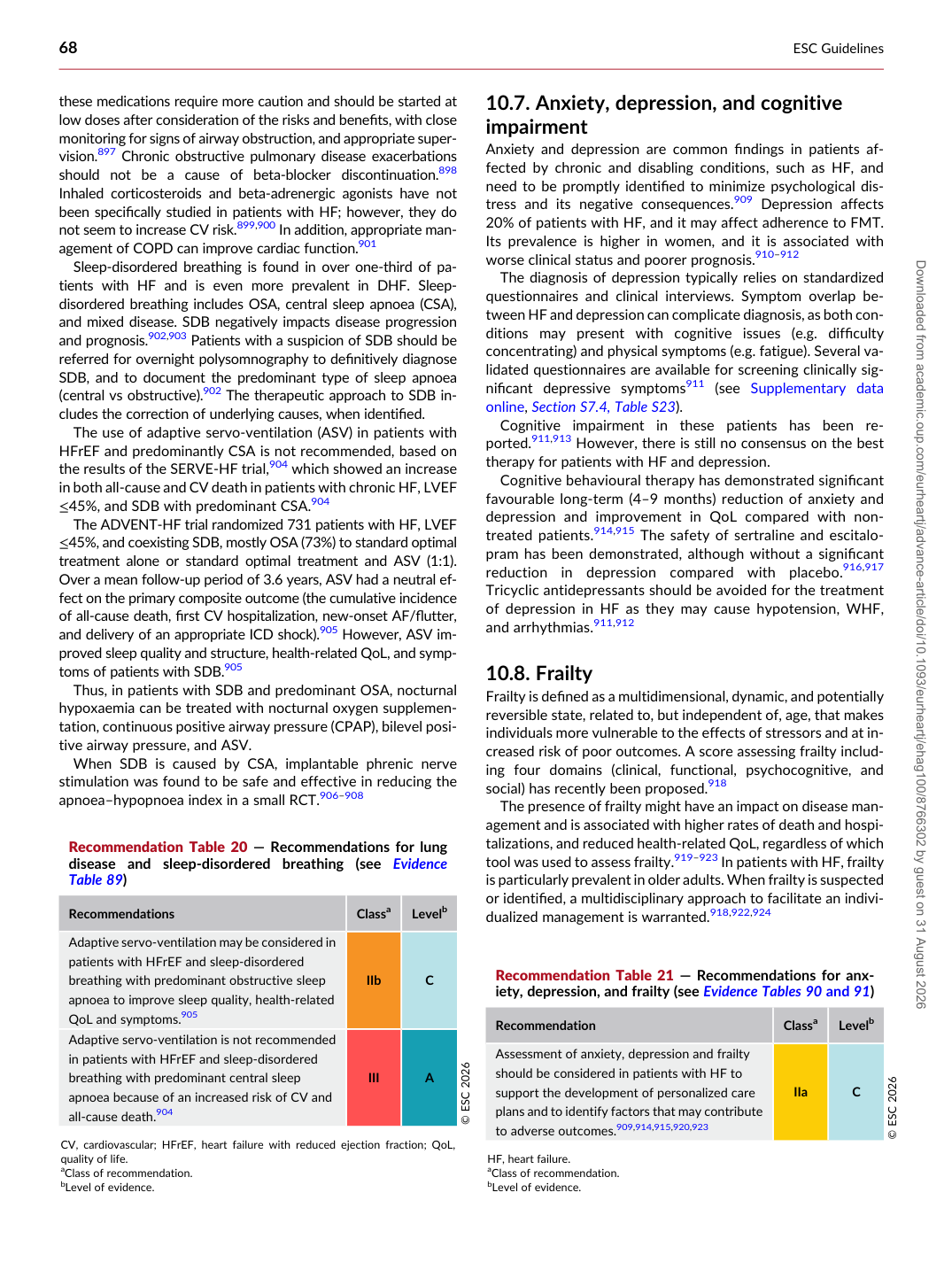
Recommendation Table 20 — Recommendations for lung disease and sleep-disordered breathing (see Evidence Table 89)

Recommendations Classa Levelb Adaptive servo-ventilation may be considered in patients with HFrEF and sleep-disordered breathing with predominant obstructive sleep apnoea to improve sleep quality, health-related QoL and symptoms.905 IIb C Adaptive servo-ventilation is not recommended in patients with HFrEF and sleep-disordered breathing with predominant central sleep apnoea because of an increased risk of CV and all-cause death.904 III A © ESC 2026 CV, cardiovascular; HFrEF, heart failure with reduced ejection fraction; QoL, quality of life. aClass of recommendation. bLevel of evidence. Recommendation Table 21 — Recommendations for anxiety, depression, and frailty (see Evidence Tables 90 and 91)

Recommendation Classa Levelb Assessment of anxiety, depression and frailty should be considered in patients with HF to support the development of personalized care plans and to identify factors that may contribute to adverse outcomes.909,914,915,920,923 IIa C © ESC 2026 HF, heart failure. aClass of recommendation. bLevel of evidence. Downloaded from academic.oup.com/eurheartj/advance-article/doi/10.1093/eurheartj/ehag100/8766302 by guest on 31 August 2026