p.67 抽出テキスト
diagnosis and treatment of acute and chronic heart failure,5 and has been used in almost all recent trials assessing the effects of i.v. iron supplementation in patients with HF and ID. However, it has recently been recognized that in patients with HF this definition does not reliably identify patients with absolute or functional ID. The current definition of ID may include patients with TSATs (≥20%) and serum ferritin levels (20– 100 mg/L) in the normal range, who are probably not iron deficient, exhibit a better prognosis, and might not respond to i.v. iron therapy.870 Moreover, serum ferritin levels are highly sensitive to inflammation and oxidative stress. Thus, an alternative definition of ID—TSAT <20%—has been proposed, mainly based on evidence from explorative analyses and meta-analyses of RCTs. A TSAT <20% has higher sensitivity and specificity compared with the previous definition of ID and is associated with higher mortality rates, independently of HF phenotype.869–871 Moreover, some meta-analyses of large RCTs reported that lower TSAT values better identify patients that will respond favourably to i.v. iron supplementation.872–874 The Task Force supports the use of this most recent definition of ID in patients with HF and recognizes the need for new trials investigating the efficacy of i.v. iron supplementation in patients with HF and ID as defined by TSAT <20%.

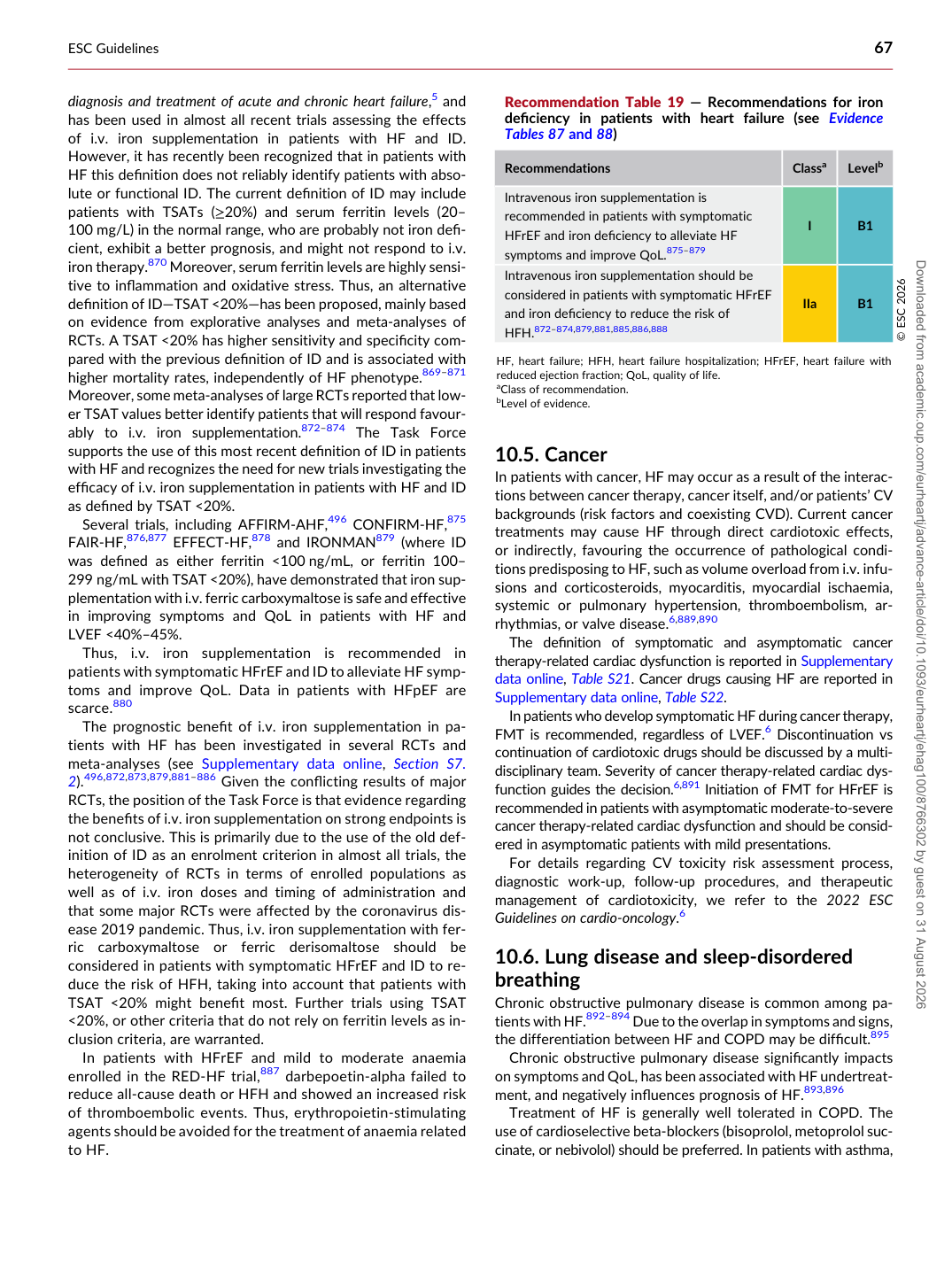
Several trials, including AFFIRM-AHF,496 CONFIRM-HF,875 FAIR-HF,876,877 EFFECT-HF,878 and IRONMAN879 (where ID was defined as either ferritin <100 ng/mL, or ferritin 100– 299 ng/mL with TSAT <20%), have demonstrated that iron supplementation with i.v. ferric carboxymaltose is safe and effective in improving symptoms and QoL in patients with HF and LVEF <40%–45%. Thus, i.v. iron supplementation is recommended in patients with symptomatic HFrEF and ID to alleviate HF symptoms and improve QoL. Data in patients with HFpEF are scarce.880 The prognostic benefit of i.v. iron supplementation in patients with HF has been investigated in several RCTs and meta-analyses (see Supplementary data online, Section S7. 2).496,872,873,879,881–886 Given the conflicting results of major RCTs, the position of the Task Force is that evidence regarding the benefits of i.v. iron supplementation on strong endpoints is not conclusive. This is primarily due to the use of the old definition of ID as an enrolment criterion in almost all trials, the heterogeneity of RCTs in terms of enrolled populations as well as of i.v. iron doses and timing of administration and that some major RCTs were affected by the coronavirus disease 2019 pandemic. Thus, i.v. iron supplementation with ferric carboxymaltose or ferric derisomaltose should be considered in patients with symptomatic HFrEF and ID to reduce the risk of HFH, taking into account that patients with TSAT <20% might benefit most. Further trials using TSAT <20%, or other criteria that do not rely on ferritin levels as inclusion criteria, are warranted. In patients with HFrEF and mild to moderate anaemia enrolled in the RED-HF trial,887 darbepoetin-alpha failed to reduce all-cause death or HFH and showed an increased risk of thromboembolic events. Thus, erythropoietin-stimulating agents should be avoided for the treatment of anaemia related to HF. 10.5 Cancer

In patients with cancer, HF may occur as a result of the interactions between cancer therapy, cancer itself, and/or patients’ CV backgrounds (risk factors and coexisting CVD). Current cancer treatments may cause HF through direct cardiotoxic effects, or indirectly, favouring the occurrence of pathological conditions predisposing to HF, such as volume overload from i.v. infusions and corticosteroids, myocarditis, myocardial ischaemia, systemic or pulmonary hypertension, thromboembolism, arrhythmias, or valve disease.6,889,890 The definition of symptomatic and asymptomatic cancer therapy-related cardiac dysfunction is reported in Supplementary data online, Table S21. Cancer drugs causing HF are reported in Supplementary data online, Table S22. In patients who develop symptomatic HF during cancer therapy, FMT is recommended, regardless of LVEF.6 Discontinuation vs continuation of cardiotoxic drugs should be discussed by a multidisciplinary team. Severity of cancer therapy-related cardiac dysfunction guides the decision.6,891 Initiation of FMT for HFrEF is recommended in patients with asymptomatic moderate-to-severe cancer therapy-related cardiac dysfunction and should be considered in asymptomatic patients with mild presentations. For details regarding CV toxicity risk assessment process, diagnostic work-up, follow-up procedures, and therapeutic management of cardiotoxicity, we refer to the 2022 ESC Guidelines on cardio-oncology.6

10.6 Lung disease and sleep-disordered

breathing Chronic obstructive pulmonary disease is common among patients with HF.892–894 Due to the overlap in symptoms and signs, the differentiation between HF and COPD may be difficult.895 Chronic obstructive pulmonary disease significantly impacts on symptoms and QoL, has been associated with HF undertreatment, and negatively influences prognosis of HF.893,896 Treatment of HF is generally well tolerated in COPD. The use of cardioselective beta-blockers (bisoprolol, metoprolol succinate, or nebivolol) should be preferred. In patients with asthma,

Recommendation Table 19 — Recommendations for iron deficiency in patients with heart failure (see Evidence Tables 87 and 88)

Recommendations Classa Levelb Intravenous iron supplementation is recommended in patients with symptomatic HFrEF and iron deficiency to alleviate HF symptoms and improve QoL.875–879 I B1 Intravenous iron supplementation should be considered in patients with symptomatic HFrEF and iron deficiency to reduce the risk of HFH.872–874,879,881,885,886,888 IIa B1 © ESC 2026 HF, heart failure; HFH, heart failure hospitalization; HFrEF, heart failure with reduced ejection fraction; QoL, quality of life. aClass of recommendation. bLevel of evidence. Downloaded from academic.oup.com/eurheartj/advance-article/doi/10.1093/eurheartj/ehag100/8766302 by guest on 31 August 2026