p.64 抽出テキスト
patients with advanced HF, LVAD or heart transplantation is recommended as first choice and TEER may be considered for symptom improvement in patients not suitable or waiting for these therapies (see Section 8) (Figure 20). Notably, patients with ventricular secondary MR experience a higher residual risk of death or HFH despite TEER.755,756 Thus, close follow-up in HF clinics is warranted.757

9.3.4 Tricuspid regurgitation

Severe TR has a high prevalence (9%–20%) in both patients with HFpEF and HFrEF.747,770 Tricuspid regurgitation is currently classified as primary TR, CIED-related TR, and secondary TR. Secondary TR is most common.747,770 Medical therapy to target TR is limited.747,771 The development of transcatheter devices to treat TR provides an alternative to surgery in selected patients. Three RCTs are currently available that investigated the role of transcatheter treatments in patients with severe symptomatic TR. They showed a significant benefit in terms of QoL in patients receiving device therapy as compared with those treated conservatively, but without reduction of death or HFH at 1-year follow-up.772–774 Recently, a possible benefit in terms of HFH was reported in patients treated with tricuspid TEER, but with a high rate of crossover after 1-year follow-up.775,776 It should be noted that all these studies were unblinded and did not focus on HFpEF or HFrEF populations.

Indications for TR treatment are reported in the 2025 ESC/ EACTS Guidelines for the management of valvular heart disease.9

9.4 Hypertension

Hypertension is common in patients with HF, especially those with HFpEF.454,777,778 In hypertensive heart disease, LV remodelling and LV hypertrophy lead to both diastolic and systolic impairment. Specific blood pressure targets for patients with hypertension and HF have not been evaluated in RCTs. In patients presenting with HF due to refractory hypertension, secondary causes [i.e. primary aldosteronism, renovascular hypertension, and obstructive sleep apnoea (OSA)] should be ruled out and treated.62 Indications for the treatment of hypertension in HF are reported in the 2024 ESC Guidelines for the management of elevated blood pressure and hypertension.62 Lifestyle interventions, such as increasing physical activity, optimizing weight, reducing salt and alcohol intake, and smoking cessation, are beneficial in all cases.62 The optimal treatment strategy for hypertension in patients with HFpEF is uncertain. FMT with effect on blood pressure (i.e. MRA) should be started, continued, or uptitrated. Loop diuretics reduce congestion and decrease blood pressure. In addition, ACE-Is, ARBs, and calcium channel blockers cause LV regression and therefore may be beneficial in both controlling blood pressure and improving HFpEF symptoms.62 Patients with HFpEF have limited preload reserve; therefore, normotension should be maintained and hypotension avoided. In patients with HFrEF, treatment strategies are similar to those for normotensive patients, as FMT also lowers blood pressure. Once FMT has been initiated and uptitrated, suboptimal blood pressure control is rare in HFrEF. If additional agents are required, amlodipine or felodipine may be considered provided the patient is euvolaemic.714,715 Alpha-blockers may be continued for the treatment of prostatic hyperplasia in the absence of hypotension but are not recommended for the treatment of hypertension in HFrEF. Non-dihydropyridine calcium channel blockers, e.g. verapamil and diltiazem, and central sympathetic agonists, e.g. moxonidine, are contraindicated due to poor outcomes in patients with HFrEF.779 In patients with HFrEF, asymptomatic hypotension should be accepted in order to maintain target doses of FMT.780

9.5 Stroke

Heart failure and stroke share common risk factors. Approximately 10%–24% of patients with ischaemic stroke have concomitant HF either de novo or pre-existing.781–784 Conversely, patients with HF have an increased risk of stroke compared with those without.785 A history of stroke is reported

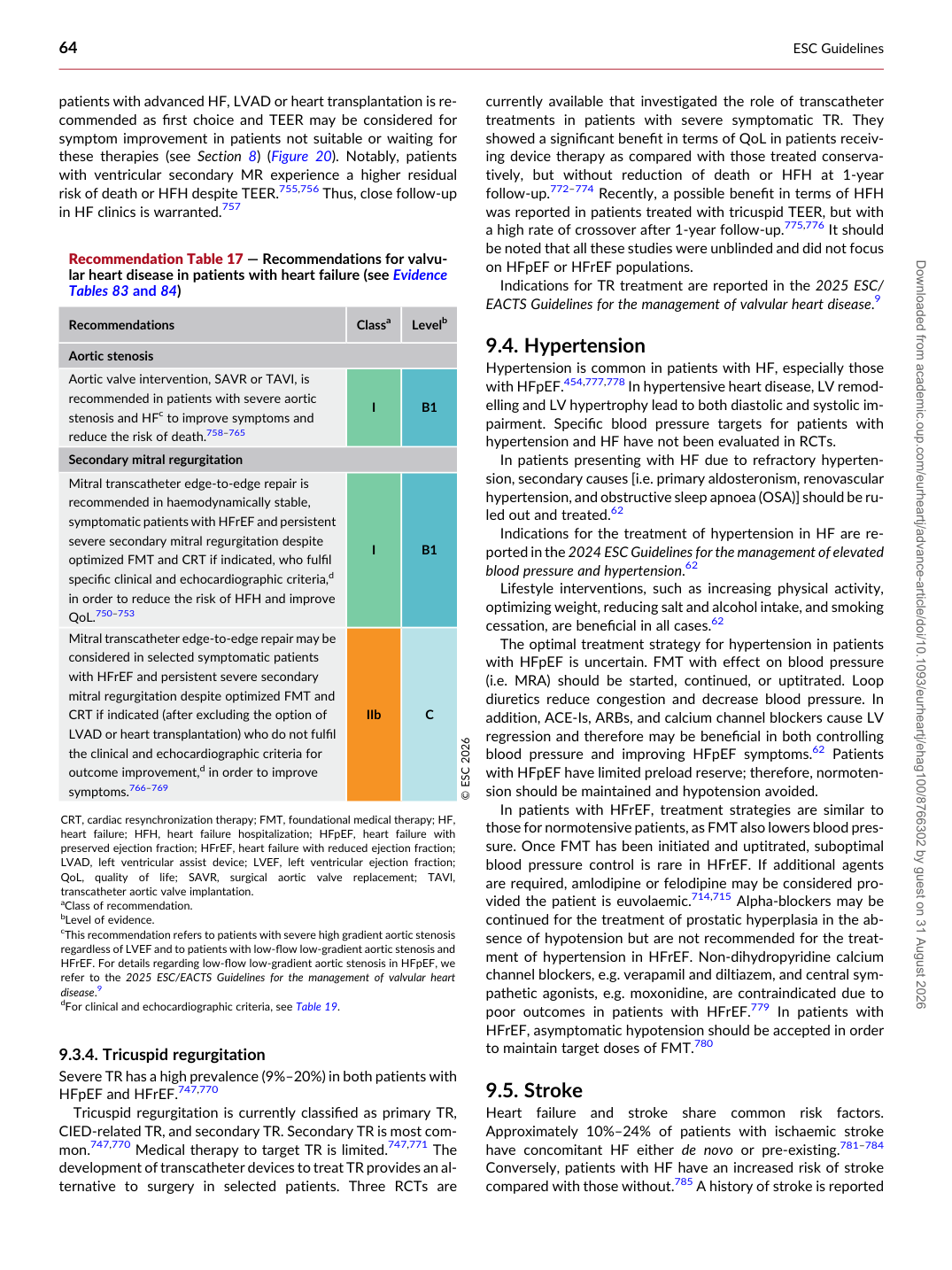
Recommendation Table 17 — Recommendations for valvular heart disease in patients with heart failure (see Evidence Tables 83 and 84)

Recommendations Classa Levelb

Aortic stenosis Aortic valve intervention, SAVR or TAVI, is recommended in patients with severe aortic stenosis and HFc to improve symptoms and reduce the risk of death.758–765 I B1 Secondary mitral regurgitation Mitral transcatheter edge-to-edge repair is recommended in haemodynamically stable, symptomatic patients with HFrEF and persistent severe secondary mitral regurgitation despite optimized FMT and CRT if indicated, who fulfil specific clinical and echocardiographic criteria,d in order to reduce the risk of HFH and improve QoL.750–753 I B1 Mitral transcatheter edge-to-edge repair may be considered in selected symptomatic patients with HFrEF and persistent severe secondary mitral regurgitation despite optimized FMT and CRT if indicated (after excluding the option of LVAD or heart transplantation) who do not fulfil the clinical and echocardiographic criteria for outcome improvement,d in order to improve symptoms.766–769 IIb C © ESC 2026 CRT, cardiac resynchronization therapy; FMT, foundational medical therapy; HF, heart failure; HFH, heart failure hospitalization; HFpEF, heart failure with preserved ejection fraction; HFrEF, heart failure with reduced ejection fraction; LVAD, left ventricular assist device; LVEF, left ventricular ejection fraction; QoL, quality of life; SAVR, surgical aortic valve replacement; TAVI, transcatheter aortic valve implantation. aClass of recommendation. bLevel of evidence. cThis recommendation refers to patients with severe high gradient aortic stenosis regardless of LVEF and to patients with low-flow low-gradient aortic stenosis and HFrEF. For details regarding low-flow low-gradient aortic stenosis in HFpEF, we refer to the 2025 ESC/EACTS Guidelines for the management of valvular heart disease.9 dFor clinical and echocardiographic criteria, see Table 19. Downloaded from academic.oup.com/eurheartj/advance-article/doi/10.1093/eurheartj/ehag100/8766302 by guest on 31 August 2026