p.62 抽出テキスト
of evidence B). However, the patient populations that were considered are slightly different in the chronic coronary syndrome guidelines (often patients with chronic coronary syndrome presenting with reduced LVEF) as compared to these guidelines (often patients with HFrEF presenting with CAD). In addition, according to the most recent system for level of evidence grading, proposed by the ESC, the Task Force considered STICHES, with all its limitations (mean age 60 years, limited number of events at 10 years, limited use of modern FMT), as the only possible study available to support the recommendation.180

9.3 Valvular heart disease

9.3.1. Aortic stenosis Aortic stenosis can contribute to or cause HF by increasing LV afterload.736 Prevalence of aortic stenosis ranges between 3% and 7% in patients with chronic HF and is higher in patients with HFpEF as compared with those with HFrEF.737 About 50% of patients with severe symptomatic aortic stenosis undergoing transcatheter aortic valve implantation (TAVI) have HF.738 Once HF symptoms develop, prognosis is poor and timely valve intervention is mandatory. HF therapies may be used cautiously and should not delay valve intervention. After valve intervention, a clinical and echocardiographic reassessment is important to detect residual HF or risk of HF readmission. In this regard, further optimization of FMT as well as treatment of comorbidities and management of procedure-related factors is appropriate.739 In the recent open-label DapaTAVI trial, 1222 patients with history of HF and at least one risk factor (diabetes, CKD, LV dysfunction) were randomly assigned to receive either dapagliflozin or standard of care. At 1-year follow-up, the risk of the primary endpoint (death from any cause or WHF events) was reduced by 28% in the treatment arm as compared with the control arm, mainly driven by WHF events.740 Therefore, treatment with a SGLT2-I is reasonable in these patients.

Aortic valve intervention is recommended in all patients with HF and a life expectancy >1 year with high-gradient severe aortic stenosis, irrespective of LVEF, as well as in patients with severe low-flow low-gradient aortic stenosis and HFrEF. In patients with severe low-flow low-gradient aortic stenosis and HFpEF, aortic valve intervention should be considered. Details on diagnostic work-up, specific indications and the modality of intervention (TAVI vs surgery) are reported in the 2025 ESC/ EACTS Guidelines for the management of valvular heart disease.9

9.3.2 Aortic regurgitation

Severe aortic regurgitation can lead to LV dilatation and dysfunction which may progress to HF. Treatment with ACE-Is/ ARNIs/ARBs/MRAs while awaiting aortic valve intervention can be beneficial.741 Beta-blockers can prolong diastole and should be used only after careful consideration of risks and benefits. Specific recommendations for intervention are reported in the 2025 ESC/EACTS Guidelines for the management of valvular heart disease.9

9.3.3 Mitral regurgitation

9.3.3.1. Primary mitral regurgitation Primary MR is caused by abnormalities of the valve apparatus and can lead to HF. In severe primary MR with HF symptoms, surgical repair is preferred over replacement whenever feasible.739,742,743 Mitral transcatheter edge-to-edge repair (TEER) should be considered in patients at high surgical risk.9,744,745

9.3.3.2 Secondary mitral regurgitation

Secondary or functional MR is primarily a disease of the left cardiac chambers rather than the valvular apparatus. It is common in patients with HF, especially those with HFrEF in whom the disease has a prevalence of 25%.746,747 In order to adequately assess the severity of MR, the patient should be euvolaemic or as close to euvolaemia as possible. The underlying aetiology and severity of MR needs to be assessed by cardiologists specialized in echocardiography and structural heart diseases.748 A new classification, differentiating between atrial secondary MR and ventricular secondary MR has been recently proposed.9 Atrial secondary MR can be associated with HFpEF.749 Indications for mitral valve treatment in atrial secondary MR are reported in the 2025 ESC/EACTS Guidelines for the management of valvular heart disease.9 In patients with severe ventricular secondary MR and HFrEF, optimization of FMT and GDIT with CRT implantation (if indicated) is mandatory before considering any mitral valve intervention (Figure 20). In case of concomitant CAD requiring revascularization, specific recommendations on management are reported in the 2025 ESC/EACTS Guidelines for the management of valvular heart disease.9 In selected patients without need for coronary revascularization, TEER is recommended. Table 19 provides the clinical and echocardiographic criteria for patient selection, which are based on inclusion criteria from RCTs. For the results of these studies, see Supplementary data online, Section S6.3.1.750–754 If the criteria reported in Table 19 are not fulfilled, other options can be considered. Specifically, in

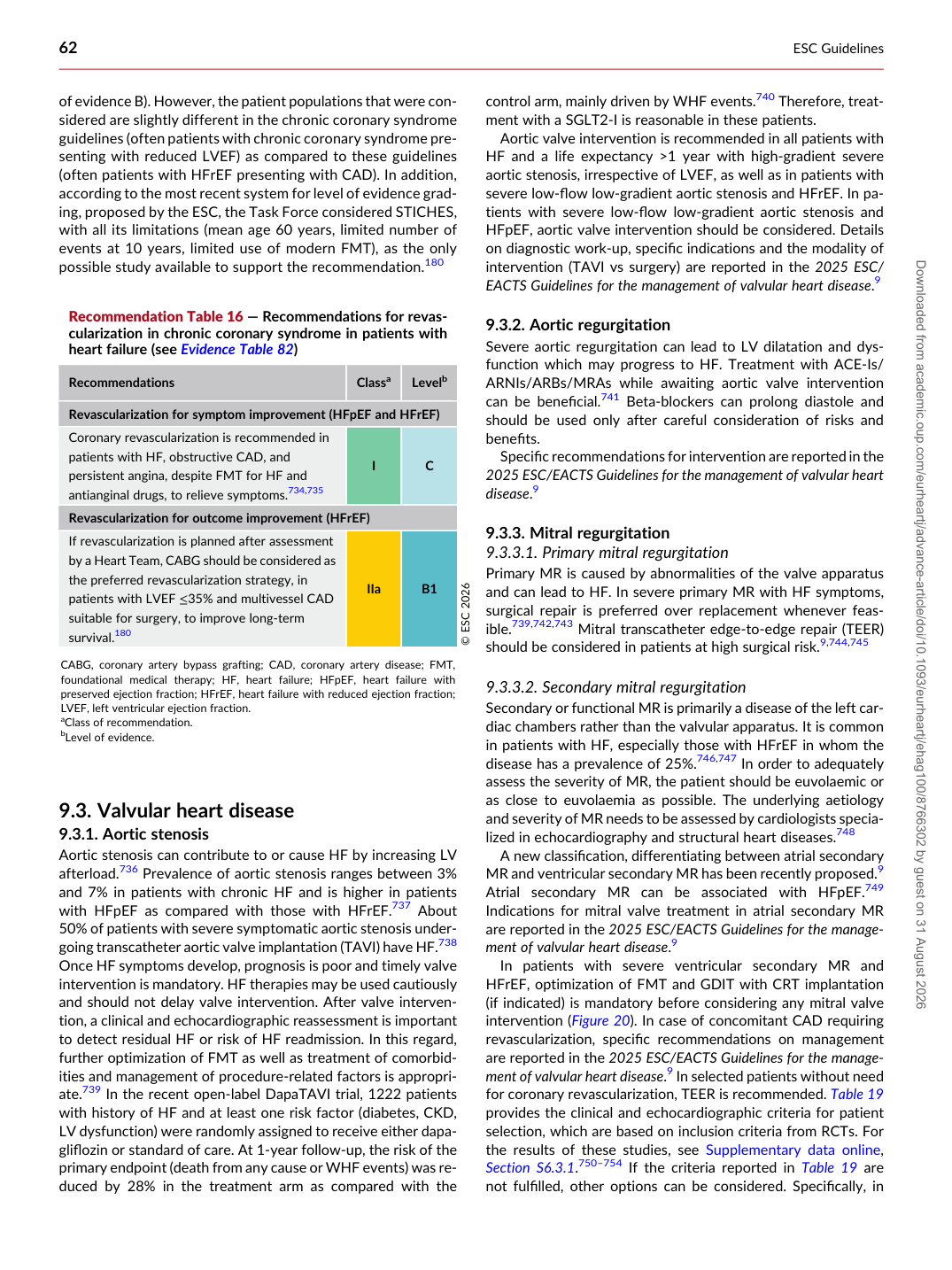
Recommendation Table 16 — Recommendations for revascularization in chronic coronary syndrome in patients with heart failure (see Evidence Table 82)

Recommendations Classa Levelb

Revascularization for symptom improvement (HFpEF and HFrEF) Coronary revascularization is recommended in patients with HF, obstructive CAD, and persistent angina, despite FMT for HF and antianginal drugs, to relieve symptoms.734,735 I C Revascularization for outcome improvement (HFrEF) If revascularization is planned after assessment by a Heart Team, CABG should be considered as the preferred revascularization strategy, in patients with LVEF ≤35% and multivessel CAD suitable for surgery, to improve long-term survival.180 IIa B1 © ESC 2026 CABG, coronary artery bypass grafting; CAD, coronary artery disease; FMT, foundational medical therapy; HF, heart failure; HFpEF, heart failure with preserved ejection fraction; HFrEF, heart failure with reduced ejection fraction; LVEF, left ventricular ejection fraction. aClass of recommendation. bLevel of evidence. Downloaded from academic.oup.com/eurheartj/advance-article/doi/10.1093/eurheartj/ehag100/8766302 by guest on 31 August 2026