p.60 抽出テキスト
9.1.2 Ventricular arrhythmias

Ventricular arrhythmias may cause HF or be a consequence thereof. In sustained ventricular tachycardia, initial management should include stabilization (electrical cardioversion), followed by identification and correction of precipitating factors, and optimization of FMT. Although amiodarone reduces ventricular arrhythmias, it does not reduce SCD or death.697 Patients with HF and resuscitated cardiac arrest or life-threatening ventricular arrhythmias have an indication for a secondary prevention ICD.119 Heart failure can occur because of frequent PVCs.698 A burden of PVCs of about 10% precipitates an increased risk of HF and the risk increases with higher burden.119,699–701 Thus, regular assessment of LVEF in this setting is indicated. Amiodarone may be considered to reduce recurrent arrhythmias and improve LV function,697 with regular follow-up to assess possible side effects. Catheter ablation of PVCs may improve LV function and, possibly, outcomes in patients with PVCs.702–705 For further details, please refer to the 2022 ESC Guidelines for the management of patients with ventricular arrhythmias and the prevention of sudden cardiac death.119

9.1.3 Bradyarrhythmias

Pacing indications in patients with HF do not differ from those without HF. However, long-term RV pacing can adversely impact LV function.706 In patients with HFrEF, where there is an expectation of high pacing requirements, i.e. complete heart block or AF with slow ventricular response, CRT implantation should be considered to improve outcomes (see Recommendation Table 7).409

9.2 Chronic coronary syndromes

Obstructive CAD is a frequent cause of HF.33 Coronary microvascular dysfunction affects up to 80% of patients with HFpEF and seems to be associated with poor prognosis.707–709 Diagnostic work-up of chronic coronary syndromes in patients with HF is described in Section 5. Treatment of chronic coronary syndrom in patients with established HF is described below.

9.2.1 Medical therapy

Beta-blockers are recommended as first-line therapy in patients with HFrEF and CAD due to their prognostic effects, closely followed by other FMT drugs.288,290,291,710–712 Ivabradine should be considered in patients with HFrEF in sinus rhythm with heart rate >70 b.p.m. despite beta-blockers at the highest tolerated dose or if beta-blockers are contraindicated.294,713 Other medications such as amlodipine,714 felodipine,715 nicorandil,716 and ranolazine717 do not have effects on death but may improve symptoms. Trimetazidine may improve LV function and exercise capacity in patients with HFrEF and chronic coronary syndrome already on beta-blockers.718–720 Importantly, initiation and/or uptitration of antianginal therapy should not lead to reduction in FMT. Short-acting nitrates can cause hypotension and should be used with caution. Non-dihydropyridine calcium channel blockers (verapamil and diltiazem) are not recommended in patients with HFrEF due to their negative inotropic effects which may precipitate the risk of HF events.721 The use of beta-blockers or calcium channel blockers do not appear to be associated with worse outcomes in HFpEF.722,723 Treatment of patients with HFpEF should be similar to that of patients without HF (see the 2024 ESC Guidelines for the management of chronic coronary syndromes).10

9.2.2 Myocardial revascularization

Data to support the prognostic benefit of myocardial revascularization in patients with stable obstructive CAD and HF are limited. Two RCTs compared revascularization vs medical therapy in patients with LVEF ≤35% and multivessel coronary disease.178–180 The STICH trial compared coronary artery bypass grafting (CABG) to medical therapy and showed survival benefit

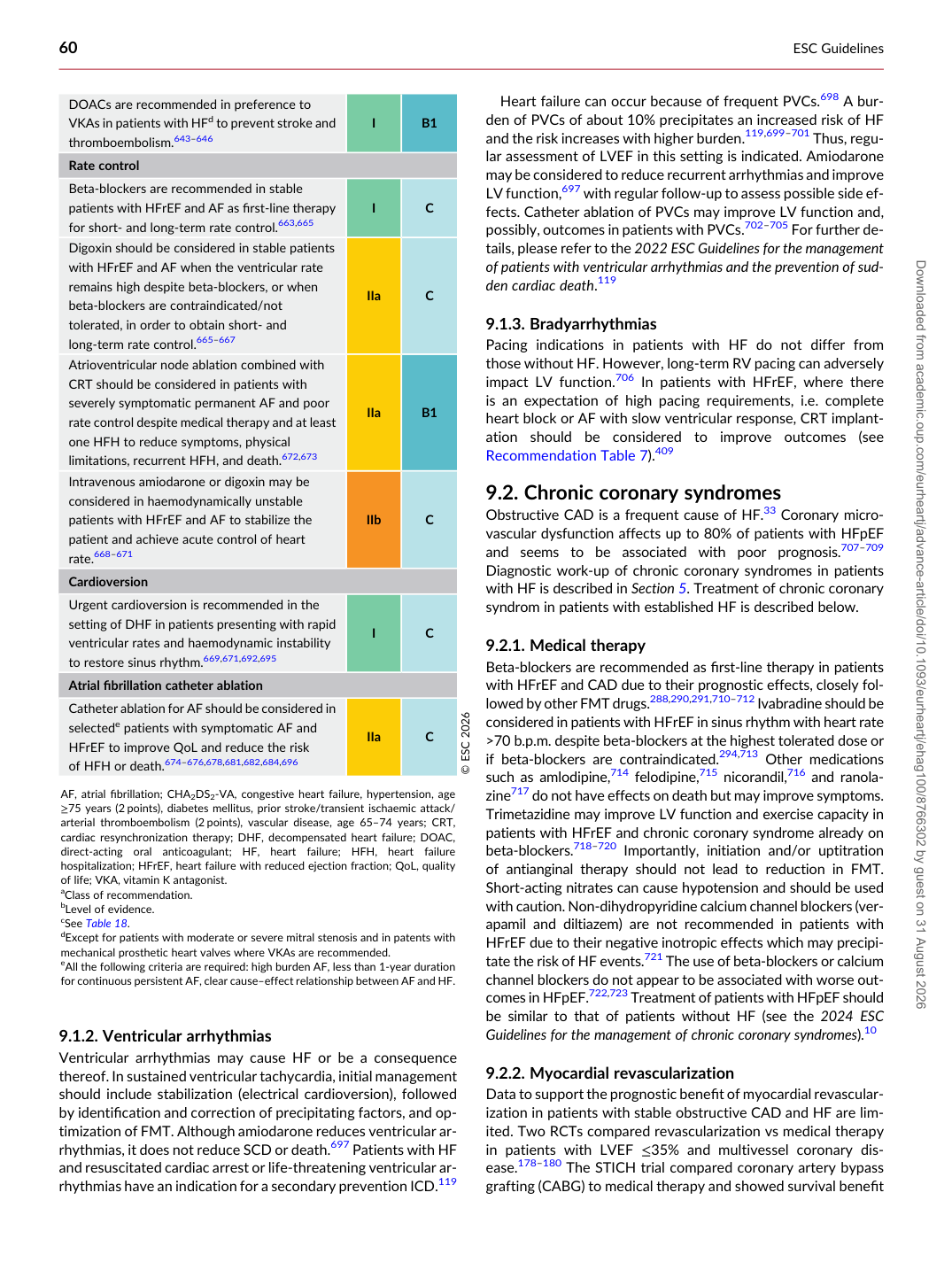
DOACs are recommended in preference to VKAs in patients with HFd to prevent stroke and thromboembolism.643–646 I B1 Rate control Beta-blockers are recommended in stable patients with HFrEF and AF as first-line therapy for short- and long-term rate control.663,665 I C Digoxin should be considered in stable patients with HFrEF and AF when the ventricular rate remains high despite beta-blockers, or when beta-blockers are contraindicated/not tolerated, in order to obtain short- and long-term rate control.665–667 IIa C Atrioventricular node ablation combined with CRT should be considered in patients with severely symptomatic permanent AF and poor rate control despite medical therapy and at least one HFH to reduce symptoms, physical limitations, recurrent HFH, and death.672,673 IIa B1 Intravenous amiodarone or digoxin may be considered in haemodynamically unstable patients with HFrEF and AF to stabilize the patient and achieve acute control of heart rate.668–671 IIb C Cardioversion Urgent cardioversion is recommended in the setting of DHF in patients presenting with rapid ventricular rates and haemodynamic instability to restore sinus rhythm.669,671,692,695 I C Atrial fibrillation catheter ablation Catheter ablation for AF should be considered in selectede patients with symptomatic AF and HFrEF to improve QoL and reduce the risk of HFH or death.674–676,678,681,682,684,696 IIa C © ESC 2026 AF, atrial fibrillation; CHA2DS2-VA, congestive heart failure, hypertension, age ≥75 years (2 points), diabetes mellitus, prior stroke/transient ischaemic attack/ arterial thromboembolism (2 points), vascular disease, age 65–74 years; CRT, cardiac resynchronization therapy; DHF, decompensated heart failure; DOAC, direct-acting oral anticoagulant; HF, heart failure; HFH, heart failure hospitalization; HFrEF, heart failure with reduced ejection fraction; QoL, quality of life; VKA, vitamin K antagonist. aClass of recommendation. bLevel of evidence. cSee Table 18. dExcept for patients with moderate or severe mitral stenosis and in patents with mechanical prosthetic heart valves where VKAs are recommended. eAll the following criteria are required: high burden AF, less than 1-year duration for continuous persistent AF, clear cause–effect relationship between AF and HF. Downloaded from academic.oup.com/eurheartj/advance-article/doi/10.1093/eurheartj/ehag100/8766302 by guest on 31 August 2026