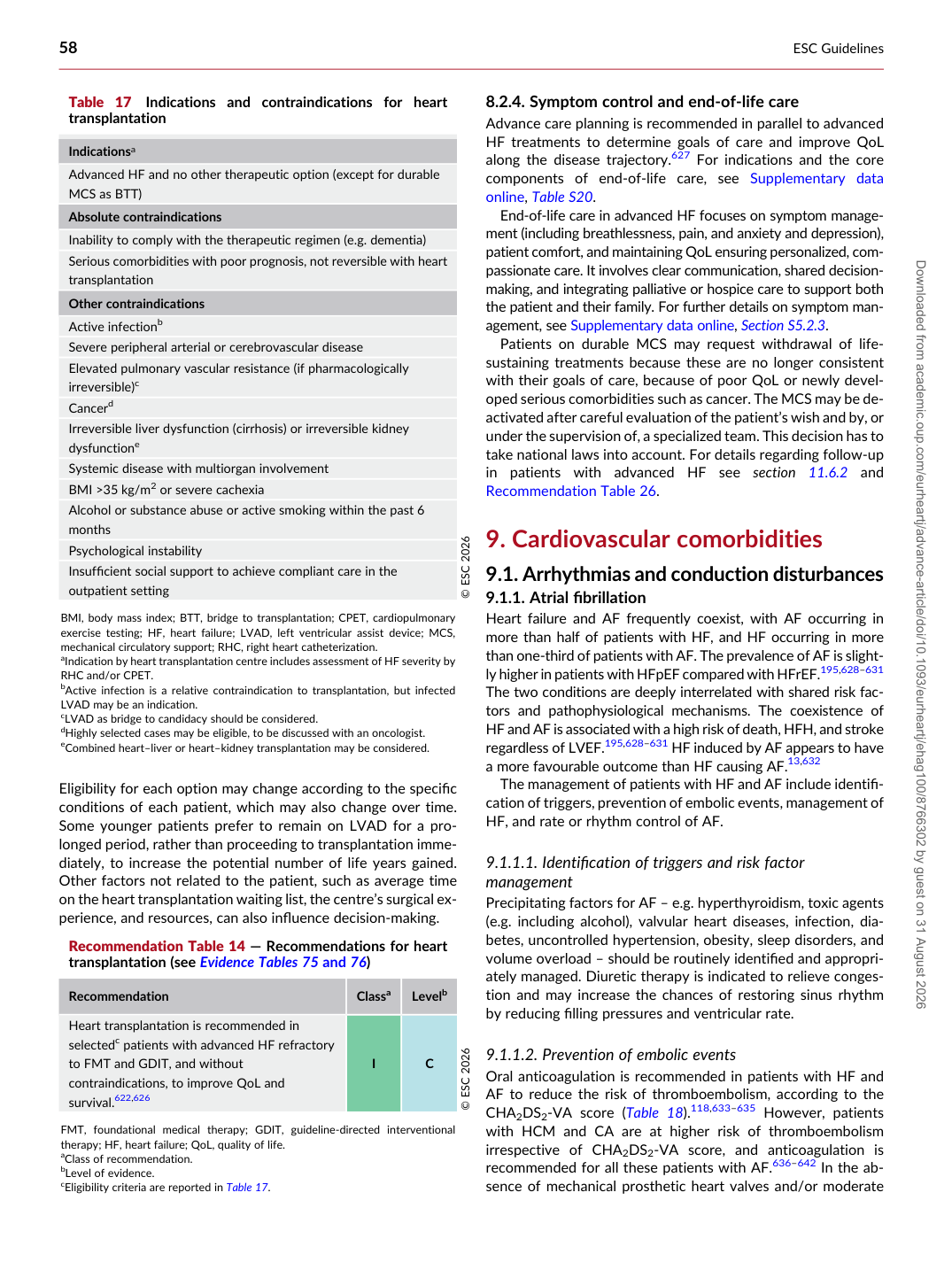
p.58 抽出テキスト
Eligibility for each option may change according to the specific conditions of each patient, which may also change over time. Some younger patients prefer to remain on LVAD for a prolonged period, rather than proceeding to transplantation immediately, to increase the potential number of life years gained. Other factors not related to the patient, such as average time on the heart transplantation waiting list, the centre’s surgical experience, and resources, can also influence decision-making. 8.2.4 Symptom control and end-of-life care

Advance care planning is recommended in parallel to advanced HF treatments to determine goals of care and improve QoL along the disease trajectory.627 For indications and the core components of end-of-life care, see Supplementary data online, Table S20. End-of-life care in advanced HF focuses on symptom management (including breathlessness, pain, and anxiety and depression), patient comfort, and maintaining QoL ensuring personalized, compassionate care. It involves clear communication, shared decisionmaking, and integrating palliative or hospice care to support both the patient and their family. For further details on symptom management, see Supplementary data online, Section S5.2.3. Patients on durable MCS may request withdrawal of lifesustaining treatments because these are no longer consistent with their goals of care, because of poor QoL or newly developed serious comorbidities such as cancer. The MCS may be deactivated after careful evaluation of the patient’s wish and by, or under the supervision of, a specialized team. This decision has to take national laws into account. For details regarding follow-up in patients with advanced HF see section 11.6.2 and Recommendation Table 26.

9 Cardiovascular comorbidities

9.1 Arrhythmias and conduction disturbances

9.1.1. Atrial fibrillation Heart failure and AF frequently coexist, with AF occurring in more than half of patients with HF, and HF occurring in more than one-third of patients with AF. The prevalence of AF is slightly higher in patients with HFpEF compared with HFrEF.195,628–631 The two conditions are deeply interrelated with shared risk factors and pathophysiological mechanisms. The coexistence of HF and AF is associated with a high risk of death, HFH, and stroke regardless of LVEF.195,628–631 HF induced by AF appears to have a more favourable outcome than HF causing AF.13,632 The management of patients with HF and AF include identification of triggers, prevention of embolic events, management of HF, and rate or rhythm control of AF.

9.1.1.1 Identification of triggers and risk factor

management Precipitating factors for AF – e.g. hyperthyroidism, toxic agents (e.g. including alcohol), valvular heart diseases, infection, diabetes, uncontrolled hypertension, obesity, sleep disorders, and volume overload – should be routinely identified and appropriately managed. Diuretic therapy is indicated to relieve congestion and may increase the chances of restoring sinus rhythm by reducing filling pressures and ventricular rate.

9.1.1.2 Prevention of embolic events

Oral anticoagulation is recommended in patients with HF and AF to reduce the risk of thromboembolism, according to the CHA2DS2-VA score (Table 18).118,633–635 However, patients with HCM and CA are at higher risk of thromboembolism irrespective of CHA2DS2-VA score, and anticoagulation is recommended for all these patients with AF.636–642 In the absence of mechanical prosthetic heart valves and/or moderate

Table 17 Indications and contraindications for heart transplantation

Indicationsa Advanced HF and no other therapeutic option (except for durable MCS as BTT) Absolute contraindications Inability to comply with the therapeutic regimen (e.g. dementia) Serious comorbidities with poor prognosis, not reversible with heart transplantation Other contraindications Active infectionb Severe peripheral arterial or cerebrovascular disease Elevated pulmonary vascular resistance (if pharmacologically irreversible)c Cancerd Irreversible liver dysfunction (cirrhosis) or irreversible kidney dysfunctione Systemic disease with multiorgan involvement BMI >35 kg/m2 or severe cachexia Alcohol or substance abuse or active smoking within the past 6 months Psychological instability Insufficient social support to achieve compliant care in the outpatient setting © ESC 2026 BMI, body mass index; BTT, bridge to transplantation; CPET, cardiopulmonary exercise testing; HF, heart failure; LVAD, left ventricular assist device; MCS, mechanical circulatory support; RHC, right heart catheterization. aIndication by heart transplantation centre includes assessment of HF severity by RHC and/or CPET. bActive infection is a relative contraindication to transplantation, but infected LVAD may be an indication. cLVAD as bridge to candidacy should be considered. dHighly selected cases may be eligible, to be discussed with an oncologist. eCombined heart–liver or heart–kidney transplantation may be considered.

Recommendation Table 14 — Recommendations for heart transplantation (see Evidence Tables 75 and 76)

Recommendation Classa Levelb Heart transplantation is recommended in selectedc patients with advanced HF refractory to FMT and GDIT, and without contraindications, to improve QoL and survival.622,626 I C © ESC 2026 FMT, foundational medical therapy; GDIT, guideline-directed interventional therapy; HF, heart failure; QoL, quality of life. aClass of recommendation. bLevel of evidence. cEligibility criteria are reported in Table 17. Downloaded from academic.oup.com/eurheartj/advance-article/doi/10.1093/eurheartj/ehag100/8766302 by guest on 31 August 2026