p.57 抽出テキスト
therapy in patients with advanced HF. REMATCH showed lower all-cause death with a previous type of LVAD therapy (HeartMate XVE) compared with medical treatment. However, mortality rates at 2 years were high in both arms.611 Other studies have not been randomized or compared different devices or post-implant strategies.604,606,607,610,612,613 Prospective RCTs have been initiated to study strategies of early LVAD implantation vs prolonged medical treatment: Early-VAD (NCT02387112),614 SweVAD,615

AMBU-VAD (NCT04768322), and TEAM-HF (NCT06526195). Histological examination of heart tissue after LVAD implantation or transplantation can identify potentially treatable or genetic causes of HF and is valuable for family screening and determining potential for myocardial recovery in LVAD patients.616–619

8.2.3 Heart transplantation

Heart transplantation, although never evaluated in RCTs, remains the gold-standard treatment for advanced HF in the absence of contraindications. Post-transplant 1-year survival is 80%–90% and median survival is around 12.5 years.622,623 Transplantation significantly improves QoL and functional status. The main challenge after heart transplantation is the balance between efficacy and side effects of immunosuppression. Organ donor shortage remains the main limitation. Several countries have now started donation after circulatory death programmes, besides donation after brain death, with comparable mid-term results624,625 and, as a result, the numbers of heart transplantations have increased. Nevertheless, careful recipient selection remains essential, based on pre-transplant and post-transplant life expectancy (both influenced by pre-operative status and comorbidities). The main indications and contraindications for heart transplantation are listed in Table 17.580 Although patients younger than 65 years of age might be more appropriate candidates due to their overall life expectancy, most programmes accept patients up to 70 years of age, and biological age as well as chronological age must be taken into account. Surgical complexity [previous sternotomies, mediastinal radiation, adult congenital heart disease (ACHD)] should also be considered. The decision pathway to transplantation or LVAD is rarely straightforward and is unique to each patient.

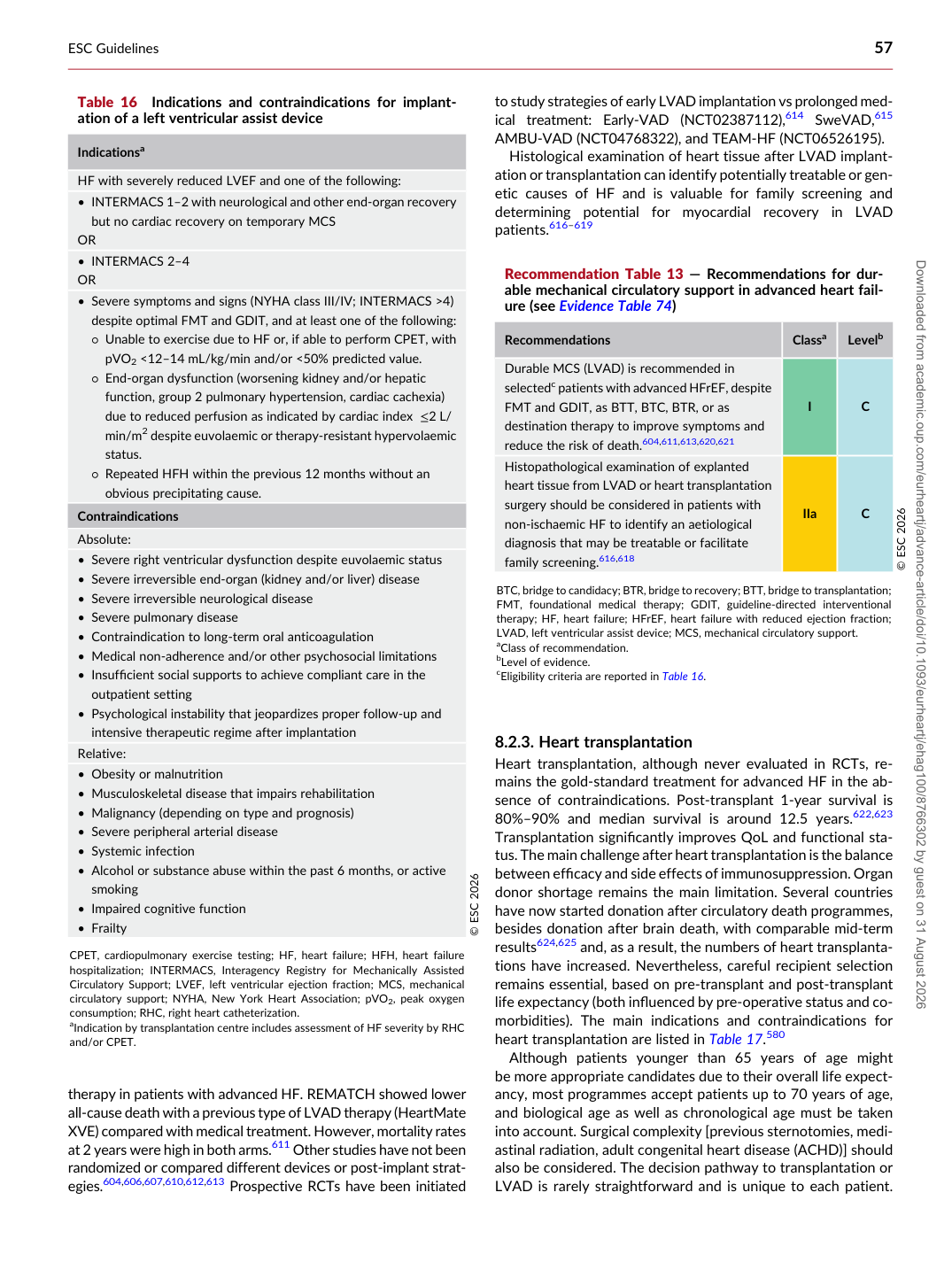
Recommendation Table 13 — Recommendations for durable mechanical circulatory support in advanced heart failure (see Evidence Table 74)

Recommendations Classa Levelb Durable MCS (LVAD) is recommended in selectedc patients with advanced HFrEF, despite FMT and GDIT, as BTT, BTC, BTR, or as destination therapy to improve symptoms and reduce the risk of death.604,611,613,620,621 I C Histopathological examination of explanted heart tissue from LVAD or heart transplantation surgery should be considered in patients with non-ischaemic HF to identify an aetiological diagnosis that may be treatable or facilitate family screening.616,618 IIa C © ESC 2026 BTC, bridge to candidacy; BTR, bridge to recovery; BTT, bridge to transplantation; FMT, foundational medical therapy; GDIT, guideline-directed interventional therapy; HF, heart failure; HFrEF, heart failure with reduced ejection fraction; LVAD, left ventricular assist device; MCS, mechanical circulatory support. aClass of recommendation. bLevel of evidence. cEligibility criteria are reported in Table 16.

Table 16 Indications and contraindications for implantation of a left ventricular assist device

Indicationsa HF with severely reduced LVEF and one of the following: • INTERMACS 1–2 with neurological and other end-organ recovery

but no cardiac recovery on temporary MCS OR • INTERMACS 2–4 OR • Severe symptoms and signs (NYHA class III/IV; INTERMACS >4)

despite optimal FMT and GDIT, and at least one of the following: ⚬Unable to exercise due to HF or, if able to perform CPET, with

pVO2 <12–14 mL/kg/min and/or <50% predicted value. ⚬End-organ dysfunction (worsening kidney and/or hepatic

function, group 2 pulmonary hypertension, cardiac cachexia) due to reduced perfusion as indicated by cardiac index  ≤2 L/ min/m2 despite euvolaemic or therapy-resistant hypervolaemic status. ⚬Repeated HFH within the previous 12 months without an

obvious precipitating cause. Contraindications Absolute: • Severe right ventricular dysfunction despite euvolaemic status • Severe irreversible end-organ (kidney and/or liver) disease • Severe irreversible neurological disease • Severe pulmonary disease • Contraindication to long-term oral anticoagulation • Medical non-adherence and/or other psychosocial limitations • Insufficient social supports to achieve compliant care in the

outpatient setting • Psychological instability that jeopardizes proper follow-up and intensive therapeutic regime after implantation Relative: • Obesity or malnutrition • Musculoskeletal disease that impairs rehabilitation • Malignancy (depending on type and prognosis) • Severe peripheral arterial disease • Systemic infection • Alcohol or substance abuse within the past 6 months, or active

smoking • Impaired cognitive function • Frailty © ESC 2026 CPET, cardiopulmonary exercise testing; HF, heart failure; HFH, heart failure hospitalization; INTERMACS, Interagency Registry for Mechanically Assisted Circulatory Support; LVEF, left ventricular ejection fraction; MCS, mechanical circulatory support; NYHA, New York Heart Association; pVO2, peak oxygen consumption; RHC, right heart catheterization. aIndication by transplantation centre includes assessment of HF severity by RHC and/or CPET. Downloaded from academic.oup.com/eurheartj/advance-article/doi/10.1093/eurheartj/ehag100/8766302 by guest on 31 August 2026