p.56 抽出テキスト
Current 2-year survival rates in patients receiving the latest LVAD types are comparable to those after heart transplantation. Among patients with fully magnetically levitated continuous-flow LVADs, 2-year and 5-year survival rates were 79% and 58.4%, respectively, in the MOMENTUM 3 trial with a previous LVAD type as the control group.604,605 These rates are considerably higher than could be expected from medical treatment in this population with >85% of patients in INTERMACS 1–3 at the time of LVAD implantation.604,605 Comparable outcomes were described in European and North American real-world populations.606–608 Adverse events may negatively affect QoL in patients receiving LVAD. Although pump thrombosis has become extremely rare, driveline infections remain similar to that with older devices.609 Right HF and arrhythmias may cause readmissions. Bleeding events can be minimized by avoiding antiplatelet therapy in addition to anticoagulation.610 A guidance document is available to support non-LVAD specialist healthcare providers outside of the implanting centre.609

Although now dated, the REMATCH trial is the only RCT comparing an LVAD as destination therapy with optimal medical

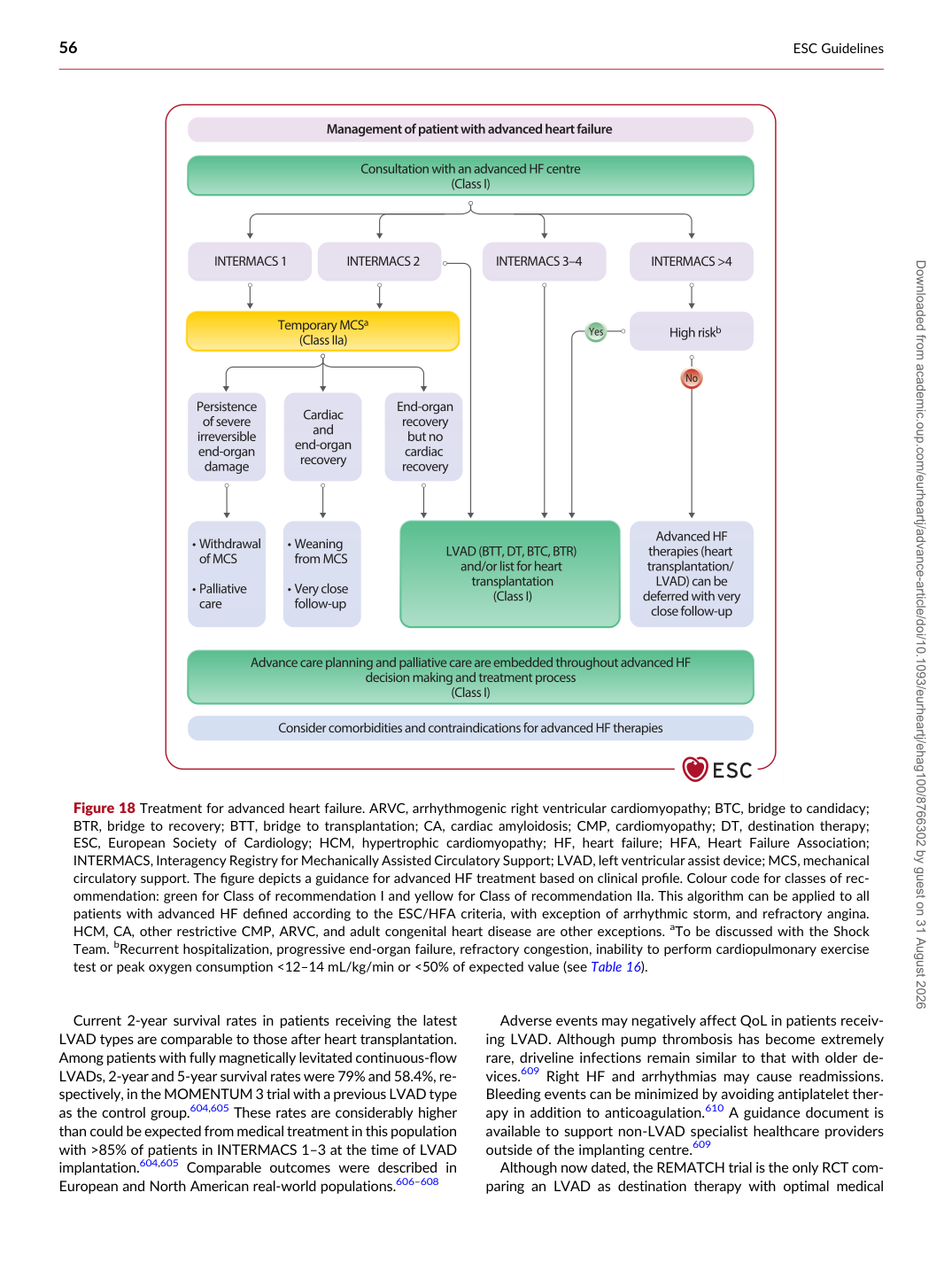
Figure 18 Treatment for advanced heart failure. ARVC, arrhythmogenic right ventricular cardiomyopathy; BTC, bridge to candidacy; BTR, bridge to recovery; BTT, bridge to transplantation; CA, cardiac amyloidosis; CMP, cardiomyopathy; DT, destination therapy; ESC, European Society of Cardiology; HCM, hypertrophic cardiomyopathy; HF, heart failure; HFA, Heart Failure Association; INTERMACS, Interagency Registry for Mechanically Assisted Circulatory Support; LVAD, left ventricular assist device; MCS, mechanical circulatory support. The figure depicts a guidance for advanced HF treatment based on clinical profile. Colour code for classes of recommendation: green for Class of recommendation I and yellow for Class of recommendation IIa. This algorithm can be applied to all patients with advanced HF defined according to the ESC/HFA criteria, with exception of arrhythmic storm, and refractory angina. HCM, CA, other restrictive CMP, ARVC, and adult congenital heart disease are other exceptions. aTo be discussed with the Shock Team. bRecurrent hospitalization, progressive end-organ failure, refractory congestion, inability to perform cardiopulmonary exercise test or peak oxygen consumption <12–14 mL/kg/min or <50% of expected value (see Table 16). Downloaded from academic.oup.com/eurheartj/advance-article/doi/10.1093/eurheartj/ehag100/8766302 by guest on 31 August 2026