p.54 抽出テキスト
8.2 Management

The indication and timing of advanced HF treatments are guided by patient goals, comorbidities, and clinical status. Pharmacological therapy and temporary MCS may be indicated until implantation of durable MCS or heart transplantation becomes available.543 The SCAI classification may be useful in identifying patients for temporary MCS as a possible bridge to advanced therapies (Table 13). The Interagency Registry for Mechanically Assisted Circulatory Support (INTERMACS) profiles592 describe clinical parameters and characteristics consistent with a need for advanced therapies (Figures 17 and 18).

8.2.1 Pharmacological therapy and kidney replacement

therapy Every effort should be made to reach target doses of FMT in all patients with HF. However, patients with advanced HF are under-represented in RCTs. Most patients with advanced HF reach a stage where dose reduction or cessation of neurohormonal therapy is necessary due to progressive intolerance. Although evidence is lacking, it is reasonable to perform individualized changes in FMT, and AMT if needed, on a patienttailored basis. For example, in a patient with hypotension and high arrhythmic burden, the ACE-I dose can be reduced so that treatment with beta-blockers can be prioritized. However, in a patient with hypoperfusion and persistently low stroke volume despite therapy, reduction or cessation of beta-blockers may be the first step to maintaining cardiac output. In these cases, amiodarone may be better tolerated than beta-blockers when arrhythmias occur. Most importantly, any of these downtitrations should prompt contact with, or referral to, an advanced HF centre if there are no absolute contraindications for MCS or heart transplantation. AMT implementation should not delay early referral to advanced HF therapies. In patients with signs of hypoperfusion, inotropes may improve haemodynamic parameters, augmenting cardiac output and aiding peripheral perfusion. They may also reduce congestion when the response to diuretic therapy is insufficient. Inotropic therapy is often used to assess reversibility of end-organ dysfunction in the screening phase for durable MCS or heart transplantation, or to maintain cardiac output until such therapies become available (see Supplementary data online, Table S18). Inotropes can be used as palliative therapy for the relief of symptoms in patients without other treatment options (see Supplementary data online, Figure S2).594 However, because inotropic therapy may exacerbate or induce myocardial ischaemia and/or tachyarrhythmias, it should only be used in the lowest required dose and for as short a period as possible.595,596

Kidney dysfunction and loop diuretic resistance often characterize the clinical course of patients with advanced HF. Doubling the loop diuretic dose or concomitant administration of non-loop diuretics is indicated.265 However, in patients who fail to respond to diuretic-based strategies, kidney replacement therapies should be considered. Ultrafiltration and peritoneal dialysis are the most common approaches. It may be considered in those with diuretic resistance to treat volume overload, even if data about its effects on clinical outcomes are inconclusive.527,597

8.2.2 Mechanical circulatory support

Mechanical circulatory support can improve survival and symptoms of patients with advanced HF. The use of MCS should be considered for the different scenarios listed in Supplementary data online, Table S19. Indications for temporary and durable MCS should be based on the SCAI classification (Table 13, Section 7) and INTERMACS profiles (Figures 17 and 18).

8.2.2.1 Temporary mechanical circulatory support

Temporary MCS devices are indicated in selected patients to reverse critical end-organ hypoperfusion and hypoxia in the setting of CS (see Section 7). The aim is to support cerebral and end-organ perfusion, reverse acidosis and multiorgan failure,

Right heart catheterization is recommended in patients with advanced HF, as part of the evaluation for heart transplantation and durable MCS.580–582 I C © ESC 2026 HF, heart failure; LVAD, left ventricular assist device; MCS, mechanical circulatory support. aClass of recommendation. bLevel of evidence. cA centre performing LVAD implantation and/or heart transplantation. dEligibility criteria are reported in Tables 16 and 17. eThis recommendation is considered by the Task Force to have level of evidence A due to clear clinical effectiveness.

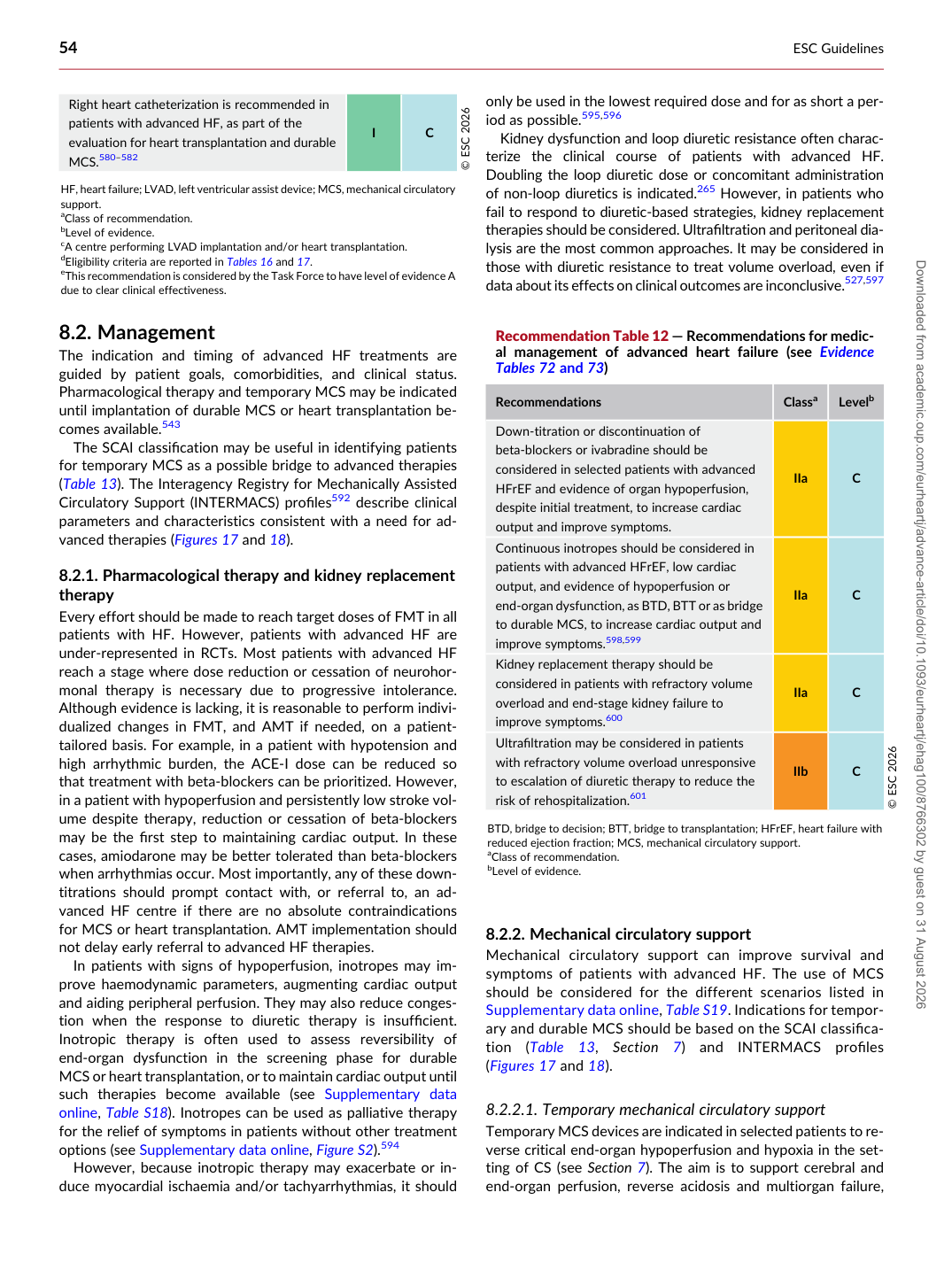
Recommendation Table 12 — Recommendations for medical management of advanced heart failure (see Evidence Tables 72 and 73)

Recommendations Classa Levelb Down-titration or discontinuation of beta-blockers or ivabradine should be considered in selected patients with advanced HFrEF and evidence of organ hypoperfusion, despite initial treatment, to increase cardiac output and improve symptoms. IIa C Continuous inotropes should be considered in patients with advanced HFrEF, low cardiac output, and evidence of hypoperfusion or end-organ dysfunction, as BTD, BTT or as bridge to durable MCS, to increase cardiac output and improve symptoms.598,599 IIa C Kidney replacement therapy should be considered in patients with refractory volume overload and end-stage kidney failure to improve symptoms.600 IIa C Ultrafiltration may be considered in patients with refractory volume overload unresponsive to escalation of diuretic therapy to reduce the risk of rehospitalization.601 IIb C © ESC 2026 BTD, bridge to decision; BTT, bridge to transplantation; HFrEF, heart failure with reduced ejection fraction; MCS, mechanical circulatory support. aClass of recommendation. bLevel of evidence. Downloaded from academic.oup.com/eurheartj/advance-article/doi/10.1093/eurheartj/ehag100/8766302 by guest on 31 August 2026