p.52 抽出テキスト
7.5.12 Thromboembolism prophylaxis

Although patients with DHF are recognized as being at increased thromboembolic risk, no RCT has compared anticoagulation vs placebo in a DHF population, thus no definitive recommendation can be made.566–570 However, in case of immobilization or other risk factors, thromboembolic prophylaxis is generally indicated. 8 Advanced heart failure

8.1 Epidemiology, definition, prognosis, and

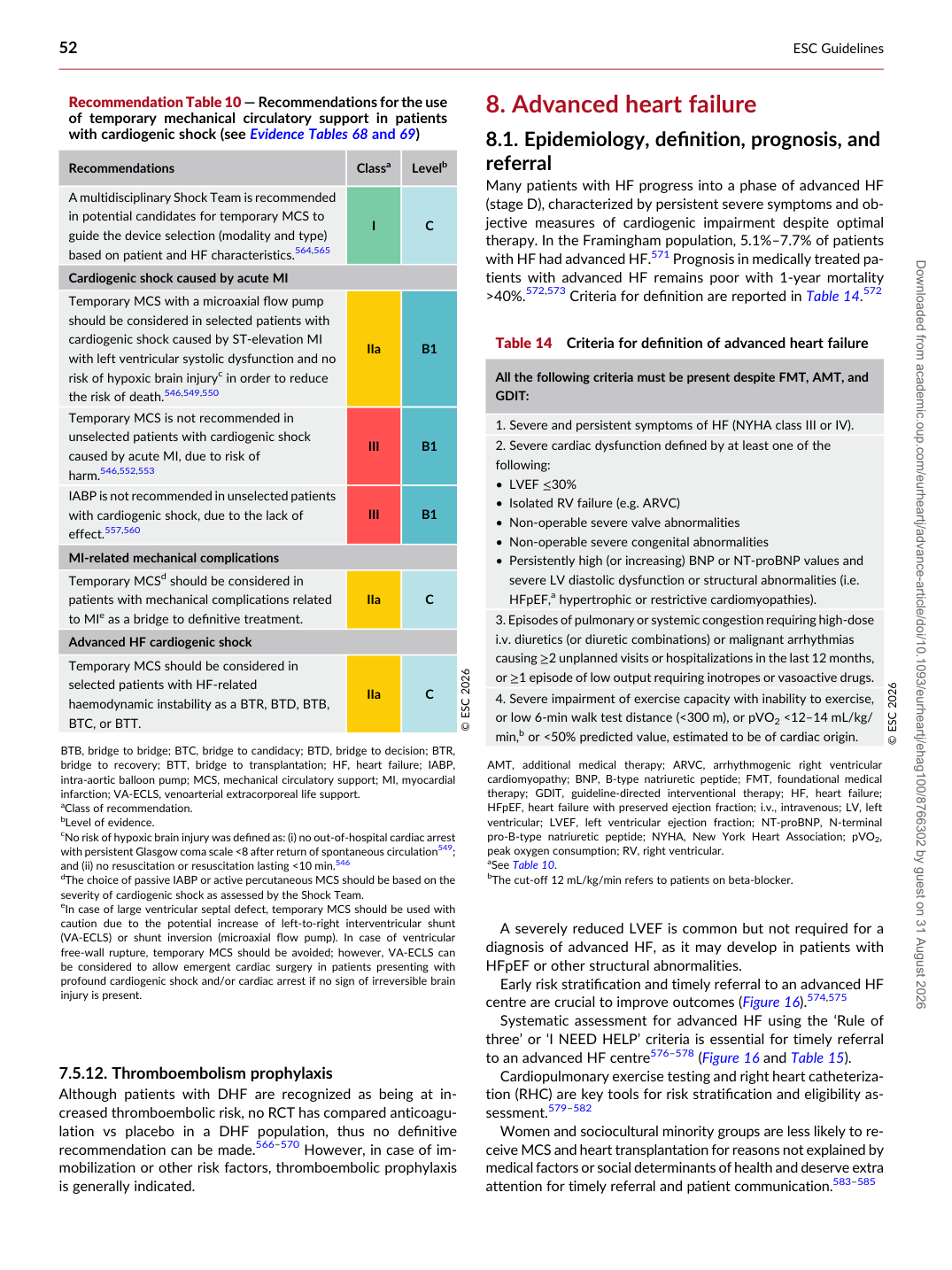
referral Many patients with HF progress into a phase of advanced HF (stage D), characterized by persistent severe symptoms and objective measures of cardiogenic impairment despite optimal therapy. In the Framingham population, 5.1%–7.7% of patients with HF had advanced HF.571 Prognosis in medically treated patients with advanced HF remains poor with 1-year mortality >40%.572,573 Criteria for definition are reported in Table 14.572

A severely reduced LVEF is common but not required for a diagnosis of advanced HF, as it may develop in patients with HFpEF or other structural abnormalities. Early risk stratification and timely referral to an advanced HF centre are crucial to improve outcomes (Figure 16).574,575 Systematic assessment for advanced HF using the ‘Rule of three’ or ‘I NEED HELP’ criteria is essential for timely referral to an advanced HF centre576–578 (Figure 16 and Table 15). Cardiopulmonary exercise testing and right heart catheterization (RHC) are key tools for risk stratification and eligibility assessment.579–582 Women and sociocultural minority groups are less likely to receive MCS and heart transplantation for reasons not explained by medical factors or social determinants of health and deserve extra attention for timely referral and patient communication.583–585

Recommendation Table 10 — Recommendations for the use of temporary mechanical circulatory support in patients with cardiogenic shock (see Evidence Tables 68 and 69)

Recommendations Classa Levelb A multidisciplinary Shock Team is recommended in potential candidates for temporary MCS to guide the device selection (modality and type) based on patient and HF characteristics.564,565 I C Cardiogenic shock caused by acute MI Temporary MCS with a microaxial flow pump should be considered in selected patients with cardiogenic shock caused by ST-elevation MI with left ventricular systolic dysfunction and no risk of hypoxic brain injuryc in order to reduce the risk of death.546,549,550 IIa B1 Temporary MCS is not recommended in unselected patients with cardiogenic shock caused by acute MI, due to risk of harm.546,552,553 III B1 IABP is not recommended in unselected patients with cardiogenic shock, due to the lack of effect.557,560 III B1 MI-related mechanical complications Temporary MCSd should be considered in patients with mechanical complications related to MIe as a bridge to definitive treatment. IIa C Advanced HF cardiogenic shock Temporary MCS should be considered in selected patients with HF-related haemodynamic instability as a BTR, BTD, BTB, BTC, or BTT. IIa C © ESC 2026 BTB, bridge to bridge; BTC, bridge to candidacy; BTD, bridge to decision; BTR, bridge to recovery; BTT, bridge to transplantation; HF, heart failure; IABP, intra-aortic balloon pump; MCS, mechanical circulatory support; MI, myocardial infarction; VA-ECLS, venoarterial extracorporeal life support. aClass of recommendation. bLevel of evidence. cNo risk of hypoxic brain injury was defined as: (i) no out-of-hospital cardiac arrest with persistent Glasgow coma scale <8 after return of spontaneous circulation549; and (ii) no resuscitation or resuscitation lasting <10 min.546 dThe choice of passive IABP or active percutaneous MCS should be based on the severity of cardiogenic shock as assessed by the Shock Team. eIn case of large ventricular septal defect, temporary MCS should be used with caution due to the potential increase of left-to-right interventricular shunt (VA-ECLS) or shunt inversion (microaxial flow pump). In case of ventricular free-wall rupture, temporary MCS should be avoided; however, VA-ECLS can be considered to allow emergent cardiac surgery in patients presenting with profound cardiogenic shock and/or cardiac arrest if no sign of irreversible brain injury is present. Table 14 Criteria for definition of advanced heart failure

All the following criteria must be present despite FMT, AMT, and GDIT: 1. Severe and persistent symptoms of HF (NYHA class III or IV).

2 Severe cardiac dysfunction defined by at least one of the

following: • LVEF ≤30% • Isolated RV failure (e.g. ARVC) • Non-operable severe valve abnormalities • Non-operable severe congenital abnormalities • Persistently high (or increasing) BNP or NT-proBNP values and

severe LV diastolic dysfunction or structural abnormalities (i.e. HFpEF,a hypertrophic or restrictive cardiomyopathies).

3 Episodes of pulmonary or systemic congestion requiring high-dose

i.v. diuretics (or diuretic combinations) or malignant arrhythmias causing ≥2 unplanned visits or hospitalizations in the last 12 months, or ≥1 episode of low output requiring inotropes or vasoactive drugs. 4. Severe impairment of exercise capacity with inability to exercise, or low 6-min walk test distance (<300 m), or pVO2 <12–14 mL/kg/ min,b or <50% predicted value, estimated to be of cardiac origin. © ESC 2026 AMT, additional medical therapy; ARVC, arrhythmogenic right ventricular cardiomyopathy; BNP, B-type natriuretic peptide; FMT, foundational medical therapy; GDIT, guideline-directed interventional therapy; HF, heart failure; HFpEF, heart failure with preserved ejection fraction; i.v., intravenous; LV, left ventricular; LVEF, left ventricular ejection fraction; NT-proBNP, N-terminal pro-B-type natriuretic peptide; NYHA, New York Heart Association; pVO2, peak oxygen consumption; RV, right ventricular. aSee Table 10. bThe cut-off 12 mL/kg/min refers to patients on beta-blocker. Downloaded from academic.oup.com/eurheartj/advance-article/doi/10.1093/eurheartj/ehag100/8766302 by guest on 31 August 2026