p.51 抽出テキスト
7.5.11 Temporary mechanical circulatory support

Temporary MCS should be considered as an option for stabilizing haemodynamics and enhancing end-organ perfusion in highly selected patients.434,474,543,544 Different percutaneous devices operate through distinct mechanisms, delivering diverse haemodynamic support levels, each associated with specific potential benefits but also possible complications. In addition to single use, multiple combinations are feasible, addressing specific needs for LV unloading or combined left and right ventricular support. Decisions on the modality and type of temporary MCS should be guided by a multidisciplinary Shock Team including a cardiologist specialized in HF, a cardiothoracic surgeon, an interventional cardiologist, and an intensive care specialist, working at an experienced advanced HF centre (i.e. highvolume for temporary MCS).488,545 A recent meta-analysis suggests that temporary MCS are beneficial in highly selected patients with ST-elevation MI complicated by CS who do not have hypoxic brain injury, although rates of severe complications remain high.546

7.5.11.1 Microaxial flow pumps

Microaxial percutaneous flow pumps provide support of up to 4 l/min. Newer devices with 5.5 l/min requiring surgical insertion offer complete LV support. Until recently, the percutaneous device had been investigated in a few RCTs on infarct-related CS and in large-scale propensity-matched studies encompassing more than 100 000 patients and consistently showed no survival benefit with higher complication rates such as major bleeding and limb ischaemia.547,548 In the DanGer Shock trial, including 360 highly selected patients with ST-elevation MI and CS, treatment with microaxial flow pump vs standard of care was associated with lower 180-day death (HR 0.74; 95% CI 0.55–0.99; P = .04), which persisted up to 10-year follow-up.549,550 This trial also showed an increased incidence of bleeding and limb ischaemia compared with controls. Despite the mortality benefit observed in this trial, multiple open questions remain.548,551 Utilization of microaxial flow pumps should be considered in highly selected patients with CS caused by ST-elevation MI, who do not have risk of hypoxic brain injury. Routine use of microaxial flow pumps in CS is not recommended. RCTs on the efficacy of microaxial flow pumps in non-infarct-related CS have yet to be conducted.546

7.5.11.2 Venoarterial extracorporeal life support

Extracorporeal life support (ECLS) can deliver support of up to 6 l/min and provide full respiratory and circulatory support. In the ECLS-SHOCK trial involving patients with severe infarct-related CS, early routine ECLS use showed no significant difference in 30-day all-cause death (relative risk 0.98; 95% CI 0.80–1.19).552 These data are in line with an individual patient data meta-analysis of ECLS RCTs in patients with infarct-related CS in which no mortality benefit was observed but more complications with ECLS were seen.553 Importantly, ECLS may harm the heart itself owing to the afterload increase by generation of retrograde blood flow. Active unloading with microaxial flow pumps or intra-aortic balloon pump (IABP) aims to mitigate these adverse effects. A recent RCT comparing routine LV unloading by a transseptal left atrial cannula vs ECLS alone showed no effect on death.554 RCTs investigating the efficacy of ECLS in non-ischaemic CS have yet to be performed.

7.5.11.3 Intra-aortic balloon pump

Routine use of IABP is not recommended in unselected patients with CS. In the IABP shock trial, 40 patients with post-MI CS were randomised to IABP treatment or standard of care. Treatment with IABP did not significantly augment cardiac output or any other haemodynamic variable as compared to control.555 In a large-scale RCT in infarct-related CS, routine use of IABP did not show a survival benefit compared with medical therapy at 30-day and longer follow-up.556–558 Also, in advanced HF CS, IABP had no survival benefit as compared to standard of care.559,560 The decision to use an IABP should therefore be highly individualized, based on patient-specific factors and the availability of alternative therapies.559,561–563

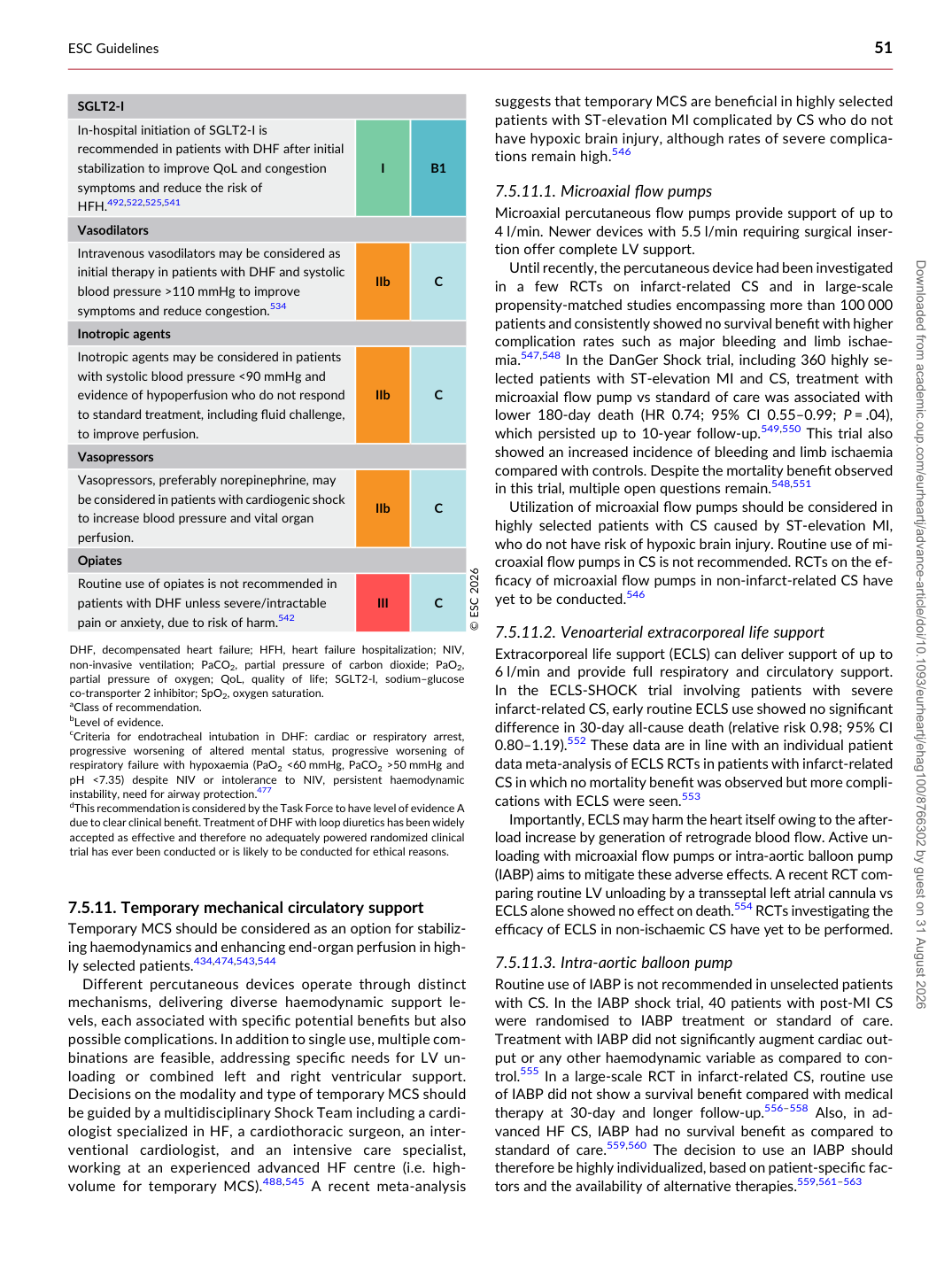
SGLT2-I In-hospital initiation of SGLT2-I is recommended in patients with DHF after initial stabilization to improve QoL and congestion symptoms and reduce the risk of HFH.492,522,525,541 I B1 Vasodilators Intravenous vasodilators may be considered as initial therapy in patients with DHF and systolic blood pressure >110 mmHg to improve symptoms and reduce congestion.534 IIb C Inotropic agents Inotropic agents may be considered in patients with systolic blood pressure <90 mmHg and evidence of hypoperfusion who do not respond to standard treatment, including fluid challenge, to improve perfusion. IIb C Vasopressors Vasopressors, preferably norepinephrine, may be considered in patients with cardiogenic shock to increase blood pressure and vital organ perfusion. IIb C Opiates Routine use of opiates is not recommended in patients with DHF unless severe/intractable pain or anxiety, due to risk of harm.542 III C © ESC 2026 DHF, decompensated heart failure; HFH, heart failure hospitalization; NIV, non-invasive ventilation; PaCO2, partial pressure of carbon dioxide; PaO2, partial pressure of oxygen; QoL, quality of life; SGLT2-I, sodium–glucose co-transporter 2 inhibitor; SpO2, oxygen saturation. aClass of recommendation. bLevel of evidence. cCriteria for endotracheal intubation in DHF: cardiac or respiratory arrest, progressive worsening of altered mental status, progressive worsening of respiratory failure with hypoxaemia (PaO2 <60 mmHg, PaCO2 >50 mmHg and pH <7.35) despite NIV or intolerance to NIV, persistent haemodynamic instability, need for airway protection.477 dThis recommendation is considered by the Task Force to have level of evidence A due to clear clinical benefit. Treatment of DHF with loop diuretics has been widely accepted as effective and therefore no adequately powered randomized clinical trial has ever been conducted or is likely to be conducted for ethical reasons. Downloaded from academic.oup.com/eurheartj/advance-article/doi/10.1093/eurheartj/ehag100/8766302 by guest on 31 August 2026