p.50 抽出テキスト
7.5.5 Sodium–glucose co-transporter 2 inhibitors

Several trials and meta-analyses have confirmed the safety and clinical benefit of in-hospital initiation of an SGLT2-I.492,522–525 The EMPULSE trial demonstrated that in-hospital initiation of 10 mg empagliflozin resulted in significantly higher chances of clinical benefit, at 90 days.492 In the SOLOIST-WHF trial, initiation of sotagliflozin in hospital or within 3 days of discharge was safe and effective in patients with HF and diabetes.326 Initiation of SGLT2-Is in HF has been shown to be associated with lower diuretic demand and facilitated decongestion even though the long-term ‘diuretic effect’ of SGLT2-Is is unknown.514,522–524,526 Thus, early initiation of SGLT2-Is in DHF is recommended both as part of FMT (i.e. prognostic implications) and as a tool to enable optimal decongestion (Figure 15).

7.5.6 Ultrafiltration

Given the available data, the role of ultrafiltration in managing DHF remains uncertain, but it may be considered in selected patients who are responding insufficiently to diuretic escalation.527,528

7.5.7 Vasodilators

Intravenous vasodilators (i.v. nitroglycerine or nitroprusside) may be effective in patients with DHF, particularly in those with predominant vasoconstriction and volume redistribution. For example, in APO, where increased cardiac filling pressures and elevated systemic blood pressures occur in the absence of, or with minimal, systemic fluid accumulation, vasodilators can reduce pulmonary congestion (Supplementary data online, Section S4.3 and Table S14).529 Importantly, close monitoring of blood pressure is recommended during drug administration, as hypotension related to vasodilatation may be harmful.529,530 None of the large-scale RCTs have shown a clear clinical benefit of vasodilatation on hard endpoints.531–533 A meta-analysis of available RCTs has demonstrated that using vasodilators was associated with a lower risk of tracheal intubation in DHF with no effect on death or length of hospital stay.534

7.5.8 Inotropes/inodilators

Inotropic agents may be considered in patients with DHF, systolic blood pressure <90 mmHg and evidence of hypoperfusion who do not respond to standard treatment, including fluid challenge, to improve perfusion. Due to risks of arrhythmias and myocardial ischaemia, their use is not routinely recommended in patients with DHF and should be cautious.535 A Cochrane analysis found insufficient evidence to establish mortality benefits of any inotrope in patients with CS or low cardiac output.536 An RCT found no difference between milrinone and dobutamine.537 For levosimendan, no relevant RCTs in CS are available. Based on the mode of action, levosimendan or phosphodiesterase-III inhibitors may be preferred over dobutamine for patients on beta-blockers. For more details on the specific inotropic agents, see Supplementary data online, Tables S15 and S16.

7.5.9 Vasopressors

Vasopressors may be considered in patients with hypotension and DHF. Some studies, although with limitations, support the use of norepinephrine as first choice, compared with dopamine or epinephrine. Dopamine vs norepinephrine was associated with significantly higher rate of arrhythmic events in an RCT including patients with unspecified shock.538 In the CS subgroup, a mortality benefit was observed with norepinephrine, although without a significant P-value for interaction. Comparing epinephrine and norepinephrine showed similar effects on cardiac index in a small trial of infarct-related CS.539

However, this trial was stopped prematurely due to a higher incidence of refractory shock with epinephrine. Vasopressin has not been studied in CS so far. The target mean blood pressure is not well defined in CS. For more details, see Supplementary data online, Table S16.

7.5.10 Opiates

Routine use of opiates is not recommended in patients with DHF; Their use should be limited to carefully selected patients with severe anxiety or distress refractory to other treatments and must be approached with caution due to the risk of respiratory failure.

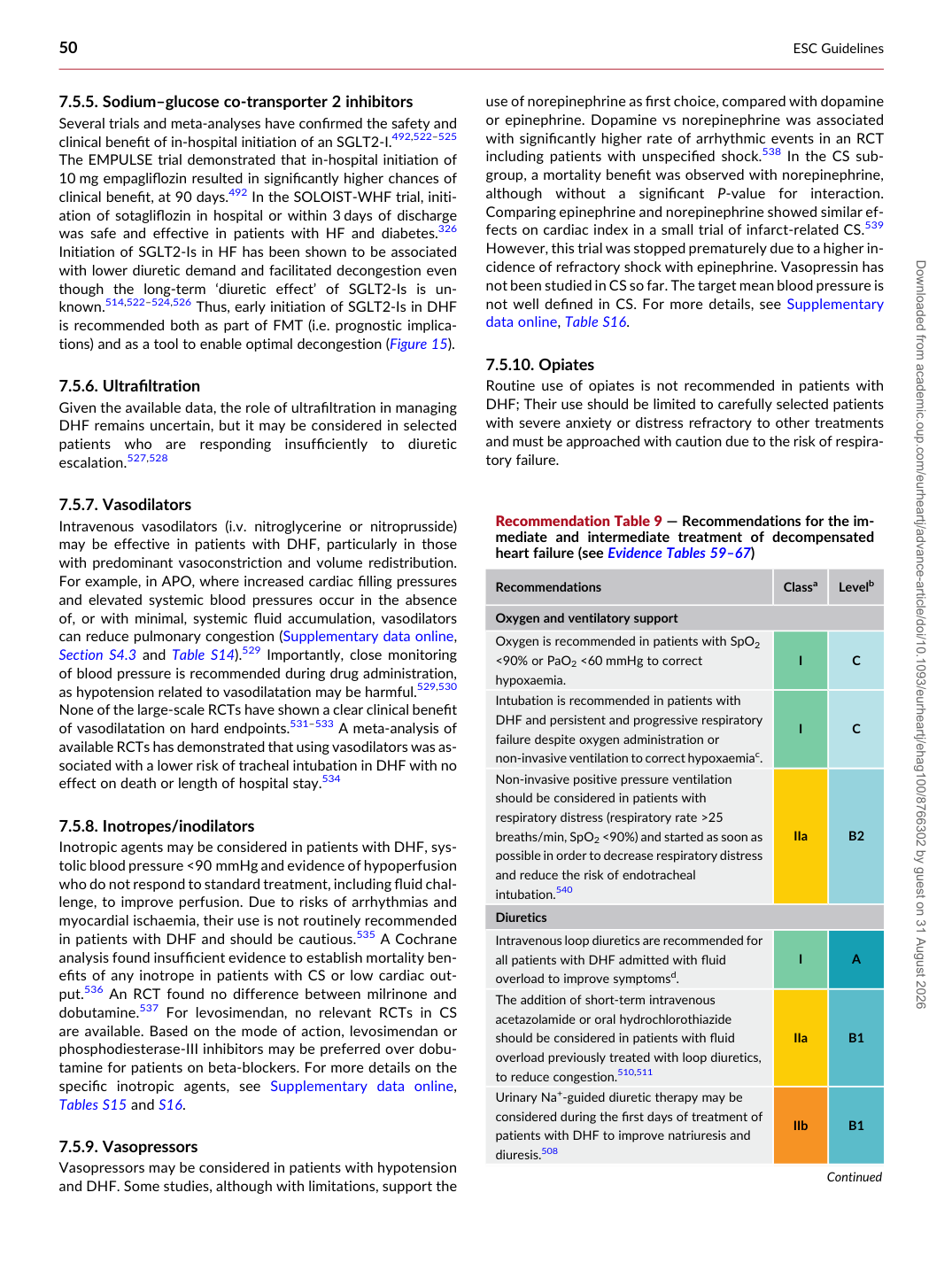
Recommendation Table 9 — Recommendations for the immediate and intermediate treatment of decompensated heart failure (see Evidence Tables 59–67)

Recommendations Classa Levelb

Oxygen and ventilatory support Oxygen is recommended in patients with SpO2 <90% or PaO2 <60 mmHg to correct hypoxaemia. I C Intubation is recommended in patients with DHF and persistent and progressive respiratory failure despite oxygen administration or non-invasive ventilation to correct hypoxaemiac. I C Non-invasive positive pressure ventilation should be considered in patients with respiratory distress (respiratory rate >25 breaths/min, SpO2 <90%) and started as soon as possible in order to decrease respiratory distress and reduce the risk of endotracheal intubation.540 IIa B2 Diuretics Intravenous loop diuretics are recommended for all patients with DHF admitted with fluid overload to improve symptomsd. I A The addition of short-term intravenous acetazolamide or oral hydrochlorothiazide should be considered in patients with fluid overload previously treated with loop diuretics, to reduce congestion.510,511 IIa B1 Urinary Na+-guided diuretic therapy may be considered during the first days of treatment of patients with DHF to improve natriuresis and diuresis.508 IIb B1

Continued Downloaded from academic.oup.com/eurheartj/advance-article/doi/10.1093/eurheartj/ehag100/8766302 by guest on 31 August 2026