p.41 抽出テキスト
patients undergoing CRT, the combined endpoint of allcause death and HFH was lowest in patients with no HFH prior to implantation (9.7 per 100 person-years) and those who had CRT during the first HFH (11.1 per 100 personyears) compared with patients who had a CRT implantation within a year of their first HFH (17.3 per 100 patientyears).415 In a study of 15 619 CRT-eligible patients with HF in the Get With The Guidelines-HF registry, all-cause death was lower in those who received CRT implantation during HFH (adjusted HR 0.63; P<.0001) compared with patients who did not have CRT.416 A lower rate HF rehospitalization was observed in patients with CRT implanted during the first hospitalization (adjusted HR 0.64; P<.0001), but not in those prescribed CRT at discharge. As HFH is a critical step in the progression of HF, it may be beneficial to implant CRT at an early stage in patients who are most likely to benefit (LVEF ≤35%, LBBB with QRS ≥150 ms), ideally before an HFH has occurred.

6.2.3 Conduction system pacing

Conduction system pacing (CSP), including His bundle and left bundle branch area pacing, aims to engage the Purkinje network for rapid and synchronous LV activation.426 Left bundle branch area pacing may prove to be a feasible alternative to CRT when implantation is challenging. However, no RCT with patientcentred outcomes has evaluated the efficacy or long-term safety of CSP in HFrEF. Therefore, no recommendations can currently be made. See Evidence Table 22 and Supplementary data online, Section S3.1.3 for further details.427–433

6.2.4 Cardiac implantable electronic device

programming and follow-up In the same way that FMT implies lifelong adherence to drugs, a CIED requires a lifelong commitment to device follow-up. For the clinician, skills in interpretation of device-derived electrograms, device-related problem solving, and programming are essential.434,435 For ICDs, routine defibrillation testing of shock efficacy does not reduce arrhythmic death and is therefore no longer recommended.436 Programming a high-rate cut-off and long detection intervals between detection of ventricular tachycardia and antitachycardia pacing or shocks dramatically reduce inappropriate shocks and unnecessary ICD therapy.436,437 At follow-up, the RV pacing burden as well as the intrinsic QRS duration are an important focus for deciding whether to upgrade from an ICD to a CRT-D device. In patients with a CRT device, regular follow-up and optimization should be implemented, as CRT programming and FMT may require further optimization after implantation.435 Appropriate programming of atrioventricular intervals and optimal LV lead vectors are required to optimize CRT response. In patients

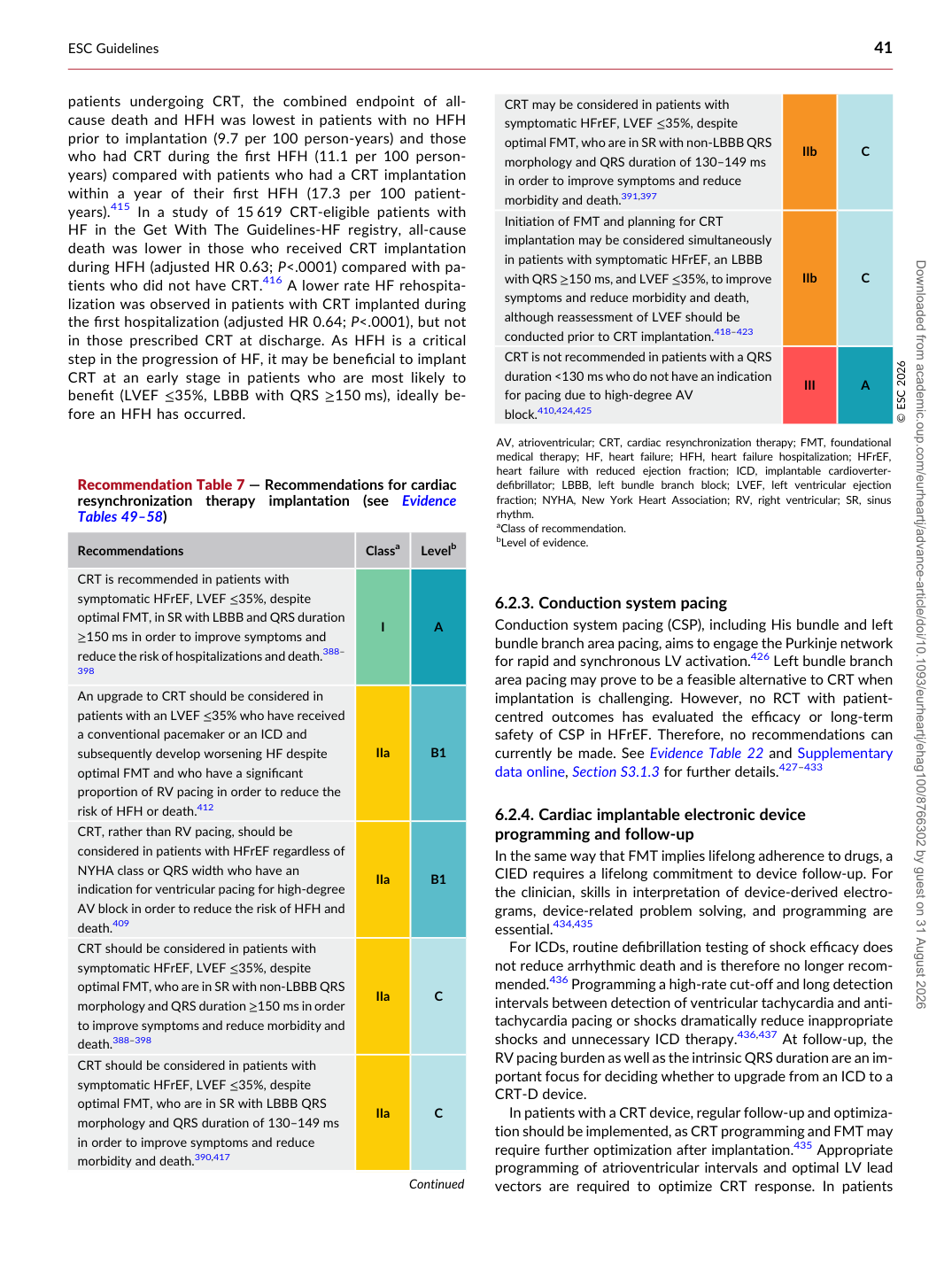
Recommendation Table 7 — Recommendations for cardiac resynchronization therapy implantation (see Evidence Tables 49–58)

Recommendations Classa Levelb CRT is recommended in patients with symptomatic HFrEF, LVEF ≤35%, despite optimal FMT, in SR with LBBB and QRS duration ≥150 ms in order to improve symptoms and reduce the risk of hospitalizations and death.388–

398 I A

An upgrade to CRT should be considered in patients with an LVEF ≤35% who have received a conventional pacemaker or an ICD and subsequently develop worsening HF despite optimal FMT and who have a significant proportion of RV pacing in order to reduce the risk of HFH or death.412 IIa B1 CRT, rather than RV pacing, should be considered in patients with HFrEF regardless of NYHA class or QRS width who have an indication for ventricular pacing for high-degree AV block in order to reduce the risk of HFH and death.409 IIa B1 CRT should be considered in patients with symptomatic HFrEF, LVEF ≤35%, despite optimal FMT, who are in SR with non-LBBB QRS morphology and QRS duration ≥150 ms in order to improve symptoms and reduce morbidity and death.388–398 IIa C CRT should be considered in patients with symptomatic HFrEF, LVEF ≤35%, despite optimal FMT, who are in SR with LBBB QRS morphology and QRS duration of 130–149 ms in order to improve symptoms and reduce morbidity and death.390,417 IIa C

Continued CRT may be considered in patients with

symptomatic HFrEF, LVEF ≤35%, despite optimal FMT, who are in SR with non-LBBB QRS morphology and QRS duration of 130–149 ms in order to improve symptoms and reduce morbidity and death.391,397 IIb C Initiation of FMT and planning for CRT implantation may be considered simultaneously in patients with symptomatic HFrEF, an LBBB with QRS ≥150 ms, and LVEF ≤35%, to improve symptoms and reduce morbidity and death, although reassessment of LVEF should be conducted prior to CRT implantation.418–423 IIb C CRT is not recommended in patients with a QRS duration <130 ms who do not have an indication for pacing due to high-degree AV block.410,424,425 III A © ESC 2026 AV, atrioventricular; CRT, cardiac resynchronization therapy; FMT, foundational medical therapy; HF, heart failure; HFH, heart failure hospitalization; HFrEF, heart failure with reduced ejection fraction; ICD, implantable cardioverterdefibrillator; LBBB, left bundle branch block; LVEF, left ventricular ejection fraction; NYHA, New York Heart Association; RV, right ventricular; SR, sinus rhythm. aClass of recommendation. bLevel of evidence. Downloaded from academic.oup.com/eurheartj/advance-article/doi/10.1093/eurheartj/ehag100/8766302 by guest on 31 August 2026