p.40 抽出テキスト
6.2.2 Cardiac resynchronization therapy

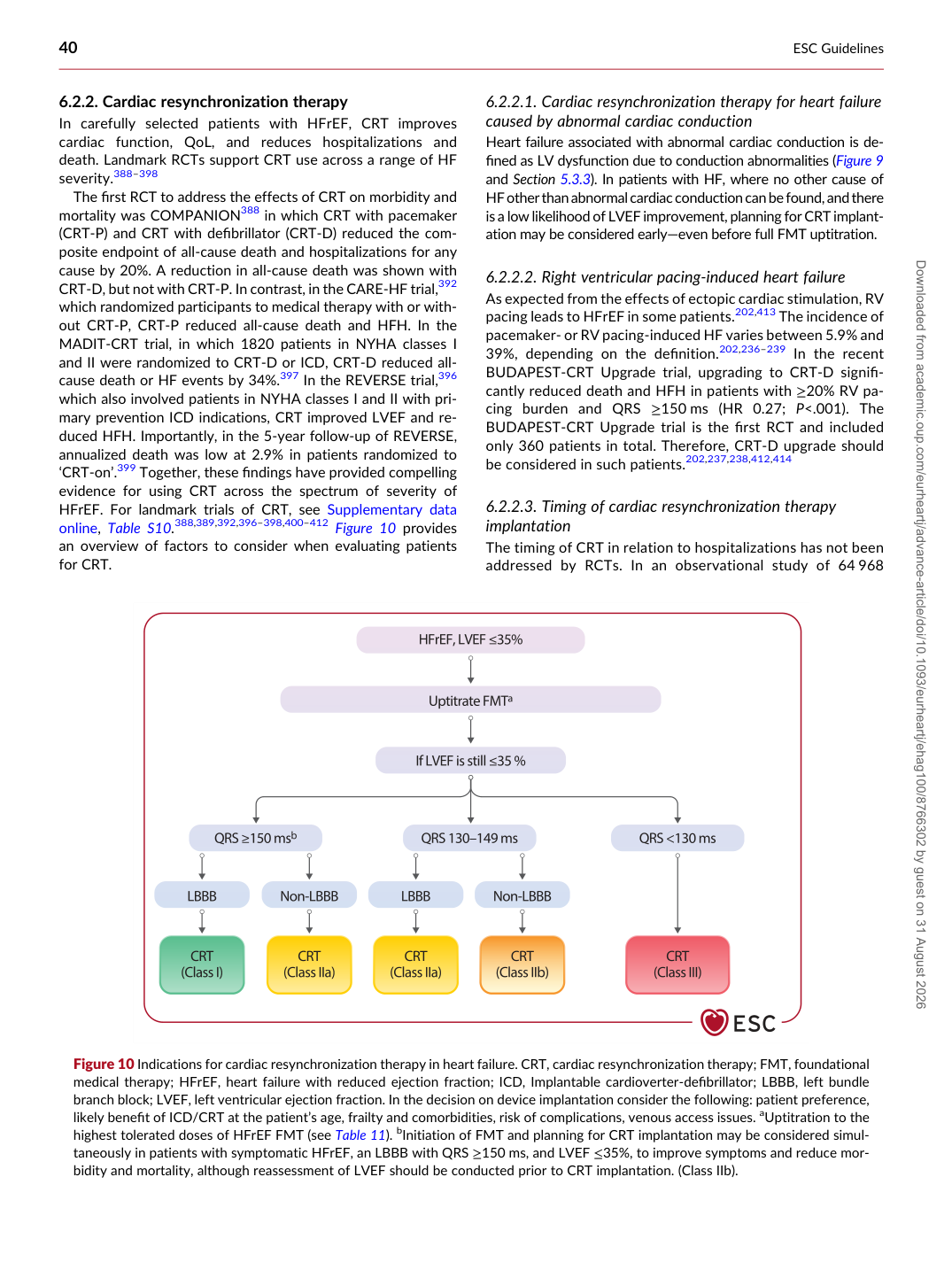
In carefully selected patients with HFrEF, CRT improves cardiac function, QoL, and reduces hospitalizations and death. Landmark RCTs support CRT use across a range of HF severity.388–398 The first RCT to address the effects of CRT on morbidity and mortality was COMPANION388 in which CRT with pacemaker (CRT-P) and CRT with defibrillator (CRT-D) reduced the composite endpoint of all-cause death and hospitalizations for any cause by 20%. A reduction in all-cause death was shown with CRT-D, but not with CRT-P. In contrast, in the CARE-HF trial,392 which randomized participants to medical therapy with or without CRT-P, CRT-P reduced all-cause death and HFH. In the MADIT-CRT trial, in which 1820 patients in NYHA classes I and II were randomized to CRT-D or ICD, CRT-D reduced allcause death or HF events by 34%.397 In the REVERSE trial,396 which also involved patients in NYHA classes I and II with primary prevention ICD indications, CRT improved LVEF and reduced HFH. Importantly, in the 5-year follow-up of REVERSE, annualized death was low at 2.9% in patients randomized to ‘CRT-on’.399 Together, these findings have provided compelling evidence for using CRT across the spectrum of severity of HFrEF. For landmark trials of CRT, see Supplementary data online, Table S10.388,389,392,396–398,400–412 Figure 10 provides an overview of factors to consider when evaluating patients for CRT. 6.2.2.1 Cardiac resynchronization therapy for heart failure

caused by abnormal cardiac conduction Heart failure associated with abnormal cardiac conduction is defined as LV dysfunction due to conduction abnormalities (Figure 9 and Section 5.3.3). In patients with HF, where no other cause of HF other than abnormal cardiac conduction can be found, and there is a low likelihood of LVEF improvement, planning for CRT implantation may be considered early—even before full FMT uptitration.

6.2.2.2 Right ventricular pacing-induced heart failure

As expected from the effects of ectopic cardiac stimulation, RV pacing leads to HFrEF in some patients.202,413 The incidence of pacemaker- or RV pacing-induced HF varies between 5.9% and 39%, depending on the definition.202,236–239 In the recent BUDAPEST-CRT Upgrade trial, upgrading to CRT-D significantly reduced death and HFH in patients with ≥20% RV pacing burden and QRS ≥150 ms (HR 0.27; P<.001). The BUDAPEST-CRT Upgrade trial is the first RCT and included only 360 patients in total. Therefore, CRT-D upgrade should be considered in such patients.202,237,238,412,414

6.2.2.3 Timing of cardiac resynchronization therapy

implantation The timing of CRT in relation to hospitalizations has not been addressed by RCTs. In an observational study of 64 968

Figure 10 Indications for cardiac resynchronization therapy in heart failure. CRT, cardiac resynchronization therapy; FMT, foundational medical therapy; HFrEF, heart failure with reduced ejection fraction; ICD, Implantable cardioverter-defibrillator; LBBB, left bundle branch block; LVEF, left ventricular ejection fraction. In the decision on device implantation consider the following: patient preference, likely benefit of ICD/CRT at the patient’s age, frailty and comorbidities, risk of complications, venous access issues. aUptitration to the highest tolerated doses of HFrEF FMT (see Table 11). bInitiation of FMT and planning for CRT implantation may be considered simultaneously in patients with symptomatic HFrEF, an LBBB with QRS ≥150 ms, and LVEF ≤35%, to improve symptoms and reduce morbidity and mortality, although reassessment of LVEF should be conducted prior to CRT implantation. (Class IIb). Downloaded from academic.oup.com/eurheartj/advance-article/doi/10.1093/eurheartj/ehag100/8766302 by guest on 31 August 2026