p.4 抽出テキスト
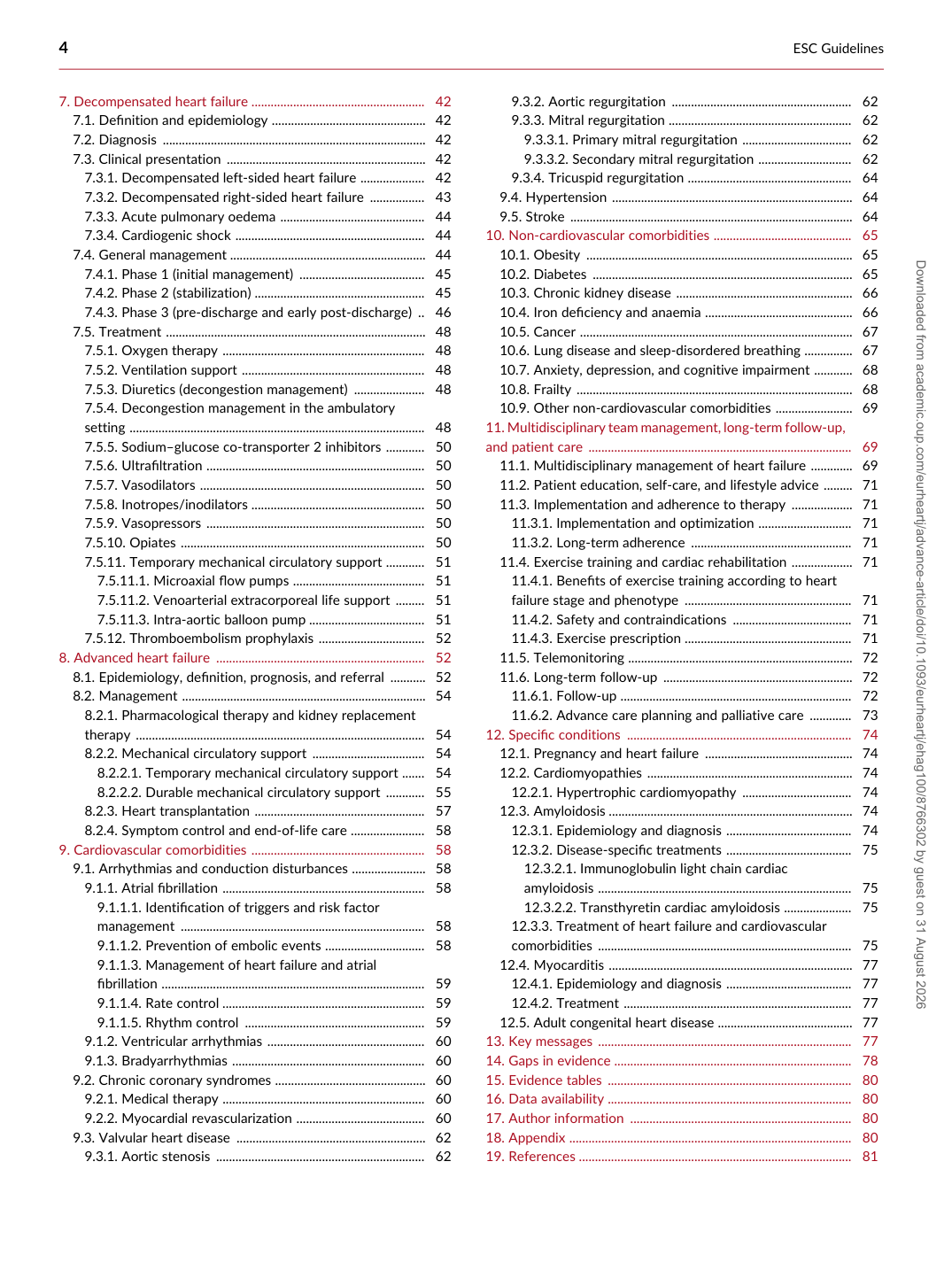
7. Decompensated heart failure ...................................................... 42 7.1. Definition and epidemiology ................................................ 42 7.2. Diagnosis .................................................................................. 42 7.3. Clinical presentation .............................................................. 42 7.3.1. Decompensated left-sided heart failure .................... 42 7.3.2. Decompensated right-sided heart failure ................. 43 7.3.3. Acute pulmonary oedema ............................................. 44 7.3.4. Cardiogenic shock ........................................................... 44 7.4. General management ............................................................. 44 7.4.1. Phase 1 (initial management) ....................................... 45 7.4.2. Phase 2 (stabilization) ..................................................... 45 7.4.3. Phase 3 (pre-discharge and early post-discharge) .. 46 7.5. Treatment ................................................................................. 48 7.5.1. Oxygen therapy ............................................................... 48 7.5.2. Ventilation support ......................................................... 48 7.5.3. Diuretics (decongestion management) ...................... 48 7.5.4. Decongestion management in the ambulatory setting ............................................................................................ 48 7.5.5. Sodium–glucose co-transporter 2 inhibitors ............ 50 7.5.6. Ultrafiltration .................................................................... 50 7.5.7. Vasodilators ...................................................................... 50 7.5.8. Inotropes/inodilators ...................................................... 50 7.5.9. Vasopressors .................................................................... 50 7.5.10. Opiates ............................................................................ 50 7.5.11. Temporary mechanical circulatory support ............ 51 7.5.11.1. Microaxial flow pumps ......................................... 51 7.5.11.2. Venoarterial extracorporeal life support ......... 51 7.5.11.3. Intra-aortic balloon pump .................................... 51 7.5.12. Thromboembolism prophylaxis ................................. 52 8. Advanced heart failure ................................................................. 52 8.1. Epidemiology, definition, prognosis, and referral ........... 52 8.2. Management ............................................................................ 54 8.2.1. Pharmacological therapy and kidney replacement therapy .......................................................................................... 54 8.2.2. Mechanical circulatory support ................................... 54 8.2.2.1. Temporary mechanical circulatory support ....... 54 8.2.2.2. Durable mechanical circulatory support ............ 55 8.2.3. Heart transplantation ..................................................... 57 8.2.4. Symptom control and end-of-life care ....................... 58 9. Cardiovascular comorbidities ...................................................... 58 9.1. Arrhythmias and conduction disturbances ....................... 58 9.1.1. Atrial fibrillation ............................................................... 58 9.1.1.1. Identification of triggers and risk factor management ............................................................................ 58 9.1.1.2. Prevention of embolic events ............................... 58 9.1.1.3. Management of heart failure and atrial fibrillation .................................................................................. 59 9.1.1.4. Rate control ............................................................... 59 9.1.1.5. Rhythm control ........................................................ 59 9.1.2. Ventricular arrhythmias ................................................. 60 9.1.3. Bradyarrhythmias ............................................................ 60 9.2. Chronic coronary syndromes ............................................... 60 9.2.1. Medical therapy ............................................................... 60 9.2.2. Myocardial revascularization ........................................ 60 9.3. Valvular heart disease ........................................................... 62 9.3.1. Aortic stenosis ................................................................. 62 9.3.2. Aortic regurgitation ........................................................ 62 9.3.3. Mitral regurgitation ......................................................... 62 9.3.3.1. Primary mitral regurgitation .................................. 62 9.3.3.2. Secondary mitral regurgitation ............................. 62 9.3.4. Tricuspid regurgitation ................................................... 64 9.4. Hypertension ........................................................................... 64 9.5. Stroke ........................................................................................ 64 10. Non-cardiovascular comorbidities ........................................... 65 10.1. Obesity ................................................................................... 65 10.2. Diabetes ................................................................................. 65 10.3. Chronic kidney disease ....................................................... 66 10.4. Iron deficiency and anaemia .............................................. 66 10.5. Cancer ..................................................................................... 67 10.6. Lung disease and sleep-disordered breathing ............... 67 10.7. Anxiety, depression, and cognitive impairment ............ 68 10.8. Frailty ...................................................................................... 68 10.9. Other non-cardiovascular comorbidities ........................ 69 11. Multidisciplinary team management, long-term follow-up, and patient care .................................................................................. 69 11.1. Multidisciplinary management of heart failure ............. 69 11.2. Patient education, self-care, and lifestyle advice ......... 71 11.3. Implementation and adherence to therapy ................... 71 11.3.1. Implementation and optimization ............................. 71 11.3.2. Long-term adherence .................................................. 71 11.4. Exercise training and cardiac rehabilitation ................... 71 11.4.1. Benefits of exercise training according to heart failure stage and phenotype .................................................... 71 11.4.2. Safety and contraindications ..................................... 71 11.4.3. Exercise prescription .................................................... 71 11.5. Telemonitoring ...................................................................... 72 11.6. Long-term follow-up ........................................................... 72 11.6.1. Follow-up ........................................................................ 72 11.6.2. Advance care planning and palliative care ............. 73 12. Specific conditions ...................................................................... 74 12.1. Pregnancy and heart failure .............................................. 74 12.2. Cardiomyopathies ................................................................ 74 12.2.1. Hypertrophic cardiomyopathy .................................. 74 12.3. Amyloidosis ............................................................................ 74 12.3.1. Epidemiology and diagnosis ....................................... 74 12.3.2. Disease-specific treatments ....................................... 75 12.3.2.1. Immunoglobulin light chain cardiac amyloidosis ............................................................................... 75 12.3.2.2. Transthyretin cardiac amyloidosis ..................... 75 12.3.3. Treatment of heart failure and cardiovascular comorbidities ............................................................................... 75 12.4. Myocarditis ............................................................................ 77 12.4.1. Epidemiology and diagnosis ....................................... 77 12.4.2. Treatment ....................................................................... 77 12.5. Adult congenital heart disease .......................................... 77 13. Key messages ............................................................................... 77 14. Gaps in evidence .......................................................................... 78 15. Evidence tables ............................................................................ 80 16. Data availability ............................................................................ 80 17. Author information ..................................................................... 80 18. Appendix ........................................................................................ 80 19. References ..................................................................................... 81 Downloaded from academic.oup.com/eurheartj/advance-article/doi/10.1093/eurheartj/ehag100/8766302 by guest on 31 August 2026