p.39 抽出テキスト
Both patient preferences and clinical factors should be carefully considered. Individualized patient information on the potential risks and benefits should be provided to support an informed decision. The presence and the extent of myocardial fibrosis, genotypes, and additional factors may help arrhythmic risk stratification in patients with cardiomyopathies.124,356,357

6.2.1.4 Timing of implantable cardioverter-defibrillator

therapy Two studies have shown that primary prevention ICD implantation within 40 days of an MI does not improve outcomes.358,359 A 3-month period after uptitration of FMT before considering ICD implantation is reasonable. Delaying ICD implantation carries a risk of SCD at 2%–4% by 6 months and ∼7% by 1 year.360

6.2.1.5 Implantable cardioverter-defibrillator generator

replacement As with FMT, the commitment to GDIT is in most cases lifelong. Implantation of an ICD commits the patient to lifelong monitoring and the need for generator replacements. The lifelong risk of complications should be considered in the decision to implant. A further question is whether ICD generators should be replaced in patients who have not had appropriate ICD therapies. ICD shocks occur in more than 15% of patients after generator replacement in those who have not had an appropriate ICD shock during the lifetime of their first ICD generator.361 Even in patients with LVEF improvement after FMT and CRT, a considerable residual risk of SCD remains.362,363 As HFrEF and comorbidities progress, the benefit of ICD therapy may diminish. The need for ICD and the risk of SCD should be reconsidered over time and prior to every generator replacement, taking risk of SCD, remaining lifespan of the patient, risk of complications, competing risks of death due to comorbidities, frailty, and patient choice into account.364–367

6.2.1.6 Non-transvenous implantable

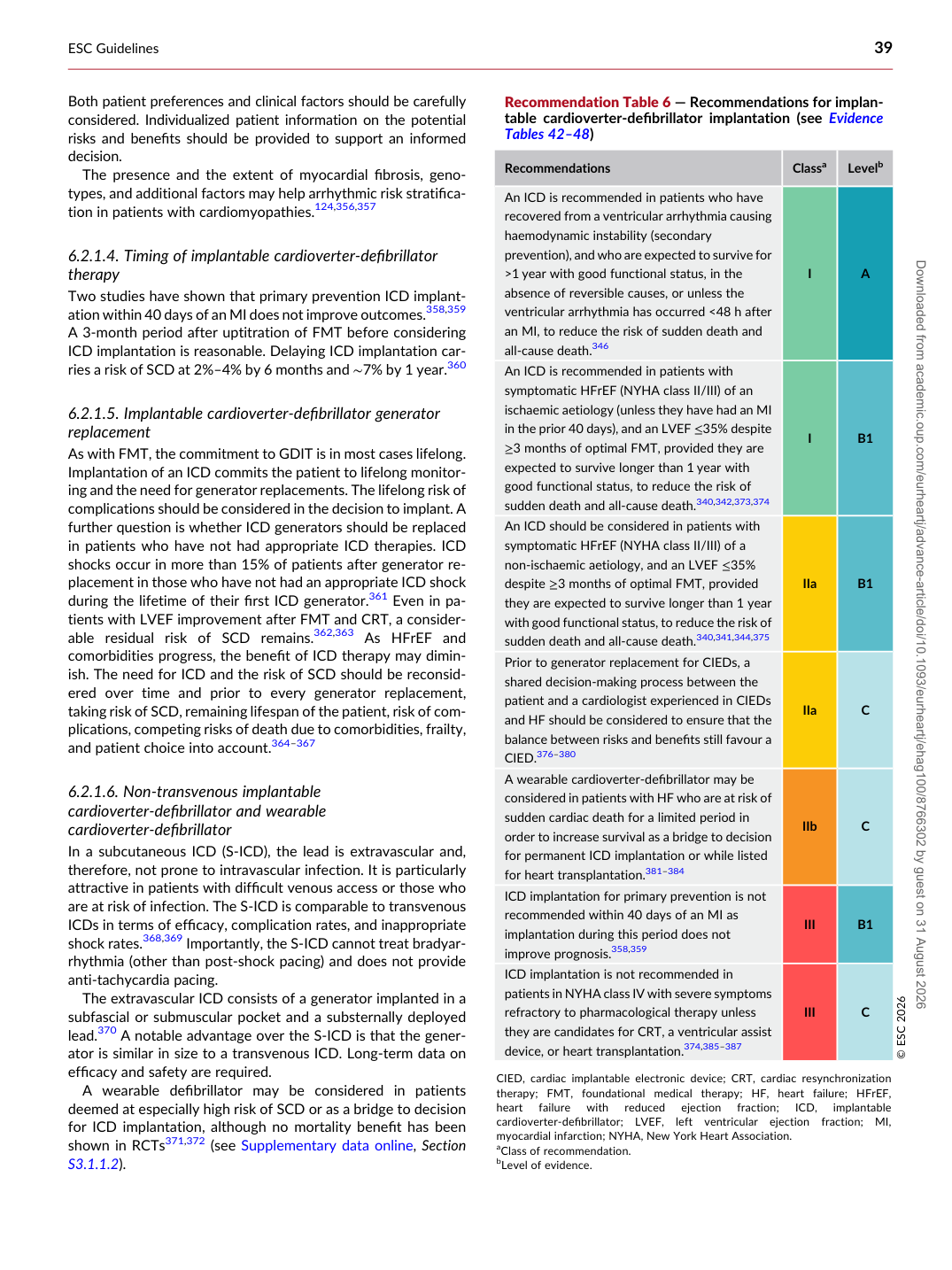
cardioverter-defibrillator and wearable cardioverter-defibrillator In a subcutaneous ICD (S-ICD), the lead is extravascular and, therefore, not prone to intravascular infection. It is particularly attractive in patients with difficult venous access or those who are at risk of infection. The S-ICD is comparable to transvenous ICDs in terms of efficacy, complication rates, and inappropriate shock rates.368,369 Importantly, the S-ICD cannot treat bradyarrhythmia (other than post-shock pacing) and does not provide anti-tachycardia pacing. The extravascular ICD consists of a generator implanted in a subfascial or submuscular pocket and a substernally deployed lead.370 A notable advantage over the S-ICD is that the generator is similar in size to a transvenous ICD. Long-term data on efficacy and safety are required. A wearable defibrillator may be considered in patients deemed at especially high risk of SCD or as a bridge to decision for ICD implantation, although no mortality benefit has been shown in RCTs371,372 (see Supplementary data online, Section S3.1.1.2). Recommendation Table 6 — Recommendations for implantable cardioverter-defibrillator implantation (see Evidence Tables 42–48)

Recommendations Classa Levelb An ICD is recommended in patients who have recovered from a ventricular arrhythmia causing haemodynamic instability (secondary prevention), and who are expected to survive for >1 year with good functional status, in the absence of reversible causes, or unless the ventricular arrhythmia has occurred <48 h after an MI, to reduce the risk of sudden death and all-cause death.346 I A An ICD is recommended in patients with symptomatic HFrEF (NYHA class II/III) of an ischaemic aetiology (unless they have had an MI in the prior 40 days), and an LVEF ≤35% despite ≥3 months of optimal FMT, provided they are expected to survive longer than 1 year with good functional status, to reduce the risk of sudden death and all-cause death.340,342,373,374 I B1 An ICD should be considered in patients with symptomatic HFrEF (NYHA class II/III) of a non-ischaemic aetiology, and an LVEF ≤35% despite ≥3 months of optimal FMT, provided they are expected to survive longer than 1 year with good functional status, to reduce the risk of sudden death and all-cause death.340,341,344,375 IIa B1 Prior to generator replacement for CIEDs, a shared decision-making process between the patient and a cardiologist experienced in CIEDs and HF should be considered to ensure that the balance between risks and benefits still favour a CIED.376–380 IIa C A wearable cardioverter-defibrillator may be considered in patients with HF who are at risk of sudden cardiac death for a limited period in order to increase survival as a bridge to decision for permanent ICD implantation or while listed for heart transplantation.381–384 IIb C ICD implantation for primary prevention is not recommended within 40 days of an MI as implantation during this period does not improve prognosis.358,359 III B1 ICD implantation is not recommended in patients in NYHA class IV with severe symptoms refractory to pharmacological therapy unless they are candidates for CRT, a ventricular assist device, or heart transplantation.374,385–387 III C © ESC 2026 CIED, cardiac implantable electronic device; CRT, cardiac resynchronization therapy; FMT, foundational medical therapy; HF, heart failure; HFrEF, heart failure with reduced ejection fraction; ICD, implantable cardioverter-defibrillator; LVEF, left ventricular ejection fraction; MI, myocardial infarction; NYHA, New York Heart Association. aClass of recommendation. bLevel of evidence. Downloaded from academic.oup.com/eurheartj/advance-article/doi/10.1093/eurheartj/ehag100/8766302 by guest on 31 August 2026