p.38 抽出テキスト
6.2 Guideline-directed interventional

therapies for chronic heart failure The term GDIT includes all guideline-directed interventional therapies for HF (see Section 3). In this section, we provide recommendations for ICDs and CRT. Other implantable devices, for which recommendations have not been made, will be discussed at the end of this section. Section 7 provides recommendations for interventional therapies in the setting of DHF, and Section 8 provides recommendations for interventional therapies in the setting of advanced HF. Section 9 covers comorbidityspecific interventional therapies.

6.2.1 Implantable cardioverter-defibrillators

The recognition that arrhythmic sudden cardiac death (SCD) accounted for ∼30%–60% of all deaths in the early HF trials338 paved the way for the use of ICDs in patients with HFrEF. Antiarrhythmic drugs, such as amiodarone and dronedarone, are effective in reducing ventricular arrhythmias, but they do not prolong survival and may shorten it.339,340 In contrast, ICDs are effective in preventing SCD and prolonging survival in patients with HFrEF who are at high risk of SCD.340–344

6.2.1.1 Secondary prevention of sudden cardiac death

Unlike antiarrhythmic drugs such as amiodarone, ICDs reduce mortality in cardiac arrest survivors and those with sustained ventricular arrhythmias, regardless of LVEF or presence of HF.345–348 Recommendations for secondary prevention ICD implantation are provided in the 2022 ESC Guidelines for the management of patients with ventricular arrhythmias and the prevention of sudden cardiac death.119 Cardiomyopathy-specific recommendations for secondary prevention ICD implantation are provided in the 2023 ESC Guidelines for the management of cardiomyopathies.124

6.2.1.2 Primary prevention of sudden cardiac death in heart

failure In the SCD-HeFT trial, compared to amiodarone, ICD reduced allcause death by 23% in patients with HFrEF.340 In MADIT-II, 1232 patients were randomized to an ICD or control, and ICD therapy reduced all-cause death by 31%.342 Although the risk of SCD has declined over time, the residual risk of SCD is still high (annual rate of 3.3 per 100 patient-years in PARADIGM-HF), warranting primary prevention ICD implantation in patients with HFrEF deemed at high risk of SCD.349 For details, see Supplementary data online, Section S3.1.1.1.340,342,349–352

6.2.1.3 Patient selection for implantable

cardioverter-defibrillator therapy Selection of patients with HFrEF for ICD implantation should be based on LVEF thresholds established in RCTs and underlying aetiology, as individuals with non-ischaemic HF may derive less benefit than those with ischaemic heart disease.341,343,353,354 However, a meta-analysis of RCTs demonstrated an overall survival benefit, even in patients with non-ischaemic HF.344 The effect of ICD treatment depends on the competing risk of non-sudden death, both CV and non-CV. Thus, in patients with many comorbidities and older age, the benefit of ICD therapy may be substantially lower.355 Shared decision-making is essential when considering ICD implantation in patients with HF.

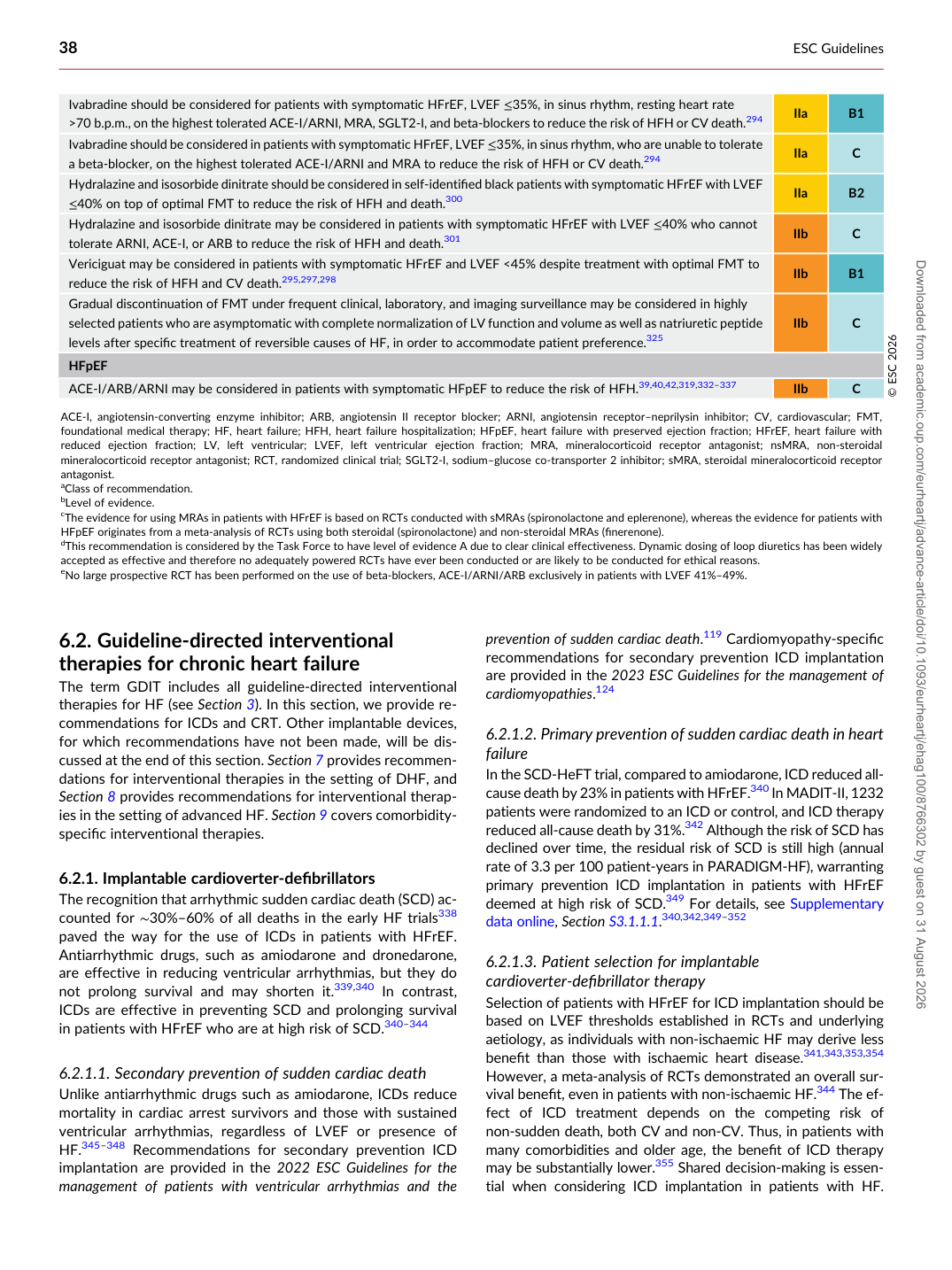
Ivabradine should be considered for patients with symptomatic HFrEF, LVEF ≤35%, in sinus rhythm, resting heart rate >70 b.p.m., on the highest tolerated ACE-I/ARNI, MRA, SGLT2-I, and beta-blockers to reduce the risk of HFH or CV death.294 IIa B1 Ivabradine should be considered in patients with symptomatic HFrEF, LVEF ≤35%, in sinus rhythm, who are unable to tolerate a beta-blocker, on the highest tolerated ACE-I/ARNI and MRA to reduce the risk of HFH or CV death.294 IIa C Hydralazine and isosorbide dinitrate should be considered in self-identified black patients with symptomatic HFrEF with LVEF ≤40% on top of optimal FMT to reduce the risk of HFH and death.300 IIa B2 Hydralazine and isosorbide dinitrate may be considered in patients with symptomatic HFrEF with LVEF ≤40% who cannot tolerate ARNI, ACE-I, or ARB to reduce the risk of HFH and death.301 IIb C Vericiguat may be considered in patients with symptomatic HFrEF and LVEF <45% despite treatment with optimal FMT to reduce the risk of HFH and CV death.295,297,298 IIb B1 Gradual discontinuation of FMT under frequent clinical, laboratory, and imaging surveillance may be considered in highly selected patients who are asymptomatic with complete normalization of LV function and volume as well as natriuretic peptide levels after specific treatment of reversible causes of HF, in order to accommodate patient preference.325 IIb C HFpEF ACE-I/ARB/ARNI may be considered in patients with symptomatic HFpEF to reduce the risk of HFH.39,40,42,319,332–337 IIb C © ESC 2026 ACE-I, angiotensin-converting enzyme inhibitor; ARB, angiotensin II receptor blocker; ARNI, angiotensin receptor–neprilysin inhibitor; CV, cardiovascular; FMT, foundational medical therapy; HF, heart failure; HFH, heart failure hospitalization; HFpEF, heart failure with preserved ejection fraction; HFrEF, heart failure with reduced ejection fraction; LV, left ventricular; LVEF, left ventricular ejection fraction; MRA, mineralocorticoid receptor antagonist; nsMRA, non-steroidal mineralocorticoid receptor antagonist; RCT, randomized clinical trial; SGLT2-I, sodium–glucose co-transporter 2 inhibitor; sMRA, steroidal mineralocorticoid receptor antagonist. aClass of recommendation. bLevel of evidence. cThe evidence for using MRAs in patients with HFrEF is based on RCTs conducted with sMRAs (spironolactone and eplerenone), whereas the evidence for patients with HFpEF originates from a meta-analysis of RCTs using both steroidal (spironolactone) and non-steroidal MRAs (finerenone). dThis recommendation is considered by the Task Force to have level of evidence A due to clear clinical effectiveness. Dynamic dosing of loop diuretics has been widely accepted as effective and therefore no adequately powered RCTs have ever been conducted or are likely to be conducted for ethical reasons. eNo large prospective RCT has been performed on the use of beta-blockers, ACE-I/ARNI/ARB exclusively in patients with LVEF 41%–49%. Downloaded from academic.oup.com/eurheartj/advance-article/doi/10.1093/eurheartj/ehag100/8766302 by guest on 31 August 2026