p.36 抽出テキスト
total HFH (rate ratio 0.85; 95% CI 0.72–1.00; P = .056) that also did not meet statistical significance. A meta-analysis of the PARADIGM-HF and PARAGON-HF trials showed a benefit of sacubitril–valsartan compared with valsartan in patients with an LVEF below 60-65%.318,319 ARNIs therefore may be considered in HFpEF, especially in those with lower LVEF ranges. Although renin–angiotensin system inhibition strategies with ACE-Is and/or ARBs have been successful in the treatment of HFrEF, clinical trials have not shown a clear benefit in HFpEF patients. In a meta-analysis of four trials evaluating ARBs in patients with HFpEF, there was no signal for benefit on CV death (HR 1.02), all-cause death (HR 1.01; 95% CI 0.92–1.11), or HFH (HR 0.92; 95% CI 0.83–1.02).320 Candesartan was associated with a reduction in recurrent HFH until LVEF was over 60%.40 Although no strong recommendation is given to start these agents in patients with HFpEF, many have coexisting indications for ACE-I/ARB therapy (hypertension/diabetes/CKD).

6.1.8 Pharmacological treatment in heart failure with

improved ejection fraction In patients with HFrEF, FMT and GDIT can result in improvement in symptoms, functional capacity, NT-proBNP levels and LVEF (i.e. reverse remodelling). However, in most patients, LV function and structural abnormalities do not fully normalize, and symptoms and biomarker abnormalities may persist or reoccur. Many patients deemed to have recovered from HFrEF with resolution of symptoms and improvement of LVEF and natriuretic peptide levels will relapse after withdrawal of FMT. TRED-HF was a small open-label trial in which phased withdrawal of FMT was conducted in patients with HFrEF and DCM whose LVEF had improved (but not necessarily normalized—from LVEF <40% to LVEF at least 50%) after treatment with FMT , their LV volume had normalized, and the NT-proBNP concentrations were reduced to <250 ng/L. Withdrawal of FMT resulted in relapse of HFrEF in 40% of the patients within 6 months, warranting reinitiation of therapy.321,322 In contrast, the CATHEDRAL-HF trial—a single-centre, open-label pilot study—randomized 60 patients with similar characteristics to those in the TRED-HF trial to either phased withdrawal of FMT (excluding carvedilol) or continued FMT. Phased withdrawal did not result in a higher rate of HFrEF relapse.323,324 Taken together, there is no solid evidence at this time to suggest that resolution of symptoms and improvement in cardiac function and biomarkers after treatment reflects actual recovery but, rather, remission, which requires FMT to be maintained.

Some causes of HF might be reversible (e.g. Takotsubo syndrome, arrhythmia-associated HF, myocarditis, HF caused by abnormal cardiac conduction). In these patients, where a completely reversible cause of HF is suspected and where complete normalization of LV function and volume has occurred after treatment of the reversible cause, including normalization of natriuretic peptides, a gradual trial of FMT withdrawal might be considered. However, this may be considered with caution and only in exceptional cases upon the request of the patient. The open-label, single-centre STOP-CRT trial indicated that gradual neurohumoral blocker withdrawal (and thus a CRT-only strategy) was feasible and safe in a small number of very selected patients with normalized LVEF after CRT.325 Such withdrawal should only be done under frequent clinical, laboratory, and imaging control to rule out relapse of HF. One should take into consideration that often coexisting comorbidities warrant continuation of FMT. However, more and larger RCTs in this domain are needed to assess the clinical effect of withdrawal of each component of FMT in patients with HFrEF and improved LVEF.

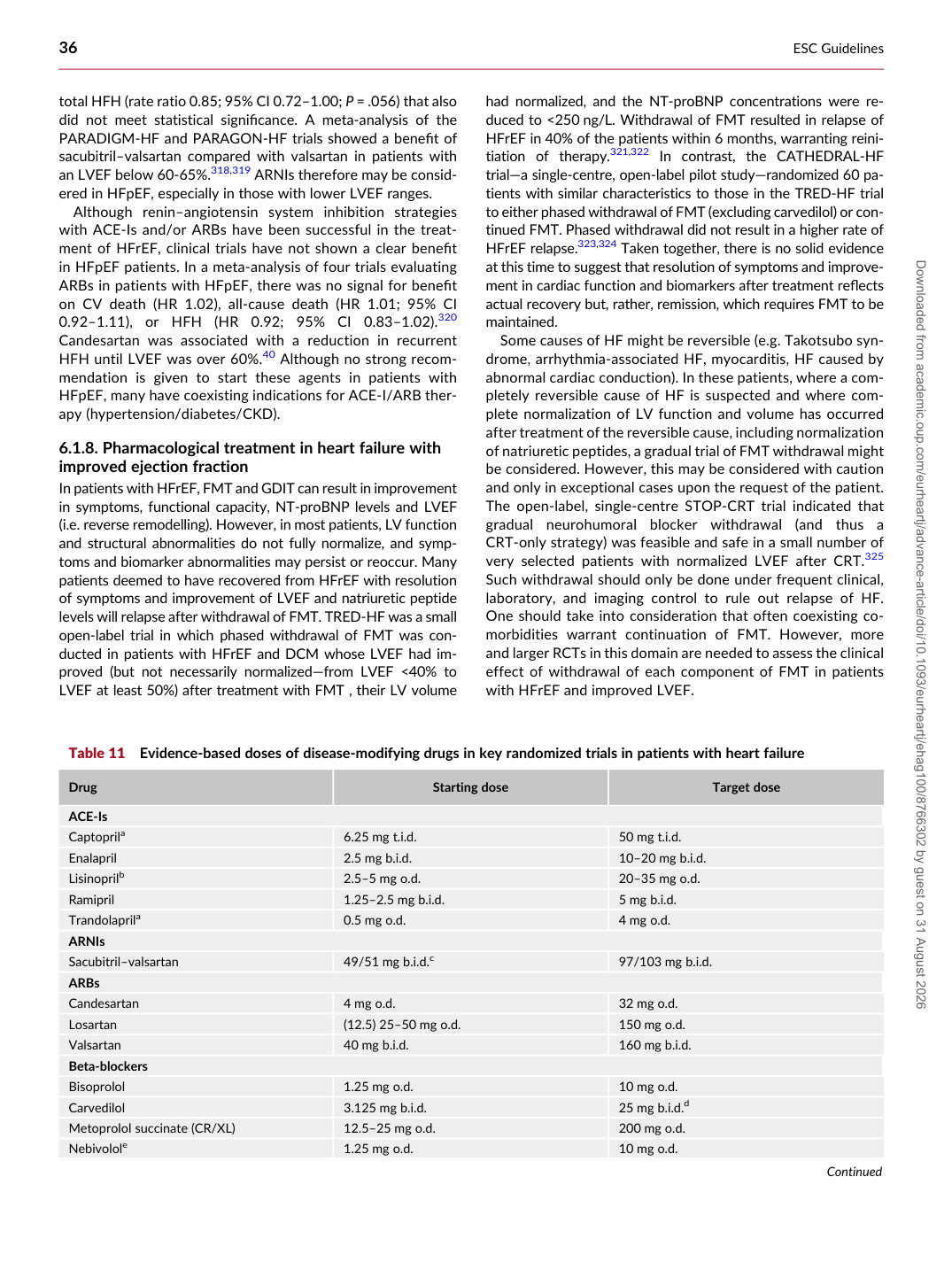
Table 11 Evidence-based doses of disease-modifying drugs in key randomized trials in patients with heart failure

Drug Starting dose Target dose ACE-Is Captoprila 6.25 mg t.i.d. 50 mg t.i.d. Enalapril 2.5 mg b.i.d. 10–20 mg b.i.d. Lisinoprilb 2.5–5 mg o.d. 20–35 mg o.d. Ramipril 1.25–2.5 mg b.i.d. 5 mg b.i.d. Trandolaprila 0.5 mg o.d. 4 mg o.d. ARNIs Sacubitril–valsartan 49/51 mg b.i.d.c 97/103 mg b.i.d. ARBs Candesartan 4 mg o.d. 32 mg o.d. Losartan (12.5) 25–50 mg o.d. 150 mg o.d. Valsartan 40 mg b.i.d. 160 mg b.i.d. Beta-blockers Bisoprolol 1.25 mg o.d. 10 mg o.d. Carvedilol 3.125 mg b.i.d. 25 mg b.i.d.d Metoprolol succinate (CR/XL) 12.5–25 mg o.d. 200 mg o.d. Nebivolole 1.25 mg o.d. 10 mg o.d.

Continued Downloaded from academic.oup.com/eurheartj/advance-article/doi/10.1093/eurheartj/ehag100/8766302 by guest on 31 August 2026