p.3 抽出テキスト
Table of contents

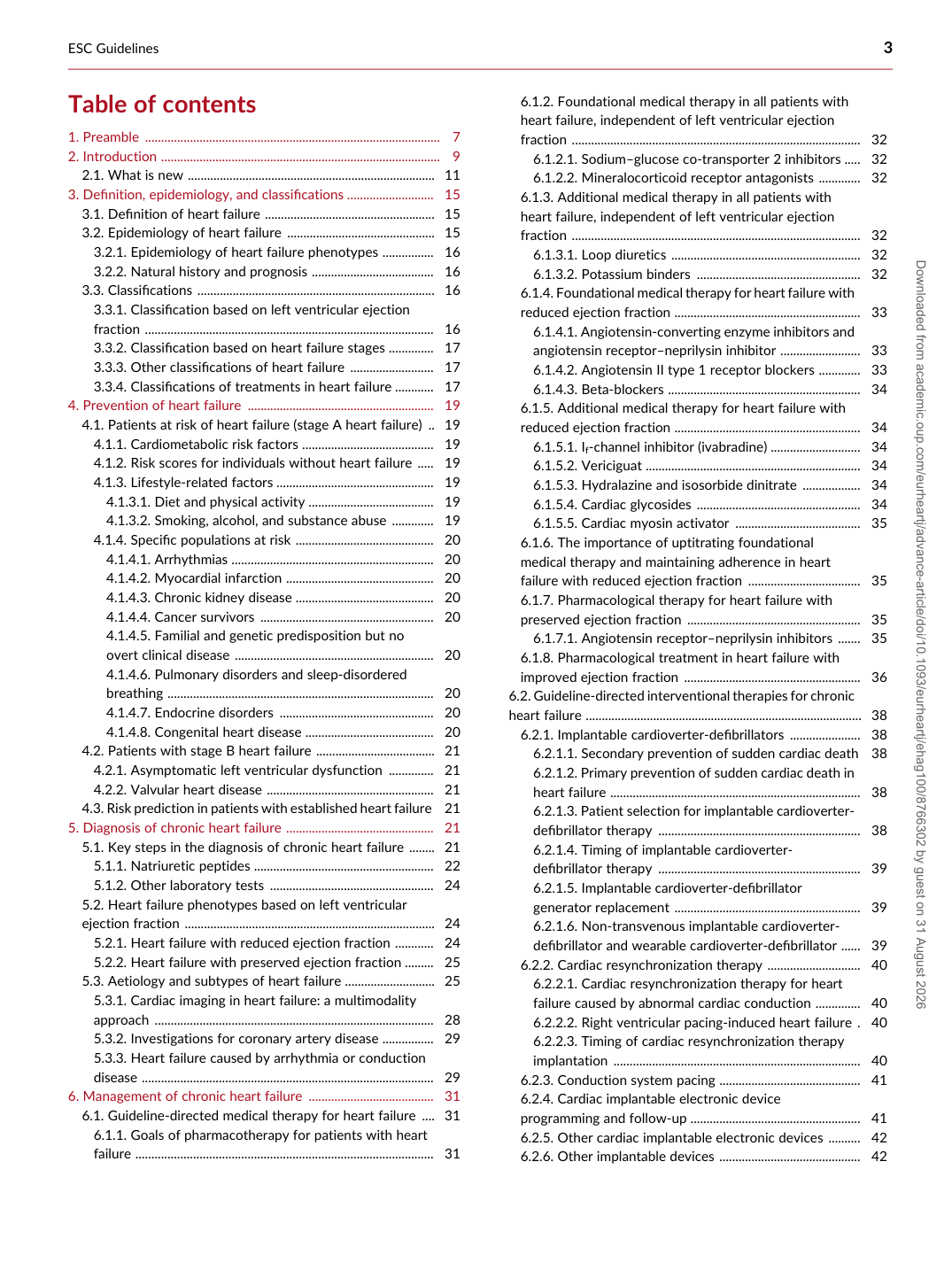
1. Preamble ............................................................................................ 7 2. Introduction ....................................................................................... 9 2.1. What is new ............................................................................. 11 3. Definition, epidemiology, and classifications ........................... 15 3.1. Definition of heart failure ..................................................... 15 3.2. Epidemiology of heart failure .............................................. 15 3.2.1. Epidemiology of heart failure phenotypes ................ 16 3.2.2. Natural history and prognosis ...................................... 16 3.3. Classifications .......................................................................... 16 3.3.1. Classification based on left ventricular ejection fraction .......................................................................................... 16 3.3.2. Classification based on heart failure stages .............. 17 3.3.3. Other classifications of heart failure .......................... 17 3.3.4. Classifications of treatments in heart failure ............ 17 4. Prevention of heart failure .......................................................... 19 4.1. Patients at risk of heart failure (stage A heart failure) .. 19 4.1.1. Cardiometabolic risk factors ......................................... 19 4.1.2. Risk scores for individuals without heart failure ..... 19 4.1.3. Lifestyle-related factors ................................................. 19 4.1.3.1. Diet and physical activity ....................................... 19 4.1.3.2. Smoking, alcohol, and substance abuse ............. 19 4.1.4. Specific populations at risk ........................................... 20 4.1.4.1. Arrhythmias ............................................................... 20 4.1.4.2. Myocardial infarction .............................................. 20 4.1.4.3. Chronic kidney disease ........................................... 20 4.1.4.4. Cancer survivors ...................................................... 20 4.1.4.5. Familial and genetic predisposition but no overt clinical disease .............................................................. 20 4.1.4.6. Pulmonary disorders and sleep-disordered breathing ................................................................................... 20 4.1.4.7. Endocrine disorders ................................................ 20 4.1.4.8. Congenital heart disease ........................................ 20 4.2. Patients with stage B heart failure ..................................... 21 4.2.1. Asymptomatic left ventricular dysfunction .............. 21 4.2.2. Valvular heart disease .................................................... 21 4.3. Risk prediction in patients with established heart failure 21 5. Diagnosis of chronic heart failure .............................................. 21 5.1. Key steps in the diagnosis of chronic heart failure ........ 21 5.1.1. Natriuretic peptides ........................................................ 22 5.1.2. Other laboratory tests ................................................... 24 5.2. Heart failure phenotypes based on left ventricular ejection fraction .............................................................................. 24 5.2.1. Heart failure with reduced ejection fraction ............ 24 5.2.2. Heart failure with preserved ejection fraction ......... 25 5.3. Aetiology and subtypes of heart failure ............................ 25 5.3.1. Cardiac imaging in heart failure: a multimodality approach ....................................................................................... 28 5.3.2. Investigations for coronary artery disease ................ 29 5.3.3. Heart failure caused by arrhythmia or conduction disease ........................................................................................... 29 6. Management of chronic heart failure ....................................... 31 6.1. Guideline-directed medical therapy for heart failure .... 31 6.1.1. Goals of pharmacotherapy for patients with heart failure ............................................................................................. 31 6.1.2. Foundational medical therapy in all patients with heart failure, independent of left ventricular ejection fraction .......................................................................................... 32 6.1.2.1. Sodium–glucose co-transporter 2 inhibitors ..... 32 6.1.2.2. Mineralocorticoid receptor antagonists ............. 32 6.1.3. Additional medical therapy in all patients with heart failure, independent of left ventricular ejection fraction .......................................................................................... 32 6.1.3.1. Loop diuretics ........................................................... 32 6.1.3.2. Potassium binders ................................................... 32 6.1.4. Foundational medical therapy for heart failure with reduced ejection fraction .......................................................... 33 6.1.4.1. Angiotensin-converting enzyme inhibitors and angiotensin receptor–neprilysin inhibitor ......................... 33 6.1.4.2. Angiotensin II type 1 receptor blockers ............. 33 6.1.4.3. Beta-blockers ............................................................ 34 6.1.5. Additional medical therapy for heart failure with reduced ejection fraction .......................................................... 34 6.1.5.1. If-channel inhibitor (ivabradine) ............................ 34 6.1.5.2. Vericiguat ................................................................... 34 6.1.5.3. Hydralazine and isosorbide dinitrate .................. 34 6.1.5.4. Cardiac glycosides ................................................... 34 6.1.5.5. Cardiac myosin activator ....................................... 35 6.1.6. The importance of uptitrating foundational medical therapy and maintaining adherence in heart failure with reduced ejection fraction ................................... 35 6.1.7. Pharmacological therapy for heart failure with preserved ejection fraction ...................................................... 35 6.1.7.1. Angiotensin receptor–neprilysin inhibitors ....... 35 6.1.8. Pharmacological treatment in heart failure with improved ejection fraction ....................................................... 36 6.2. Guideline-directed interventional therapies for chronic heart failure ...................................................................................... 38

6.2.1. Implantable cardioverter-defibrillators ...................... 38 6.2.1.1. Secondary prevention of sudden cardiac death 38 6.2.1.2. Primary prevention of sudden cardiac death in heart failure .............................................................................. 38 6.2.1.3. Patient selection for implantable cardioverterdefibrillator therapy ............................................................... 38 6.2.1.4. Timing of implantable cardioverterdefibrillator therapy ............................................................... 39 6.2.1.5. Implantable cardioverter-defibrillator generator replacement .......................................................... 39 6.2.1.6. Non-transvenous implantable cardioverterdefibrillator and wearable cardioverter-defibrillator ...... 39 6.2.2. Cardiac resynchronization therapy ............................. 40 6.2.2.1. Cardiac resynchronization therapy for heart failure caused by abnormal cardiac conduction .............. 40 6.2.2.2. Right ventricular pacing-induced heart failure . 40 6.2.2.3. Timing of cardiac resynchronization therapy implantation ............................................................................. 40 6.2.3. Conduction system pacing ............................................ 41 6.2.4. Cardiac implantable electronic device programming and follow-up ..................................................... 41 6.2.5. Other cardiac implantable electronic devices .......... 42 6.2.6. Other implantable devices ............................................ 42 Downloaded from academic.oup.com/eurheartj/advance-article/doi/10.1093/eurheartj/ehag100/8766302 by guest on 31 August 2026