p.21 抽出テキスト
(e.g. tetralogy of Fallot, transposition of the great arteries, truncus arteriosus, double-outlet right or left ventricle, with up to 42-fold risk), and severe non-conotruncal defects (e.g. atrioventricular septal defects, single ventricle and hypoplastic left heart syndrome, with up to 21-fold increased risk).131 Conventional HF risk factors (e.g. CAD, hypertension, diabetes, and obesity) are common in patients with congenital heart disease and contribute significantly to HF risk.132–134 Careful attention to riskfactor modification is warranted as they are likely to contribute to the risk of developing HF.

4.2 Patients with stage B heart failure

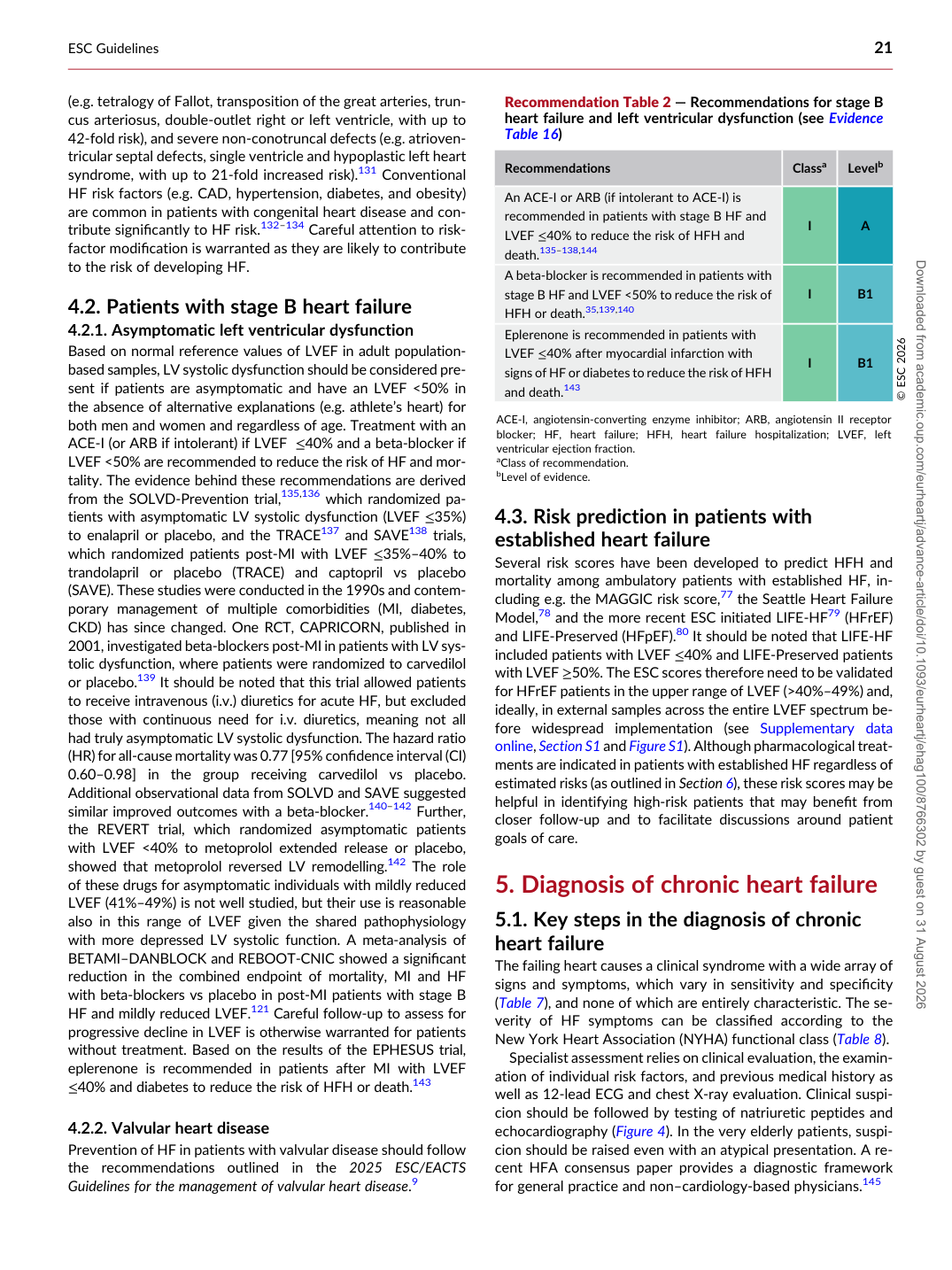
4.2.1. Asymptomatic left ventricular dysfunction Based on normal reference values of LVEF in adult populationbased samples, LV systolic dysfunction should be considered present if patients are asymptomatic and have an LVEF <50% in the absence of alternative explanations (e.g. athlete’s heart) for both men and women and regardless of age. Treatment with an ACE-I (or ARB if intolerant) if LVEF  ≤40% and a beta-blocker if LVEF <50% are recommended to reduce the risk of HF and mortality. The evidence behind these recommendations are derived from the SOLVD-Prevention trial,135,136 which randomized patients with asymptomatic LV systolic dysfunction (LVEF ≤35%) to enalapril or placebo, and the TRACE137 and SAVE138 trials, which randomized patients post-MI with LVEF ≤35%–40% to trandolapril or placebo (TRACE) and captopril vs placebo (SAVE). These studies were conducted in the 1990s and contemporary management of multiple comorbidities (MI, diabetes, CKD) has since changed. One RCT, CAPRICORN, published in 2001, investigated beta-blockers post-MI in patients with LV systolic dysfunction, where patients were randomized to carvedilol or placebo.139 It should be noted that this trial allowed patients to receive intravenous (i.v.) diuretics for acute HF, but excluded those with continuous need for i.v. diuretics, meaning not all had truly asymptomatic LV systolic dysfunction. The hazard ratio (HR) for all-cause mortality was 0.77 [95% confidence interval (CI) 0.60–0.98] in the group receiving carvedilol vs placebo. Additional observational data from SOLVD and SAVE suggested similar improved outcomes with a beta-blocker.140–142 Further, the REVERT trial, which randomized asymptomatic patients with LVEF <40% to metoprolol extended release or placebo, showed that metoprolol reversed LV remodelling.142 The role of these drugs for asymptomatic individuals with mildly reduced LVEF (41%–49%) is not well studied, but their use is reasonable also in this range of LVEF given the shared pathophysiology with more depressed LV systolic function. A meta-analysis of BETAMI–DANBLOCK and REBOOT-CNIC showed a significant reduction in the combined endpoint of mortality, MI and HF with beta-blockers vs placebo in post-MI patients with stage B HF and mildly reduced LVEF.121 Careful follow-up to assess for progressive decline in LVEF is otherwise warranted for patients without treatment. Based on the results of the EPHESUS trial, eplerenone is recommended in patients after MI with LVEF ≤40% and diabetes to reduce the risk of HFH or death.143

4.2.2 Valvular heart disease

Prevention of HF in patients with valvular disease should follow the recommendations outlined in the 2025 ESC/EACTS Guidelines for the management of valvular heart disease.9 4.3 Risk prediction in patients with

established heart failure Several risk scores have been developed to predict HFH and mortality among ambulatory patients with established HF, including e.g. the MAGGIC risk score,77 the Seattle Heart Failure Model,78 and the more recent ESC initiated LIFE-HF79 (HFrEF) and LIFE-Preserved (HFpEF).80 It should be noted that LIFE-HF included patients with LVEF ≤40% and LIFE-Preserved patients with LVEF ≥50%. The ESC scores therefore need to be validated for HFrEF patients in the upper range of LVEF (>40%–49%) and, ideally, in external samples across the entire LVEF spectrum before widespread implementation (see Supplementary data online, Section S1 and Figure S1). Although pharmacological treatments are indicated in patients with established HF regardless of estimated risks (as outlined in Section 6), these risk scores may be helpful in identifying high-risk patients that may benefit from closer follow-up and to facilitate discussions around patient goals of care.

5 Diagnosis of chronic heart failure

5.1 Key steps in the diagnosis of chronic

heart failure The failing heart causes a clinical syndrome with a wide array of signs and symptoms, which vary in sensitivity and specificity (Table 7), and none of which are entirely characteristic. The severity of HF symptoms can be classified according to the New York Heart Association (NYHA) functional class (Table 8). Specialist assessment relies on clinical evaluation, the examination of individual risk factors, and previous medical history as well as 12-lead ECG and chest X-ray evaluation. Clinical suspicion should be followed by testing of natriuretic peptides and echocardiography (Figure 4). In the very elderly patients, suspicion should be raised even with an atypical presentation. A recent HFA consensus paper provides a diagnostic framework for general practice and non–cardiology-based physicians.145

Recommendation Table 2 — Recommendations for stage B heart failure and left ventricular dysfunction (see Evidence Table 16)

Recommendations Classa Levelb An ACE-I or ARB (if intolerant to ACE-I) is recommended in patients with stage B HF and LVEF ≤40% to reduce the risk of HFH and death.135–138,144 I A A beta-blocker is recommended in patients with stage B HF and LVEF <50% to reduce the risk of HFH or death.35,139,140 I B1 Eplerenone is recommended in patients with LVEF ≤40% after myocardial infarction with signs of HF or diabetes to reduce the risk of HFH and death.143 I B1 © ESC 2026 ACE-I, angiotensin-converting enzyme inhibitor; ARB, angiotensin II receptor blocker; HF, heart failure; HFH, heart failure hospitalization; LVEF, left ventricular ejection fraction. aClass of recommendation. bLevel of evidence. Downloaded from academic.oup.com/eurheartj/advance-article/doi/10.1093/eurheartj/ehag100/8766302 by guest on 31 August 2026