p.20 抽出テキスト
4.1.4 Specific populations at risk

4.1.4.1. Arrhythmias Atrial fibrillation (AF) and other supraventricular tachyarrhythmias, as well as frequent ventricular ectopy and conduction disease, can all lead to HF. Prevention of HF in these conditions mainly relates to treatment of the underlying condition, which is covered in the 2024 ESC Guidelines for the management of atrial fibrillation118 and the 2022 ESC Guidelines for the management of patients with ventricular arrhythmias and the prevention of sudden cardiac death.119 Investigation of LV systolic dysfunction and for underlying causes driving the arrhythmia should be considered based on clinical presentation (e.g. genetic, infiltrative, or inflammatory cardiomyopathy). In some patients, AF may be a marker of especially subclinical HFpEF, and evaluation and treatment of common cardiometabolic and lifestyle-related risk factors is warranted in such patients.

4.1.4.2 Myocardial infarction

Patients with MI are at high risk of HF even in absence of wall motion abnormalities or structural dysfunction. Treatment of cardiometabolic risk factors should be optimized. In post-MI patients with preserved LVEF (>50%), no difference in the risk of HF was shown for beta-blocker therapy vs placebo in the REDUCE-AMI trial, arguing against routine use of beta-blockers in this setting.120 A meta-analysis of BETAMI–DANBLOCK and the REBOOT-CNIC trials showed no difference in major CV outcomes.121

4.1.4.3 Chronic kidney disease

Chronic kidney disease is a strong risk marker for future HF risk, and efforts should be undertaken to optimize the control of concomitant risk factors (diabetes, hypertension, ASCVD) to prevent or delay HF onset.76 There is strong evidence that both SGLT2-Is and finerenone lower HF risk in patients with type 2 diabetes mellitus (T2DM) and CKD.104–108 Recommendations on specific preventive treatments for patients with CKD and CVD are outlined in the 2026 ESC Guidelines on cardiovascular disease and chronic kidney disease.122

4.1.4.4 Cancer survivors

Cancer survivors, especially those with prior radiation or exposure to cardiotoxic agents (anthracycline, cyclophosphamide, immune checkpoint inhibitors, trastuzumab) are at higher risk of asymptomatic LV systolic dysfunction and HF. The prevention of HF in these patients, as well as surveillance and risk modification strategies among those undergoing active cancer treatment, are outlined in the 2022 ESC Guidelines on cardio-oncology.6

4.1.4.5 Familial and genetic predisposition but no overt

clinical disease Because modifiable risk factors are likely to be significant contributors to disease onset in many genetically predisposed individuals, optimal risk-factor control is recommended in individuals with familial or genetic predisposition to HF, but without clinical disease.123 In carriers of dilated cardiomyopathy (DCM), nondilated LV cardiomyopathy, or ARVC-related variants, regular follow-up and cardiac screening is suggested, according to the specific recommendations provided in the 2023 ESC Guidelines for the management of cardiomyopathies.124

4.1.4.6 Pulmonary disorders and sleep-disordered breathing

Poor sleep quality, sleep-disordered breathing (SDB), sleep apnoea, and chronic obstructive pulmonary disease (COPD) are all associated with a higher incidence of HF.125–127 Recommendations for screening and treatment of these conditions are outlined in the 2021 ESC Guidelines on cardiovascular disease prevention in clinical practice.61

4.1.4.7 Endocrine disorders

Thyroid disorders, acromegaly, and pheochromocytoma are all associated with increased risk of HF.61,128 Prevention of HF is primarily related to correction of the underlying hormonal dysfunction and should otherwise follow the general principles outlined in this section.

4.1.4.8 Congenital heart disease

Advances in surgical repair and life expectancy for patients with congenital heart disease have led to an increasing burden of HF in this population.129,130 Patients with congenital heart disease have an eight-fold overall increased relative risk of developing HF and are on average 20–25 years younger at the time of HF onset, compared with age- and sex-matched controls.131 The risk is greatest in complex lesions such as conotruncal defects

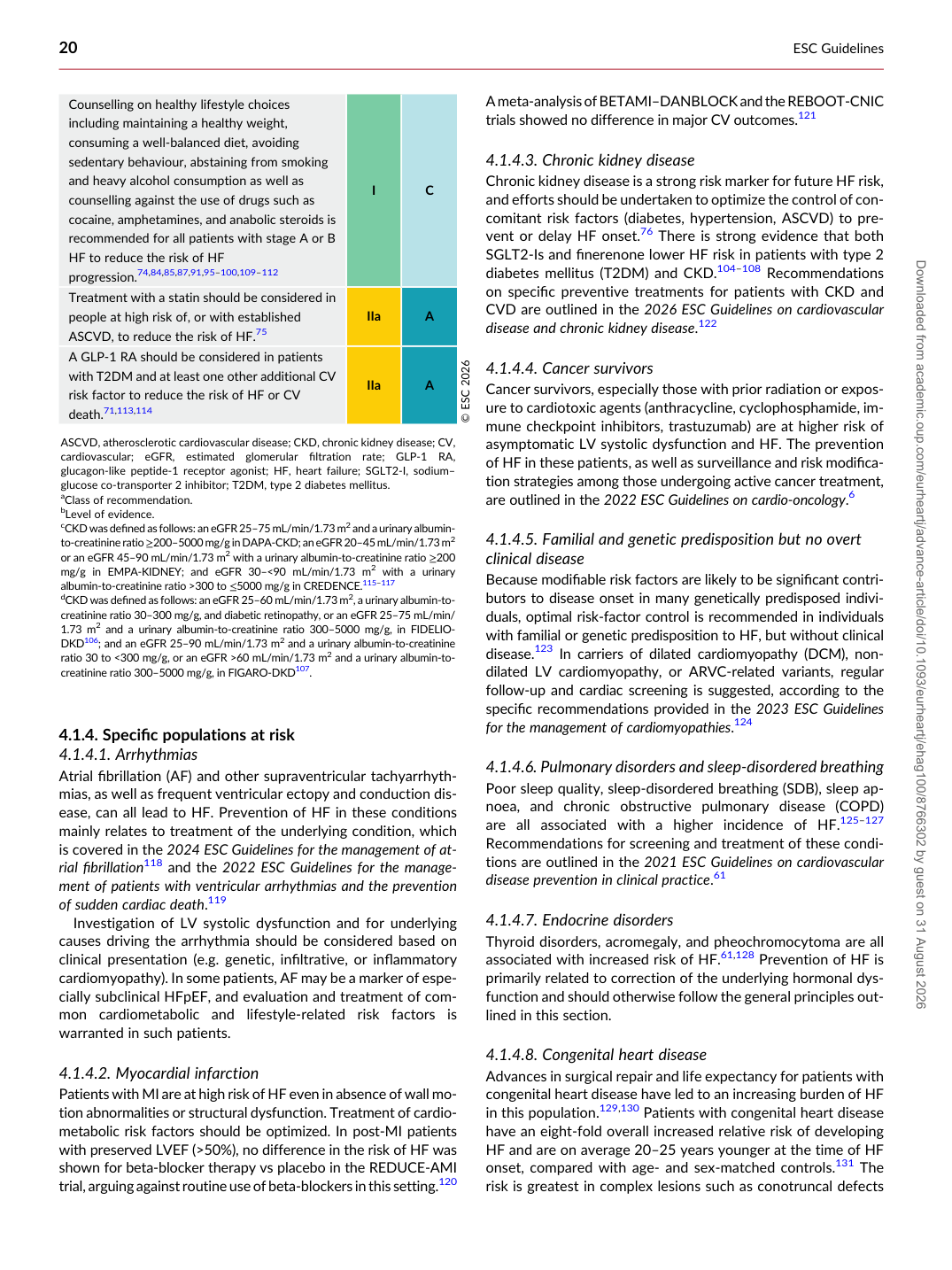
Counselling on healthy lifestyle choices including maintaining a healthy weight, consuming a well-balanced diet, avoiding sedentary behaviour, abstaining from smoking and heavy alcohol consumption as well as counselling against the use of drugs such as cocaine, amphetamines, and anabolic steroids is recommended for all patients with stage A or B HF to reduce the risk of HF progression.74,84,85,87,91,95–100,109–112 I C Treatment with a statin should be considered in people at high risk of, or with established ASCVD, to reduce the risk of HF.75 IIa A A GLP-1 RA should be considered in patients with T2DM and at least one other additional CV risk factor to reduce the risk of HF or CV death.71,113,114 IIa A © ESC 2026 ASCVD, atherosclerotic cardiovascular disease; CKD, chronic kidney disease; CV, cardiovascular; eGFR, estimated glomerular filtration rate; GLP-1 RA, glucagon-like peptide-1 receptor agonist; HF, heart failure; SGLT2-I, sodium– glucose co-transporter 2 inhibitor; T2DM, type 2 diabetes mellitus. aClass of recommendation. bLevel of evidence. cCKD was defined as follows: an eGFR 25–75 mL/min/1.73 m2 and a urinary albuminto-creatinine ratio ≥200–5000 mg/g in DAPA-CKD; an eGFR 20–45 mL/min/1.73 m2 or an eGFR 45–90 mL/min/1.73 m2 with a urinary albumin-to-creatinine ratio ≥200 mg/g in EMPA-KIDNEY; and eGFR 30–<90 mL/min/1.73 m2 with a urinary albumin-to-creatinine ratio >300 to ≤5000 mg/g in CREDENCE.115–117 dCKD was defined as follows: an eGFR 25–60 mL/min/1.73 m2, a urinary albumin-tocreatinine ratio 30–300 mg/g, and diabetic retinopathy, or an eGFR 25–75 mL/min/ 1.73 m2 and a urinary albumin-to-creatinine ratio 300–5000 mg/g, in FIDELIO- DKD106; and an eGFR 25–90 mL/min/1.73 m2 and a urinary albumin-to-creatinine ratio 30 to <300 mg/g, or an eGFR >60 mL/min/1.73 m2 and a urinary albumin-tocreatinine ratio 300–5000 mg/g, in FIGARO-DKD107. Downloaded from academic.oup.com/eurheartj/advance-article/doi/10.1093/eurheartj/ehag100/8766302 by guest on 31 August 2026