p.19 抽出テキスト
4 Prevention of heart failure

4.1 Patients at risk of heart failure (stage A

heart failure) 4.1.1. Cardiometabolic risk factors Diabetes, hypertension, obesity, and smoking account for approximately 50% of all HF events on a population-based level, ranging from 30%–40% among the oldest individuals (over 75 years) to 75%–80% among individuals aged <55 years, and are similar for HFpEF and HFrEF.50–52 These risk factors often cluster within the same individuals and tend to be stable over the life course unless intervened upon.53–56 Unhealthy lifestyle changes have led to a rising incidence and prevalence of obesity, hypertension, and type 2 diabetes over the past decades in many regions across Europe, particularly among young to middle-aged adults.57–59 Concomitantly, increases have been observed in the incidence rates of HF among young adults, underscoring the need for earlier and better prevention strategies on a population-based level.16,19,20 As the risk of HF is related to both risk-factor burden (intensity) and risk-factor duration (exposure time), early risk-factor management should be considered for younger people with longer anticipated exposure time. Personalized HF risk estimations (see Section 4.1.2) may aid clinicians and patients in discussions, management, and treatment decisions. Specific recommendations on the management of obesity, hypertension, and diabetes are outlined in the ESC guidelines on prevention of CV disease (CVD), hypertension, and diabetes, respectively.60–62 For hypertension, most evidence supports targeting a blood pressure <130 mmHg to reduce HF risk, although there are likely additional benefits of achieving lower treatment targets if tolerated.63–69 For diabetes, glucose-lowering drugs without proven HF safety should be avoided,70 and among those at particular risk of HF [especially in the presence of atherosclerotic CVD (ASCVD)], SGLT2-Is and GLP-1 RAs have been shown to lower risk of HFH and CV death.71–73 For obesity, declines in fat mass and waist circumference, but not lean mass, lowers HF risk and should be targeted.74 High cholesterol levels increase the risk of HF mainly through CAD, and the use of statins has shown to modestly lower HF events in people at high risk of ASCVD and HF.75,76

4.1.2 Risk scores for individuals without heart

failure To assist in more individualized HF risk estimation, the use of risk scores may be considered. In addition to risk scores to predict HFH and mortality among ambulatory patients with established HF77–80 several risk scores for primary HF prevention have been developed81–83. The American Heart Association (AHA) PREVENT-HF risk score81 and the ESC SCORE2-HF82 were both derived to estimate risk in people without pre-existing HF over a 10-and 30-year horizon. The ESC risk scores have been calibrated for low-, moderate-, high-, and very high-risk countries to fit the European population. The ESC SMART2-HF risk score83 was derived to estimate 10-year risk of HF in people with pre-existing ASCVD. These risk scores are described in Supplementary data online, Section S1 and Figure S1.

4.1.3 Lifestyle-related factors

4.1.3.1. Diet and physical activity Epidemiological studies have shown that diets high in sugars, saturated fats, refined grains, and processed food are associated with increased HF risk (especially HFpEF).84–90 In contrast, adherence to a diet rich in vegetables, nuts, whole grains, fish, and unsaturated fats have been associated with lowered HF risk.84,87 However, a secondary analysis of the PREDIMED trial comparing a Mediterranean diet (with olive oil vs nuts) to a lowfat diet in individuals at high risk of CVD did not show a significant difference in HF incidence between the groups over a median follow-up of 4.8 years.89 Similarly, sedentary behaviour and physical inactivity are strong risk factors for especially HFpEF development60,91, but no randomized controlled trials (RCTs) have investigated the role of physical activity for the prevention of HF.91–93 Recommendations on exercise type and intensity to promote general CV health are outlined in the 2020 ESC Guidelines on sports cardiology and exercise in patients with cardiovascular disease.94

4.1.3.2 Smoking, alcohol, and substance abuse

Smoking cessation has been shown to reduce HF risk over time in epidemiological studies and should be encouraged in all individuals.95–97 Similarly, heavy alcohol use is associated with increased risk of HF and is discouraged, whereas light-to-moderate intake has shown more mixed data with regard to HF risk.98 Any form of substance abuse, recreational or continuous, with drugs such as cocaine, amphetamine, and anabolic steroids is associated with increased risk of cardiomyopathy and HF.99–101 If use is suspected, this should be addressed with the patient and advised against.

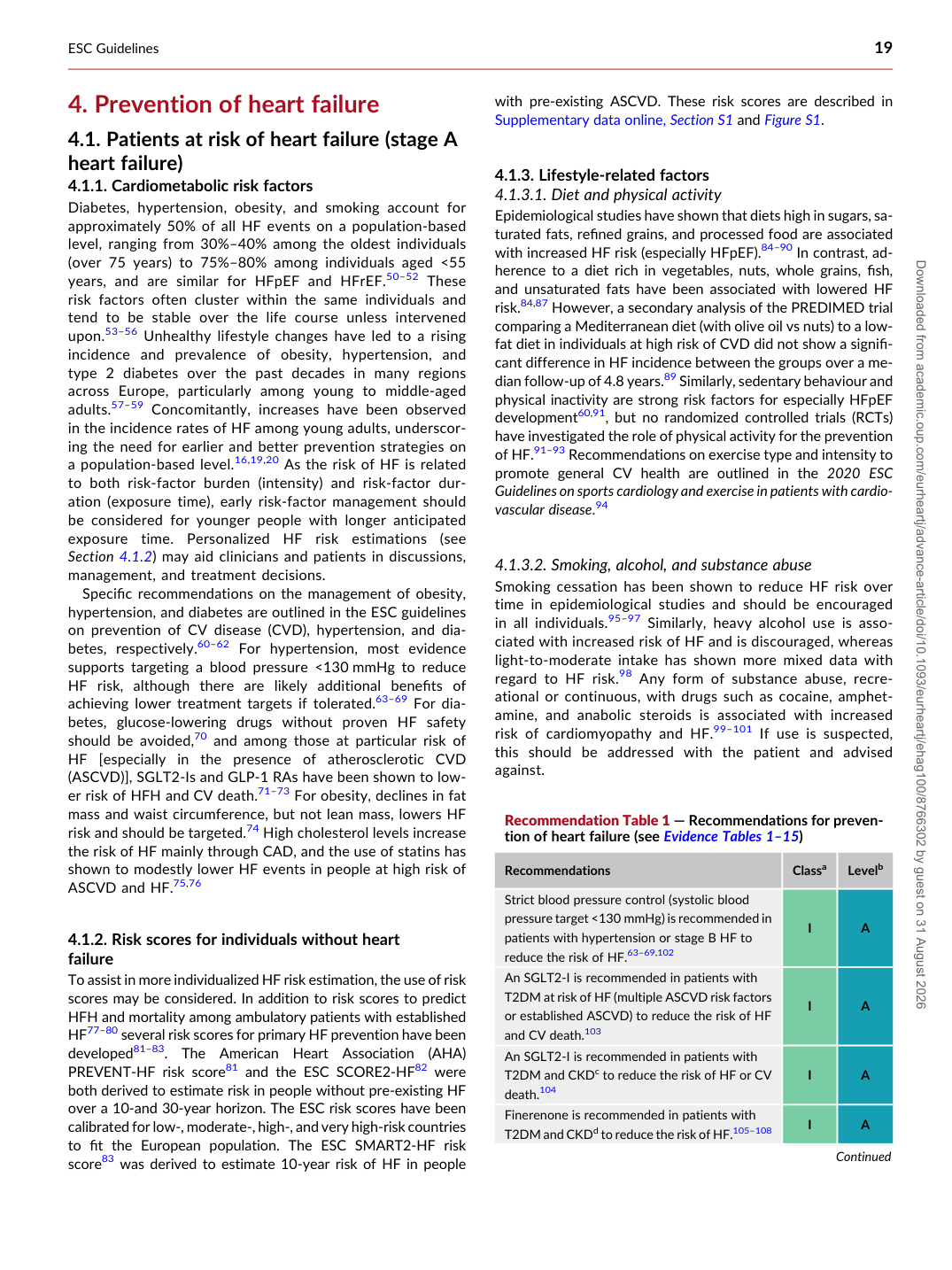
Recommendation Table 1 — Recommendations for prevention of heart failure (see Evidence Tables 1–15)

Recommendations Classa Levelb Strict blood pressure control (systolic blood pressure target <130 mmHg) is recommended in patients with hypertension or stage B HF to reduce the risk of HF.63–69,102 I A An SGLT2-I is recommended in patients with T2DM at risk of HF (multiple ASCVD risk factors or established ASCVD) to reduce the risk of HF and CV death.103 I A An SGLT2-I is recommended in patients with T2DM and CKDc to reduce the risk of HF or CV death.104 I A Finerenone is recommended in patients with T2DM and CKDd to reduce the risk of HF.105–108 I A

Continued Downloaded from academic.oup.com/eurheartj/advance-article/doi/10.1093/eurheartj/ehag100/8766302 by guest on 31 August 2026