p.15 抽出テキスト
3 Definition, epidemiology, and

classifications

3.1 Definition of heart failure

Heart failure is a clinical syndrome comprising signs and/or symptoms caused by structural and/or functional abnormalities of the heart that result in elevated intracardiac pressures and/or inadequate cardiac output at rest and/or during exercise.11 In addition to the subjective symptoms of HF, clinically assessed objective evidence of cardiogenic pulmonary and/or systemic congestion and diagnostic supportive tests are needed to reach the diagnosis (see Section 5).11 People who are in asymptomatic stages are not included under the above definition as having HF. They are defined as being at risk for HF (stage A) or having pre-HF (stage B) (see Section 3.3).

Identification of the aetiology of the underlying cardiac dysfunction is not included in the definition of HF, although determining aetiology is clinically important as the specific pathology can determine subsequent treatment and prognosis. Specific investigations needed to identify underlying aetiologies are described in Section 5.

3.2 Epidemiology of heart failure

The prevalence of HF is estimated to be 1%–3% in the general adult population, with significant geographical, age- and sex-related

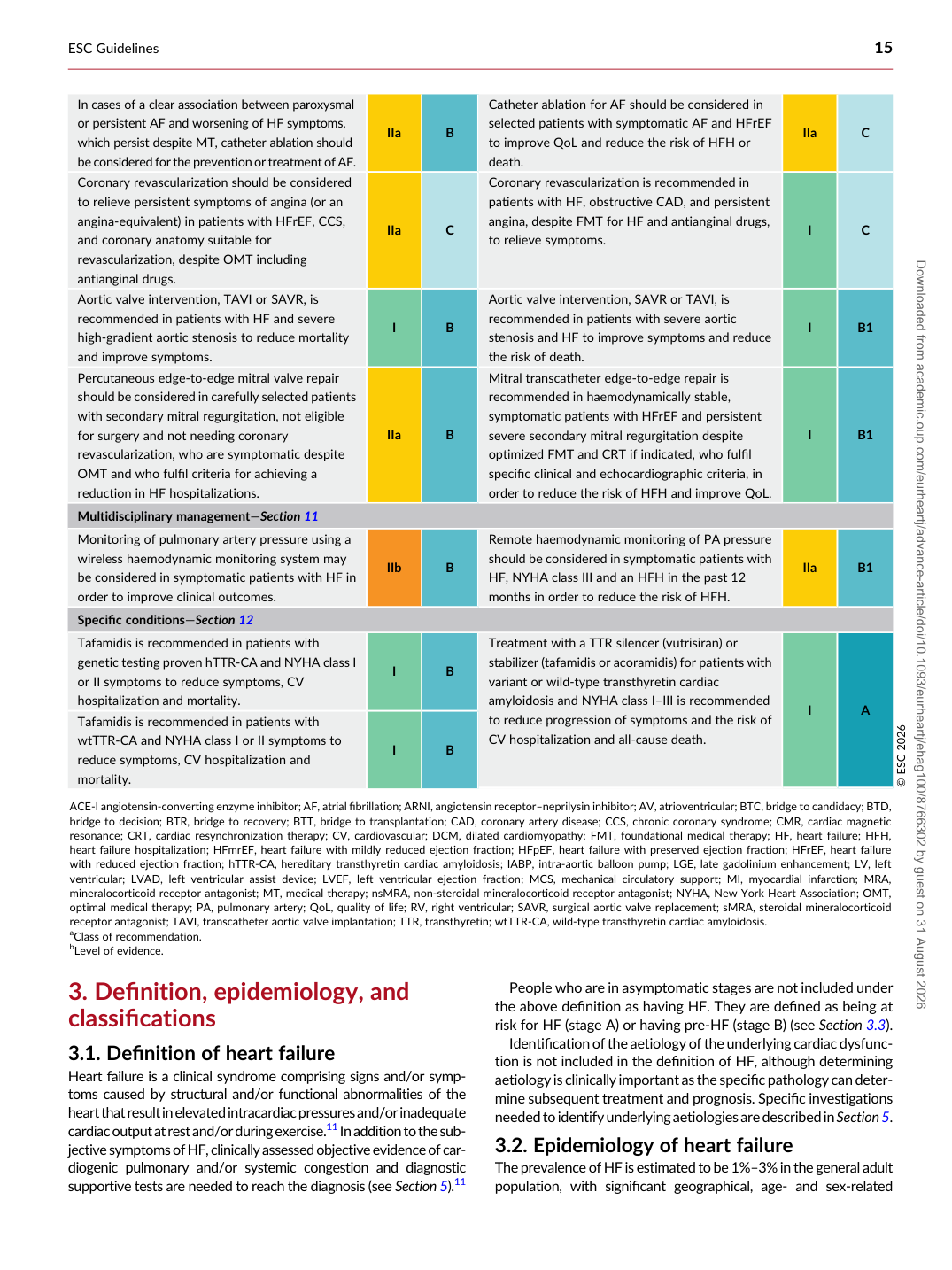
In cases of a clear association between paroxysmal or persistent AF and worsening of HF symptoms, which persist despite MT, catheter ablation should be considered for the prevention or treatment of AF. IIa B Catheter ablation for AF should be considered in

selected patients with symptomatic AF and HFrEF to improve QoL and reduce the risk of HFH or death. IIa C

Coronary revascularization should be considered to relieve persistent symptoms of angina (or an angina-equivalent) in patients with HFrEF, CCS, and coronary anatomy suitable for revascularization, despite OMT including antianginal drugs. IIa C Coronary revascularization is recommended in patients with HF, obstructive CAD, and persistent

angina, despite FMT for HF and antianginal drugs, to relieve symptoms. I C

Aortic valve intervention, TAVI or SAVR, is recommended in patients with HF and severe high-gradient aortic stenosis to reduce mortality and improve symptoms. I B Aortic valve intervention, SAVR or TAVI, is

recommended in patients with severe aortic stenosis and HF to improve symptoms and reduce the risk of death. I B1

Percutaneous edge-to-edge mitral valve repair should be considered in carefully selected patients with secondary mitral regurgitation, not eligible for surgery and not needing coronary revascularization, who are symptomatic despite OMT and who fulfil criteria for achieving a reduction in HF hospitalizations. IIa B Mitral transcatheter edge-to-edge repair is recommended in haemodynamically stable,

symptomatic patients with HFrEF and persistent severe secondary mitral regurgitation despite optimized FMT and CRT if indicated, who fulfil specific clinical and echocardiographic criteria, in order to reduce the risk of HFH and improve QoL. I B1

Multidisciplinary management—Section 11 Monitoring of pulmonary artery pressure using a wireless haemodynamic monitoring system may be considered in symptomatic patients with HF in order to improve clinical outcomes. IIb B Remote haemodynamic monitoring of PA pressure

should be considered in symptomatic patients with HF, NYHA class III and an HFH in the past 12 months in order to reduce the risk of HFH. IIa B1

Specific conditions—Section 12 Tafamidis is recommended in patients with genetic testing proven hTTR-CA and NYHA class I or II symptoms to reduce symptoms, CV hospitalization and mortality. I B Treatment with a TTR silencer (vutrisiran) or stabilizer (tafamidis or acoramidis) for patients with

variant or wild-type transthyretin cardiac amyloidosis and NYHA class I–III is recommended to reduce progression of symptoms and the risk of CV hospitalization and all-cause death.

I A Tafamidis is recommended in patients with wtTTR-CA and NYHA class I or II symptoms to reduce symptoms, CV hospitalization and mortality. I B © ESC 2026 ACE-I angiotensin-converting enzyme inhibitor; AF, atrial fibrillation; ARNI, angiotensin receptor–neprilysin inhibitor; AV, atrioventricular; BTC, bridge to candidacy; BTD, bridge to decision; BTR, bridge to recovery; BTT, bridge to transplantation; CAD, coronary artery disease; CCS, chronic coronary syndrome; CMR, cardiac magnetic resonance; CRT, cardiac resynchronization therapy; CV, cardiovascular; DCM, dilated cardiomyopathy; FMT, foundational medical therapy; HF, heart failure; HFH, heart failure hospitalization; HFmrEF, heart failure with mildly reduced ejection fraction; HFpEF, heart failure with preserved ejection fraction; HFrEF, heart failure with reduced ejection fraction; hTTR-CA, hereditary transthyretin cardiac amyloidosis; IABP, intra-aortic balloon pump; LGE, late gadolinium enhancement; LV, left ventricular; LVAD, left ventricular assist device; LVEF, left ventricular ejection fraction; MCS, mechanical circulatory support; MI, myocardial infarction; MRA, mineralocorticoid receptor antagonist; MT, medical therapy; nsMRA, non-steroidal mineralocorticoid receptor antagonist; NYHA, New York Heart Association; OMT, optimal medical therapy; PA, pulmonary artery; QoL, quality of life; RV, right ventricular; SAVR, surgical aortic valve replacement; sMRA, steroidal mineralocorticoid receptor antagonist; TAVI, transcatheter aortic valve implantation; TTR, transthyretin; wtTTR-CA, wild-type transthyretin cardiac amyloidosis. aClass of recommendation. bLevel of evidence. Downloaded from academic.oup.com/eurheartj/advance-article/doi/10.1093/eurheartj/ehag100/8766302 by guest on 31 August 2026