p.14 抽出テキスト
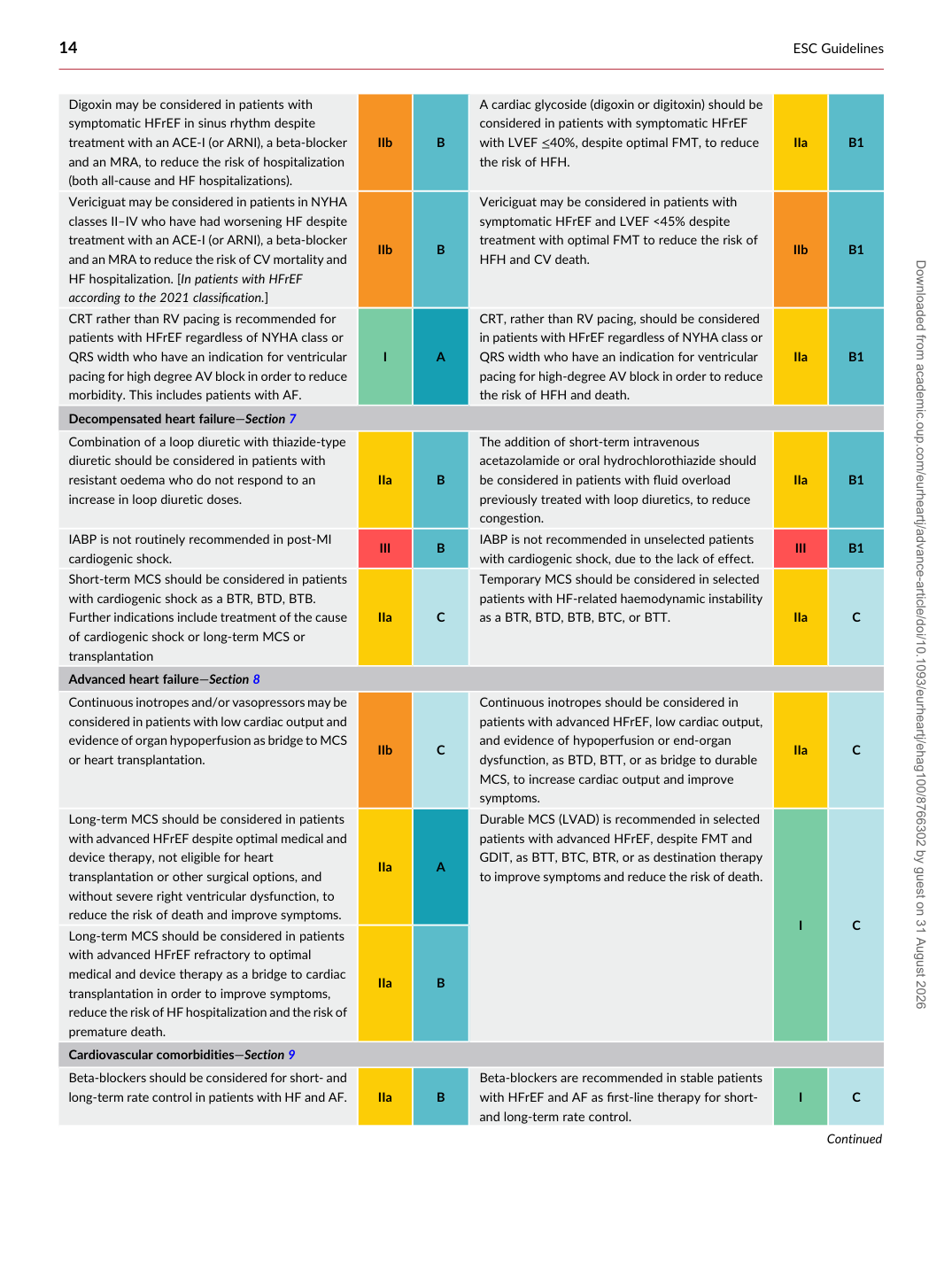
Digoxin may be considered in patients with symptomatic HFrEF in sinus rhythm despite treatment with an ACE-I (or ARNI), a beta-blocker and an MRA, to reduce the risk of hospitalization (both all-cause and HF hospitalizations). IIb B A cardiac glycoside (digoxin or digitoxin) should be

considered in patients with symptomatic HFrEF with LVEF ≤40%, despite optimal FMT, to reduce the risk of HFH. IIa B1

Vericiguat may be considered in patients in NYHA classes II–IV who have had worsening HF despite treatment with an ACE-I (or ARNI), a beta-blocker and an MRA to reduce the risk of CV mortality and HF hospitalization. [In patients with HFrEF according to the 2021 classification.] IIb B Vericiguat may be considered in patients with

symptomatic HFrEF and LVEF <45% despite treatment with optimal FMT to reduce the risk of HFH and CV death. IIb B1

CRT rather than RV pacing is recommended for patients with HFrEF regardless of NYHA class or QRS width who have an indication for ventricular pacing for high degree AV block in order to reduce morbidity. This includes patients with AF. I A CRT, rather than RV pacing, should be considered

in patients with HFrEF regardless of NYHA class or QRS width who have an indication for ventricular pacing for high-degree AV block in order to reduce the risk of HFH and death. IIa B1

Decompensated heart failure—Section 7 Combination of a loop diuretic with thiazide-type diuretic should be considered in patients with resistant oedema who do not respond to an increase in loop diuretic doses. IIa B The addition of short-term intravenous

acetazolamide or oral hydrochlorothiazide should be considered in patients with fluid overload previously treated with loop diuretics, to reduce congestion. IIa B1

IABP is not routinely recommended in post-MI

cardiogenic shock. III B IABP is not recommended in unselected patients

with cardiogenic shock, due to the lack of effect. III B1

Short-term MCS should be considered in patients with cardiogenic shock as a BTR, BTD, BTB. Further indications include treatment of the cause of cardiogenic shock or long-term MCS or transplantation IIa C Temporary MCS should be considered in selected

patients with HF-related haemodynamic instability as a BTR, BTD, BTB, BTC, or BTT. IIa C

Advanced heart failure—Section 8 Continuous inotropes and/or vasopressors may be considered in patients with low cardiac output and evidence of organ hypoperfusion as bridge to MCS or heart transplantation. IIb C Continuous inotropes should be considered in

patients with advanced HFrEF, low cardiac output, and evidence of hypoperfusion or end-organ dysfunction, as BTD, BTT, or as bridge to durable MCS, to increase cardiac output and improve symptoms. IIa C

Long-term MCS should be considered in patients with advanced HFrEF despite optimal medical and device therapy, not eligible for heart transplantation or other surgical options, and without severe right ventricular dysfunction, to reduce the risk of death and improve symptoms. IIa A Durable MCS (LVAD) is recommended in selected

patients with advanced HFrEF, despite FMT and GDIT, as BTT, BTC, BTR, or as destination therapy to improve symptoms and reduce the risk of death.

I C Long-term MCS should be considered in patients with advanced HFrEF refractory to optimal medical and device therapy as a bridge to cardiac transplantation in order to improve symptoms, reduce the risk of HF hospitalization and the risk of premature death. IIa B Cardiovascular comorbidities—Section 9 Beta-blockers should be considered for short- and long-term rate control in patients with HF and AF. IIa B Beta-blockers are recommended in stable patients

with HFrEF and AF as first-line therapy for shortand long-term rate control. I C

Continued Downloaded from academic.oup.com/eurheartj/advance-article/doi/10.1093/eurheartj/ehag100/8766302 by guest on 31 August 2026