p.9 抽出テキスト
VHD and do not deal in detail with overlapping cardiovascular diseases such as infective endocarditis,5 chronic coronary syndrome,6 and atrial fibrillation (AF),7 as well as all scenarios of aortic or congenital disease,8,9 because these topics are covered in separate Guidelines. The 2025 ESC/EACTS Guidelines for the management of valvular heart disease aim to be concise, focused on relevant issues for clinicians and patients, and to provide clear and simple practical recommendations, assisting healthcare providers in their daily clinical decision-making. A compilation of the evidence considered for new recommendations, or those with an updated class of recommendation or level of evidence, can be consulted online (see Supplementary data online, Evidence Tables). The Task Force for these Guidelines acknowledges that multiple factors influence and ultimately determine the most appropriate treatment of individual patients within a given community. These factors include the availability of equipment and technology, and the expertise and volumes, in complex procedures, such as valve repair or transcatheter interventions. Moreover, given the lack of evidence on some topics related to VHD, several recommendations are the result of expert consensus opinion. Therefore, deviations from these Guidelines may be appropriate in certain clinical circumstances, and decision-making should always be based on a collaborative, multidisciplinary Heart Team approach centred on individual characteristics, needs, and prognosis, as well as the preferences of the informed patient.

2.1 What is new

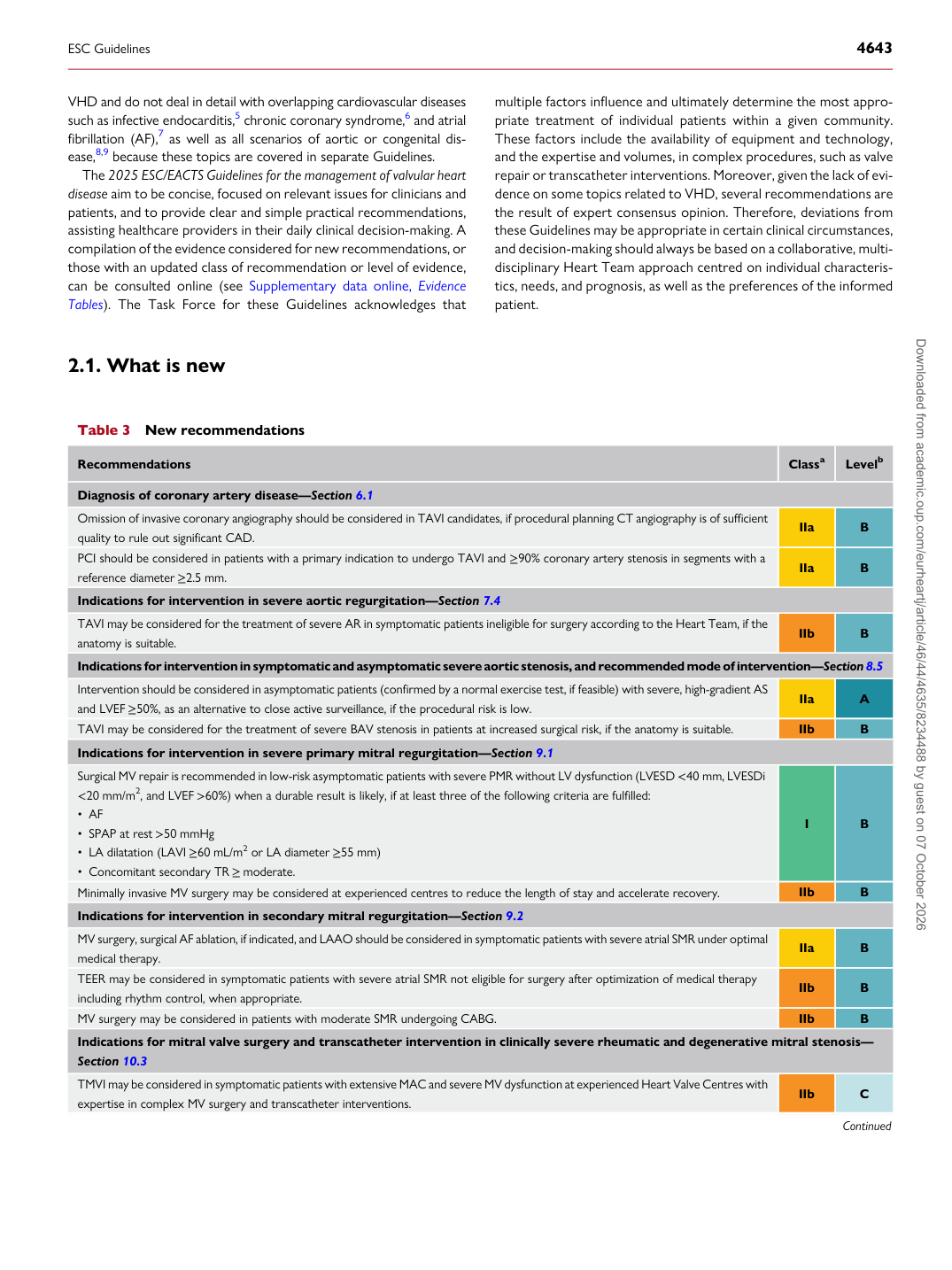
Table 3 New recommendations

Recommendations Classa Levelb

Diagnosis of coronary artery disease—Section 6.1 Omission of invasive coronary angiography should be considered in TAVI candidates, if procedural planning CT angiography is of sufficient quality to rule out significant CAD. IIa B PCI should be considered in patients with a primary indication to undergo TAVI and ≥90% coronary artery stenosis in segments with a reference diameter ≥2.5 mm. IIa B Indications for intervention in severe aortic regurgitation—Section 7.4 TAVI may be considered for the treatment of severe AR in symptomatic patients ineligible for surgery according to the Heart Team, if the anatomy is suitable. IIb B Indications for intervention in symptomatic and asymptomatic severe aortic stenosis, and recommended mode of intervention—Section 8.5 Intervention should be considered in asymptomatic patients (confirmed by a normal exercise test, if feasible) with severe, high-gradient AS and LVEF ≥50%, as an alternative to close active surveillance, if the procedural risk is low. IIa A TAVI may be considered for the treatment of severe BAV stenosis in patients at increased surgical risk, if the anatomy is suitable. IIb B Indications for intervention in severe primary mitral regurgitation—Section 9.1 Surgical MV repair is recommended in low-risk asymptomatic patients with severe PMR without LV dysfunction (LVESD <40 mm, LVESDi <20 mm/m2, and LVEF >60%) when a durable result is likely, if at least three of the following criteria are fulfilled: • AF • SPAP at rest >50 mmHg • LA dilatation (LAVI ≥60 mL/m2 or LA diameter ≥55 mm) • Concomitant secondary TR ≥ moderate. I B Minimally invasive MV surgery may be considered at experienced centres to reduce the length of stay and accelerate recovery. IIb B Indications for intervention in secondary mitral regurgitation—Section 9.2 MV surgery, surgical AF ablation, if indicated, and LAAO should be considered in symptomatic patients with severe atrial SMR under optimal medical therapy. IIa B TEER may be considered in symptomatic patients with severe atrial SMR not eligible for surgery after optimization of medical therapy including rhythm control, when appropriate. IIb B MV surgery may be considered in patients with moderate SMR undergoing CABG. IIb B Indications for mitral valve surgery and transcatheter intervention in clinically severe rheumatic and degenerative mitral stenosis— Section 10.3 TMVI may be considered in symptomatic patients with extensive MAC and severe MV dysfunction at experienced Heart Valve Centres with expertise in complex MV surgery and transcatheter interventions. IIb C

Continued

ESC Guidelines                                                                                                                                                                                          4643

Downloaded from academic.oup.com/eurheartj/article/46/44/4635/8234488 by guest on 07 October 2026