p.73 抽出テキスト
Pregnancy • More data are required on optimal management of anticoagulation in pregnant women with MHVs. Prospective studies comparing different antithrombotic regimens are lacking.

Non-cardiac surgery • Clinical utility of scales for peri-operative risk evaluation needs to be determined.

Sex-specific considerations • The development of sex-adjusted surgical risk prediction tools is required. • Additional data are needed to validate sex-specific cut-offs indicating interventions. • Further research is needed to investigate sex-related differences in the prognosis and treatment of specific valve diseases, especially TR.

20. ‘What to do’ and ‘What not to do’ messages from the Guidelines

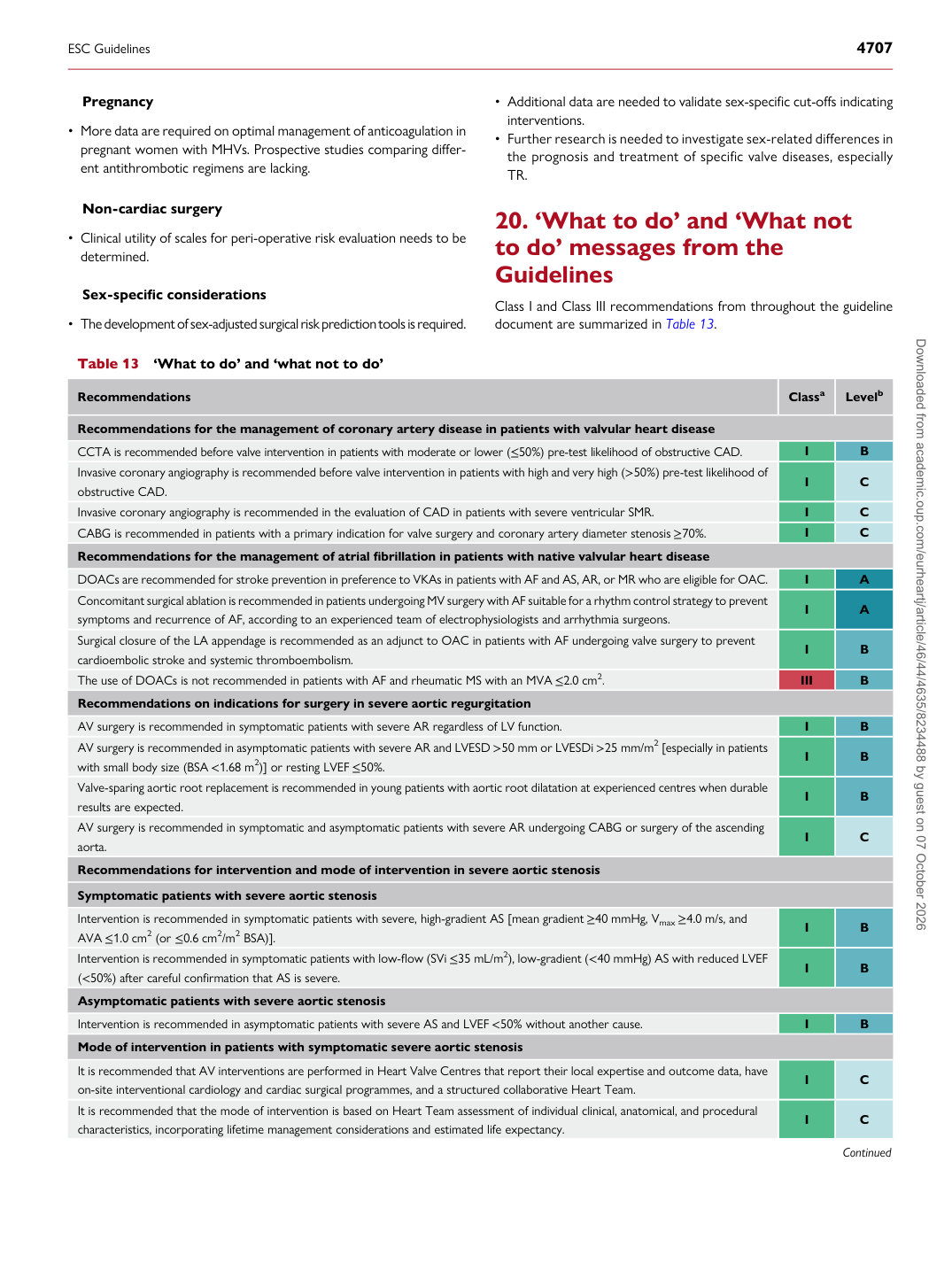
Class I and Class III recommendations from throughout the guideline document are summarized in Table 13.

Table 13 ‘What to do’ and ‘what not to do’

Recommendations Classa Levelb

Recommendations for the management of coronary artery disease in patients with valvular heart disease CCTA is recommended before valve intervention in patients with moderate or lower (≤50%) pre-test likelihood of obstructive CAD. I B Invasive coronary angiography is recommended before valve intervention in patients with high and very high (>50%) pre-test likelihood of obstructive CAD. I C Invasive coronary angiography is recommended in the evaluation of CAD in patients with severe ventricular SMR. I C CABG is recommended in patients with a primary indication for valve surgery and coronary artery diameter stenosis ≥70%. I C Recommendations for the management of atrial fibrillation in patients with native valvular heart disease DOACs are recommended for stroke prevention in preference to VKAs in patients with AF and AS, AR, or MR who are eligible for OAC. I A Concomitant surgical ablation is recommended in patients undergoing MV surgery with AF suitable for a rhythm control strategy to prevent symptoms and recurrence of AF, according to an experienced team of electrophysiologists and arrhythmia surgeons. I A Surgical closure of the LA appendage is recommended as an adjunct to OAC in patients with AF undergoing valve surgery to prevent cardioembolic stroke and systemic thromboembolism. I B The use of DOACs is not recommended in patients with AF and rheumatic MS with an MVA ≤2.0 cm2. III B Recommendations on indications for surgery in severe aortic regurgitation AV surgery is recommended in symptomatic patients with severe AR regardless of LV function. I B AV surgery is recommended in asymptomatic patients with severe AR and LVESD >50 mm or LVESDi >25 mm/m2 [especially in patients with small body size (BSA <1.68 m2)] or resting LVEF ≤50%. I B Valve-sparing aortic root replacement is recommended in young patients with aortic root dilatation at experienced centres when durable results are expected. I B AV surgery is recommended in symptomatic and asymptomatic patients with severe AR undergoing CABG or surgery of the ascending aorta. I C Recommendations for intervention and mode of intervention in severe aortic stenosis Symptomatic patients with severe aortic stenosis Intervention is recommended in symptomatic patients with severe, high-gradient AS [mean gradient ≥40 mmHg, Vmax ≥4.0 m/s, and AVA ≤1.0 cm2 (or ≤0.6 cm2/m2 BSA)]. I B Intervention is recommended in symptomatic patients with low-flow (SVi ≤35 mL/m2), low-gradient (<40 mmHg) AS with reduced LVEF (<50%) after careful confirmation that AS is severe. I B Asymptomatic patients with severe aortic stenosis Intervention is recommended in asymptomatic patients with severe AS and LVEF <50% without another cause. I B Mode of intervention in patients with symptomatic severe aortic stenosis It is recommended that AV interventions are performed in Heart Valve Centres that report their local expertise and outcome data, have on-site interventional cardiology and cardiac surgical programmes, and a structured collaborative Heart Team. I C It is recommended that the mode of intervention is based on Heart Team assessment of individual clinical, anatomical, and procedural characteristics, incorporating lifetime management considerations and estimated life expectancy. I C

Continued

ESC Guidelines                                                                                                                                                                                          4707

Downloaded from academic.oup.com/eurheartj/article/46/44/4635/8234488 by guest on 07 October 2026