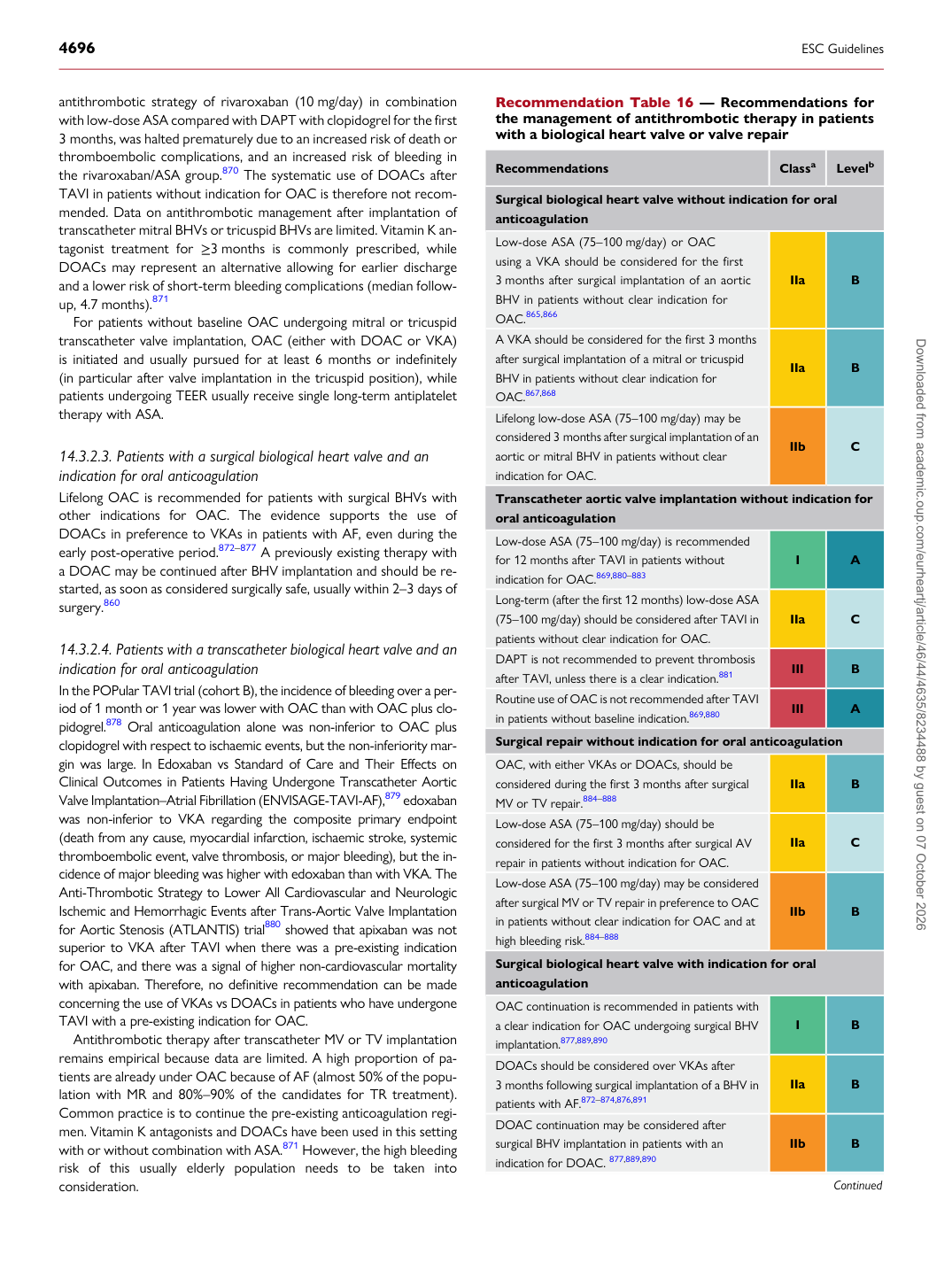
p.62 抽出テキスト
antithrombotic strategy of rivaroxaban (10 mg/day) in combination with low-dose ASA compared with DAPT with clopidogrel for the first 3 months, was halted prematurely due to an increased risk of death or thromboembolic complications, and an increased risk of bleeding in the rivaroxaban/ASA group.870 The systematic use of DOACs after TAVI in patients without indication for OAC is therefore not recommended. Data on antithrombotic management after implantation of transcatheter mitral BHVs or tricuspid BHVs are limited. Vitamin K antagonist treatment for ≥3 months is commonly prescribed, while DOACs may represent an alternative allowing for earlier discharge and a lower risk of short-term bleeding complications (median followup, 4.7 months).871 For patients without baseline OAC undergoing mitral or tricuspid transcatheter valve implantation, OAC (either with DOAC or VKA) is initiated and usually pursued for at least 6 months or indefinitely (in particular after valve implantation in the tricuspid position), while patients undergoing TEER usually receive single long-term antiplatelet therapy with ASA.

14.3.2.3 Patients with a surgical biological heart valve and an

indication for oral anticoagulation Lifelong OAC is recommended for patients with surgical BHVs with other indications for OAC. The evidence supports the use of DOACs in preference to VKAs in patients with AF, even during the early post-operative period.872–877 A previously existing therapy with a DOAC may be continued after BHV implantation and should be restarted, as soon as considered surgically safe, usually within 2–3 days of surgery.860

14.3.2.4 Patients with a transcatheter biological heart valve and an

indication for oral anticoagulation In the POPular TAVI trial (cohort B), the incidence of bleeding over a period of 1 month or 1 year was lower with OAC than with OAC plus clopidogrel.878 Oral anticoagulation alone was non-inferior to OAC plus clopidogrel with respect to ischaemic events, but the non-inferiority margin was large. In Edoxaban vs Standard of Care and Their Effects on Clinical Outcomes in Patients Having Undergone Transcatheter Aortic Valve Implantation–Atrial Fibrillation (ENVISAGE-TAVI-AF),879 edoxaban was non-inferior to VKA regarding the composite primary endpoint (death from any cause, myocardial infarction, ischaemic stroke, systemic thromboembolic event, valve thrombosis, or major bleeding), but the incidence of major bleeding was higher with edoxaban than with VKA. The Anti-Thrombotic Strategy to Lower All Cardiovascular and Neurologic Ischemic and Hemorrhagic Events after Trans-Aortic Valve Implantation for Aortic Stenosis (ATLANTIS) trial880 showed that apixaban was not superior to VKA after TAVI when there was a pre-existing indication for OAC, and there was a signal of higher non-cardiovascular mortality with apixaban. Therefore, no definitive recommendation can be made concerning the use of VKAs vs DOACs in patients who have undergone TAVI with a pre-existing indication for OAC. Antithrombotic therapy after transcatheter MV or TV implantation remains empirical because data are limited. A high proportion of patients are already under OAC because of AF (almost 50% of the population with MR and 80%–90% of the candidates for TR treatment). Common practice is to continue the pre-existing anticoagulation regimen. Vitamin K antagonists and DOACs have been used in this setting with or without combination with ASA.871 However, the high bleeding risk of this usually elderly population needs to be taken into consideration. Recommendation Table 16 — Recommendations for the management of antithrombotic therapy in patients with a biological heart valve or valve repair

Recommendations Classa Levelb

Surgical biological heart valve without indication for oral anticoagulation Low-dose ASA (75–100 mg/day) or OAC using a VKA should be considered for the first 3 months after surgical implantation of an aortic BHV in patients without clear indication for OAC.865,866 IIa B A VKA should be considered for the first 3 months after surgical implantation of a mitral or tricuspid BHV in patients without clear indication for OAC.867,868 IIa B Lifelong low-dose ASA (75–100 mg/day) may be considered 3 months after surgical implantation of an aortic or mitral BHV in patients without clear indication for OAC. IIb C Transcatheter aortic valve implantation without indication for oral anticoagulation Low-dose ASA (75–100 mg/day) is recommended for 12 months after TAVI in patients without indication for OAC.869,880–883 I A Long-term (after the first 12 months) low-dose ASA (75–100 mg/day) should be considered after TAVI in patients without clear indication for OAC. IIa C DAPT is not recommended to prevent thrombosis after TAVI, unless there is a clear indication.881 III B Routine use of OAC is not recommended after TAVI in patients without baseline indication.869,880 III A Surgical repair without indication for oral anticoagulation OAC, with either VKAs or DOACs, should be considered during the first 3 months after surgical MV or TV repair.884–888 IIa B Low-dose ASA (75–100 mg/day) should be considered for the first 3 months after surgical AV repair in patients without indication for OAC. IIa C Low-dose ASA (75–100 mg/day) may be considered after surgical MV or TV repair in preference to OAC in patients without clear indication for OAC and at high bleeding risk.884–888 IIb B Surgical biological heart valve with indication for oral anticoagulation OAC continuation is recommended in patients with a clear indication for OAC undergoing surgical BHV implantation.877,889,890 I B DOACs should be considered over VKAs after 3 months following surgical implantation of a BHV in patients with AF.872–874,876,891 IIa B DOAC continuation may be considered after surgical BHV implantation in patients with an indication for DOAC. 877,889,890 IIb B

Continued Downloaded from academic.oup.com/eurheartj/article/46/44/4635/8234488 by guest on 07 October 2026