p.61 抽出テキスト
For patients with an MHV and low cardioembolic risk (e.g. a newgeneration MHV in the aortic position without additional risk factors) undergoing elective major NCS or invasive procedures, VKA interruption (3–4 days before surgery)816,857,858,861–864 and resumption861–863 within 24 h may be performed without bridging to reduce post-surgical bleeding without increasing the risk of thrombosis (see Figure 18).

14.3.2 Biological heart valves

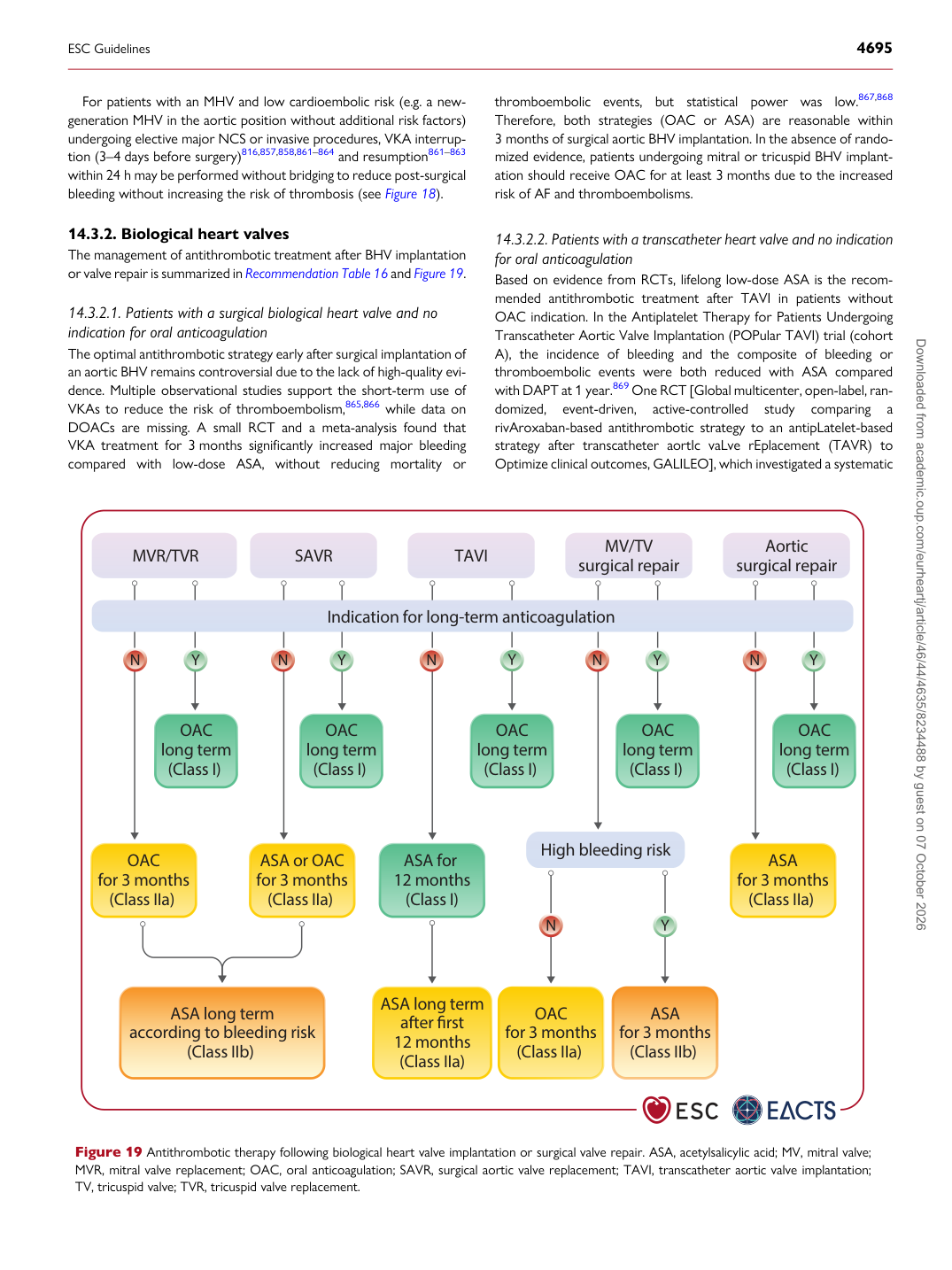
The management of antithrombotic treatment after BHV implantation or valve repair is summarized in Recommendation Table 16 and Figure 19.

14.3.2.1 Patients with a surgical biological heart valve and no

indication for oral anticoagulation The optimal antithrombotic strategy early after surgical implantation of an aortic BHV remains controversial due to the lack of high-quality evidence. Multiple observational studies support the short-term use of VKAs to reduce the risk of thromboembolism,865,866 while data on DOACs are missing. A small RCT and a meta-analysis found that VKA treatment for 3 months significantly increased major bleeding compared with low-dose ASA, without reducing mortality or thromboembolic events, but statistical power was low.867,868

Therefore, both strategies (OAC or ASA) are reasonable within 3 months of surgical aortic BHV implantation. In the absence of randomized evidence, patients undergoing mitral or tricuspid BHV implantation should receive OAC for at least 3 months due to the increased risk of AF and thromboembolisms.

14.3.2.2 Patients with a transcatheter heart valve and no indication

for oral anticoagulation Based on evidence from RCTs, lifelong low-dose ASA is the recommended antithrombotic treatment after TAVI in patients without OAC indication. In the Antiplatelet Therapy for Patients Undergoing Transcatheter Aortic Valve Implantation (POPular TAVI) trial (cohort A), the incidence of bleeding and the composite of bleeding or thromboembolic events were both reduced with ASA compared with DAPT at 1 year.869 One RCT [Global multicenter, open-label, randomized, event-driven, active-controlled study comparing a rivAroxaban-based antithrombotic strategy to an antipLatelet-based strategy after transcatheter aortIc vaLve rEplacement (TAVR) to Optimize clinical outcomes, GALILEO], which investigated a systematic

OAC for 3 months

(Class IIa) ASA for 3 months

(Class IIb)

MV/TV surgical repair

OAC long term

(Class I) OAC long term

(Class I)

ASA for 12 months (Class I) OAC long term

(Class I) OAC long term

(Class I) OAC long term

(Class I)

OAC for 3 months

(Class IIa)

ASA long term

after first 12 months (Class IIa)

ASA long term according to bleeding risk

(Class IIb) ASA or OAC for 3 months

(Class IIa) ASA for 3 months

(Class IIa)

TAVI SAVR MVR/TVR Aortic surgical repair

Indication for long-term anticoagulation

High bleeding risk

Figure 19 Antithrombotic therapy following biological heart valve implantation or surgical valve repair. ASA, acetylsalicylic acid; MV, mitral valve; MVR, mitral valve replacement; OAC, oral anticoagulation; SAVR, surgical aortic valve replacement; TAVI, transcatheter aortic valve implantation; TV, tricuspid valve; TVR, tricuspid valve replacement.

ESC Guidelines                                                                                                                                                                                          4695

Downloaded from academic.oup.com/eurheartj/article/46/44/4635/8234488 by guest on 07 October 2026