p.60 抽出テキスト
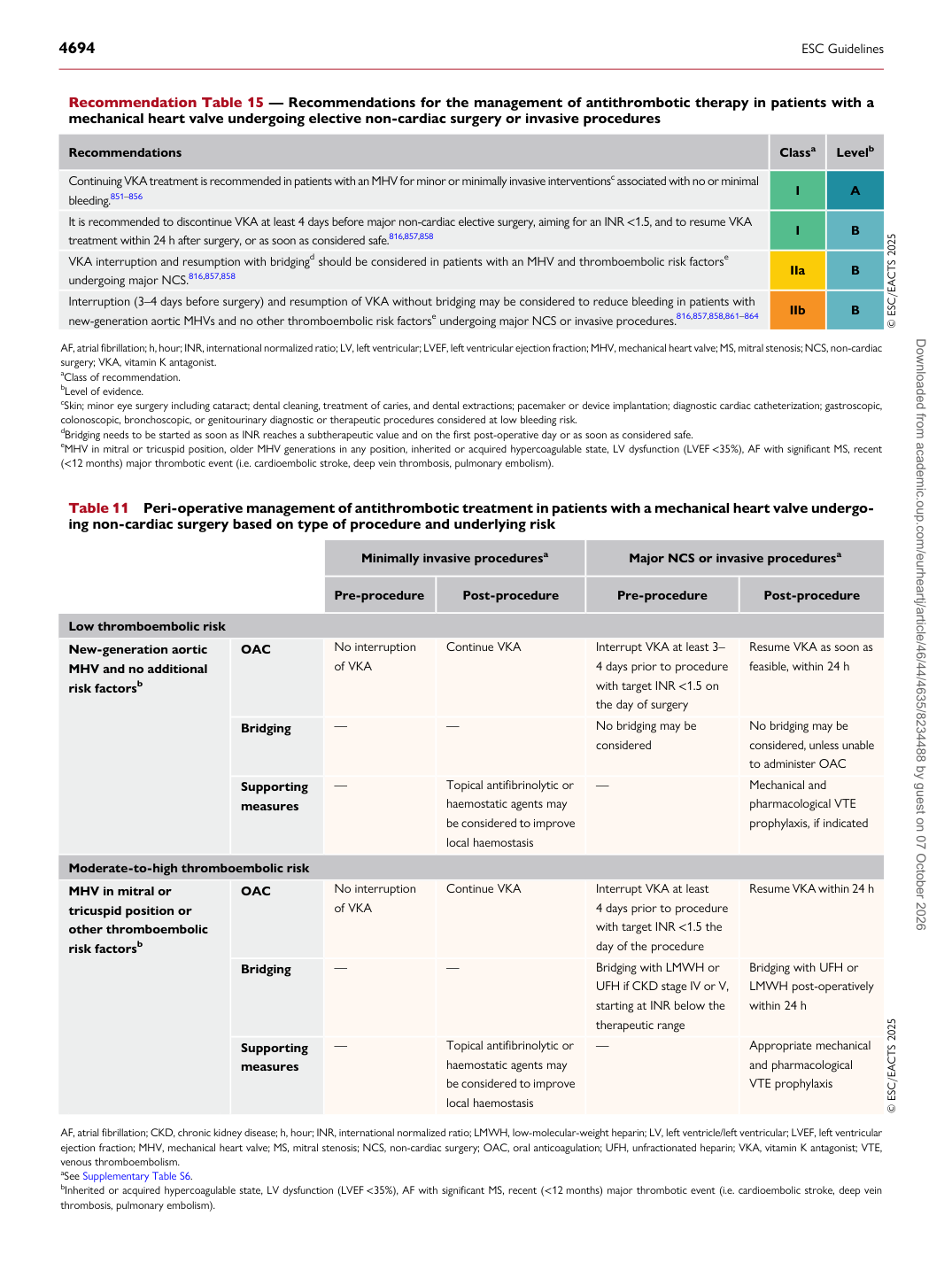
Recommendation Table 15 — Recommendations for the management of antithrombotic therapy in patients with a mechanical heart valve undergoing elective non-cardiac surgery or invasive procedures

Recommendations Classa Levelb Continuing VKA treatment is recommended in patients with an MHV for minor or minimally invasive interventionsc associated with no or minimal bleeding.851–856 I A It is recommended to discontinue VKA at least 4 days before major non-cardiac elective surgery, aiming for an INR <1.5, and to resume VKA treatment within 24 h after surgery, or as soon as considered safe.816,857,858 I B VKA interruption and resumption with bridgingd should be considered in patients with an MHV and thromboembolic risk factorse undergoing major NCS.816,857,858 IIa B Interruption (3–4 days before surgery) and resumption of VKA without bridging may be considered to reduce bleeding in patients with new-generation aortic MHVs and no other thromboembolic risk factorse undergoing major NCS or invasive procedures.816,857,858,861–864 IIb B © ESC/EACTS 2025

AF, atrial fibrillation; h, hour; INR, international normalized ratio; LV, left ventricular; LVEF, left ventricular ejection fraction; MHV, mechanical heart valve; MS, mitral stenosis; NCS, non-cardiac surgery; VKA, vitamin K antagonist. aClass of recommendation. bLevel of evidence. cSkin; minor eye surgery including cataract; dental cleaning, treatment of caries, and dental extractions; pacemaker or device implantation; diagnostic cardiac catheterization; gastroscopic, colonoscopic, bronchoscopic, or genitourinary diagnostic or therapeutic procedures considered at low bleeding risk. dBridging needs to be started as soon as INR reaches a subtherapeutic value and on the first post-operative day or as soon as considered safe. eMHV in mitral or tricuspid position, older MHV generations in any position, inherited or acquired hypercoagulable state, LV dysfunction (LVEF <35%), AF with significant MS, recent (<12 months) major thrombotic event (i.e. cardioembolic stroke, deep vein thrombosis, pulmonary embolism).

Table 11 Peri-operative management of antithrombotic treatment in patients with a mechanical heart valve undergoing non-cardiac surgery based on type of procedure and underlying risk

Minimally invasive proceduresa Major NCS or invasive proceduresa

Pre-procedure Post-procedure Pre-procedure Post-procedure

Low thromboembolic risk New-generation aortic MHV and no additional risk factorsb OAC No interruption

of VKA Continue VKA Interrupt VKA at least 3–

4 days prior to procedure with target INR <1.5 on the day of surgery Resume VKA as soon as

feasible, within 24 h

Bridging — — No bridging may be

considered No bridging may be

considered, unless unable to administer OAC

Supporting measures — Topical antifibrinolytic or

haemostatic agents may be considered to improve local haemostasis — Mechanical and

pharmacological VTE prophylaxis, if indicated

Moderate-to-high thromboembolic risk MHV in mitral or tricuspid position or other thromboembolic risk factorsb OAC No interruption

of VKA Continue VKA Interrupt VKA at least

4 days prior to procedure with target INR <1.5 the day of the procedure Resume VKA within 24 h

Bridging — — Bridging with LMWH or UFH if CKD stage IV or V,

starting at INR below the therapeutic range Bridging with UFH or LMWH post-operatively

within 24 h

Supporting measures — Topical antifibrinolytic or

haemostatic agents may be considered to improve local haemostasis — Appropriate mechanical

and pharmacological VTE prophylaxis © ESC/EACTS 2025

AF, atrial fibrillation; CKD, chronic kidney disease; h, hour; INR, international normalized ratio; LMWH, low-molecular-weight heparin; LV, left ventricle/left ventricular; LVEF, left ventricular ejection fraction; MHV, mechanical heart valve; MS, mitral stenosis; NCS, non-cardiac surgery; OAC, oral anticoagulation; UFH, unfractionated heparin; VKA, vitamin K antagonist; VTE, venous thromboembolism. aSee Supplementary Table S6. bInherited or acquired hypercoagulable state, LV dysfunction (LVEF <35%), AF with significant MS, recent (<12 months) major thrombotic event (i.e. cardioembolic stroke, deep vein thrombosis, pulmonary embolism). Downloaded from academic.oup.com/eurheartj/article/46/44/4635/8234488 by guest on 07 October 2026