p.59 抽出テキスト
14.3.1.2 Prevention and management of bleeding

Since patients with MHVs receive lifelong VKA, strategies to prevent bleeding need to be implemented. Proton pump inhibitors reduce the risk of upper gastrointestinal bleeding by approximately 40% in patients taking VKAs825,839,840 and should therefore be prescribed to patients with MHVs, particularly in those with additional bleeding risk factors (e.g. elderly, antiplatelet agent co-administration, chronic use of non-steroidal anti-inflammatory drugs, high INR, or alcohol abuse). Randomized controlled trials and a meta-analysis did not demonstrate a benefit of oral vitamin K1 supplementation in addition to temporary VKA cessation in non-bleeding patients with a supratherapeutic INR (4.5–10.0), with a trend toward reduced safety, which may be relevant for MHV patients.841,842 For non-bleeding patients with an INR of >10.0, oral vitamin K1 (2.0–3.0 mg) should be administered, avoiding overcorrection.841,843

In cases of uncontrolled life-threatening or other major bleeding,844 VKA use must be interrupted and reversal with non-activated four-factor prothrombin complex concentrates is preferred over fresh frozen plasma, because of higher safety and effectiveness.845–848 A reduced starting dose (12.5 rather than 25 IU/kg) in patients with more thrombogenic MHVs may be considered.849 In addition, vitamin K1 should be administered to reverse the effect of VKA. Intravenous route corrects INR ∼4 h faster than oral administration,850 with no differences at 24 h and an unknown clinical impact. VKA should be restarted as soon as major bleeding is controlled.

14.3.1.3 Management of anticoagulation therapy before and after

non-cardiac invasive procedures In patients with an MHV, VKA treatment should not be interrupted for: minor or minimally invasive procedures on the skin or eyes (including cataract with topical anaesthesia); dental cleaning, treatment of caries, and dental extractions; pacemaker implantation; cardiac catheterization; and endoscopic procedures (Recommendation Table 15; Table 11).851–856 Topical antifibrinolytic or haemostatic agents may improve local haemostasis.853 In patients with an MHV and high thromboembolic risk (Recommendation Table 16; Table 11) undergoing non-cardiac, elective major invasive procedures with high risk of bleeding (see Supplementary data online, Table S6), VKA treatment must be interrupted at least 4 days before the procedure, bridging with LMWH should be started as soon as the INR reaches a subtherapeutic value, and the INR should be <1.5 on the day of surgery.816,857,858 Measuring anti-Xa activity at peak and trough may be appropriate to manage LMWH dosing in selected patients, such as those with severe obesity or underweight.859 In cases of urgent, major invasive procedures, four-factor prothrombin complex concentrate should be administrated to timely correct the INR for the intervention, if needed. For the management of antithrombotic drugs in patients undergoing major cardiac surgery, please refer to recent EACTS Guidelines.860

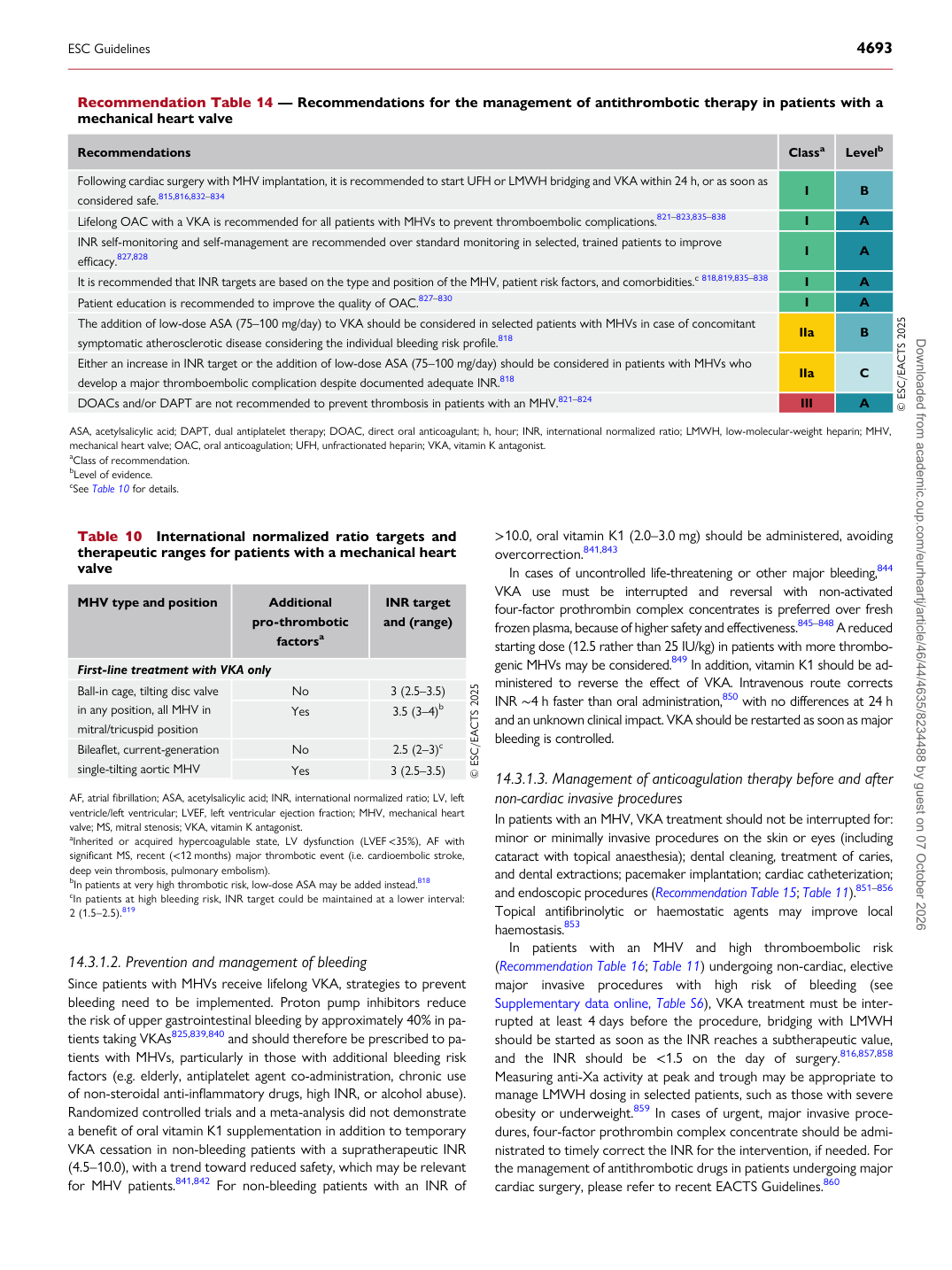
Recommendation Table 14 — Recommendations for the management of antithrombotic therapy in patients with a mechanical heart valve

Recommendations Classa Levelb

Following cardiac surgery with MHV implantation, it is recommended to start UFH or LMWH bridging and VKA within 24 h, or as soon as considered safe.815,816,832–834 I B Lifelong OAC with a VKA is recommended for all patients with MHVs to prevent thromboembolic complications.821–823,835–838 I A INR self-monitoring and self-management are recommended over standard monitoring in selected, trained patients to improve efficacy.827,828 I A It is recommended that INR targets are based on the type and position of the MHV, patient risk factors, and comorbidities.c 818,819,835–838 I A Patient education is recommended to improve the quality of OAC.827–830 I A The addition of low-dose ASA (75–100 mg/day) to VKA should be considered in selected patients with MHVs in case of concomitant symptomatic atherosclerotic disease considering the individual bleeding risk profile.818 IIa B Either an increase in INR target or the addition of low-dose ASA (75–100 mg/day) should be considered in patients with MHVs who develop a major thromboembolic complication despite documented adequate INR.818 IIa C DOACs and/or DAPT are not recommended to prevent thrombosis in patients with an MHV.821–824 III A © ESC/EACTS 2025

ASA, acetylsalicylic acid; DAPT, dual antiplatelet therapy; DOAC, direct oral anticoagulant; h, hour; INR, international normalized ratio; LMWH, low-molecular-weight heparin; MHV, mechanical heart valve; OAC, oral anticoagulation; UFH, unfractionated heparin; VKA, vitamin K antagonist. aClass of recommendation. bLevel of evidence. cSee Table 10 for details.

Table 10 International normalized ratio targets and therapeutic ranges for patients with a mechanical heart valve

MHV type and position Additional

pro-thrombotic

factorsa INR target

and (range)

First-line treatment with VKA only Ball-in cage, tilting disc valve in any position, all MHV in mitral/tricuspid position No 3 (2.5–3.5)

Yes 3.5 (3–4)b

Bileaflet, current-generation single-tilting aortic MHV No 2.5 (2–3)c

Yes 3 (2.5–3.5) © ESC/EACTS 2025

AF, atrial fibrillation; ASA, acetylsalicylic acid; INR, international normalized ratio; LV, left ventricle/left ventricular; LVEF, left ventricular ejection fraction; MHV, mechanical heart valve; MS, mitral stenosis; VKA, vitamin K antagonist. aInherited or acquired hypercoagulable state, LV dysfunction (LVEF <35%), AF with significant MS, recent (<12 months) major thrombotic event (i.e. cardioembolic stroke, deep vein thrombosis, pulmonary embolism). bIn patients at very high thrombotic risk, low-dose ASA may be added instead.818 cIn patients at high bleeding risk, INR target could be maintained at a lower interval: 2 (1.5–2.5).819

ESC Guidelines                                                                                                                                                                                          4693

Downloaded from academic.oup.com/eurheartj/article/46/44/4635/8234488 by guest on 07 October 2026