p.57 抽出テキスト
14.2 Follow-up of patients with prosthetic

valves All patients with prosthetic valves require lifelong clinical and echocardiographic follow-up to detect deterioration of prosthetic function, associated cardiac damage, or progressive disease of another valve. Serial TTE measurements of transprosthetic gradients, calculation of the effective valve area, and evaluation of leaflet motion and morphology should be performed in patients receiving a BHV within 3 months after valve implantation, again at 1 year, and annually thereafter, or sooner if new cardiovascular symptoms occur.812 TOE is recommended in all cases of suspected prosthetic valve dysfunction or endocarditis. In the latter case, CCT and PET-CT are also recommended, if the diagnosis is unclear, and to identify primary or secondary infection foci.5 Cinefluoroscopy for MHVs and CCT provide useful additional information, if valve thrombus or pannus is suspected.812 Imaging should be repeated in the case of thrombolytic and antithrombotic treatment of MVH thrombosis, even if gradients are normalized.813 14.3 Antithrombotic therapy in patients

with treated valvular heart disease 14.3.1. Mechanical heart valves 14.3.1.1. Post-operative anticoagulation and therapeutic targets Mechanical heart valves require lifelong treatment with a VKA guided by the INR. Bridging with either therapeutic unfractionated heparin (UFH) or low-molecular-weight heparin (LMWH) and VKA should be initiated within 24 h after MHV implantation, or as soon as considered safe. Heparin can be stopped when the INR is documented for 2 consecutive days within the therapeutic range (Figure 18).814 Two meta-analyses and a prospective study have suggested slightly lower bleeding rates using UFH bridging compared with LMWH after MHV replacement or cardiac surgery.814–816 However, RCTs comparing the timing and dosage of each bridging strategy are lacking. For all patients with an MHV, lifelong VKA is recommended to avoid major thrombotic complications, since cardioembolic or valve thrombosis rates without anticoagulation are substantial (12% per year and 22% per year for first-generation aortic and mitral MHVs, respectively).817 The INR target and range should be chosen considering the type, position, and number of valves, the patient’s thrombotic risk, and comorbidities (see Table 10 and Recommendation Table 14). In patients with an MHV developing a major thromboembolic complication despite adequate INR and time in therapeutic range (TTR, usually defined as >60%),820 either increased VKA intensity (e.g. INR target and range increased by 0.5 units) or the addition of low-dose acetylsalicylic acid (ASA) (75–100 mg/day) should be considered.818 Direct oral anticoagulants or dual antiplatelet therapy (DAPT) are contraindicated to prevent thromboembolism in patients with an MHV.821–824 Given the complexity of lifelong VKA therapy due to high intraand interpatient variability, the need for monitoring, drug and food interactions,825,826 the narrow therapeutic window, influence of comorbidities, and non-modifiable characteristics (e.g. ageing, genetics, and ethnicity), RCTs have shown that patient’s education, as well as disease and treatment awareness, significantly improves anticoagulation quality and adherence.827–830 International normalized ratio self-monitoring and/or self-management increase efficacy, but not safety, as compared with a standard approach; INR selfmonitoring can be used by motivated patients after adequate training.827–830 The indication for VKA and DAPT combination in MHV patients presenting with acute coronary syndrome is described in the corresponding ESC Guidelines.151,831 In patients with an MHV and an indication for single antiplatelet therapy (SAPT) due to symptomatic major atherosclerotic diseases and low bleeding risk, low-dose ASA in combination with a VKA should be considered, because this strategy has been shown to significantly lower the incidence of major adverse cardiovascular events.818 However, the combination of antiplatelet agents (single or dual) and VKA increases the risk of bleeding,825 and therefore their use should be carefully weighted. In a large meta-analysis that included MHV patients, the combination of VKA with either ASA or clopidogrel increased clinically relevant bleeding compared with VKA alone (clopidogrel odds ratio, 3.55; 95% CI, 2.78–4.54; ASA odds ratio, 1.50; 95% CI, 1.29– 1.74), which may be aggravated because of potential pharmacokinetic drug interactions on the cytochrome P (CYP)450s 2C19 and 3A4.825

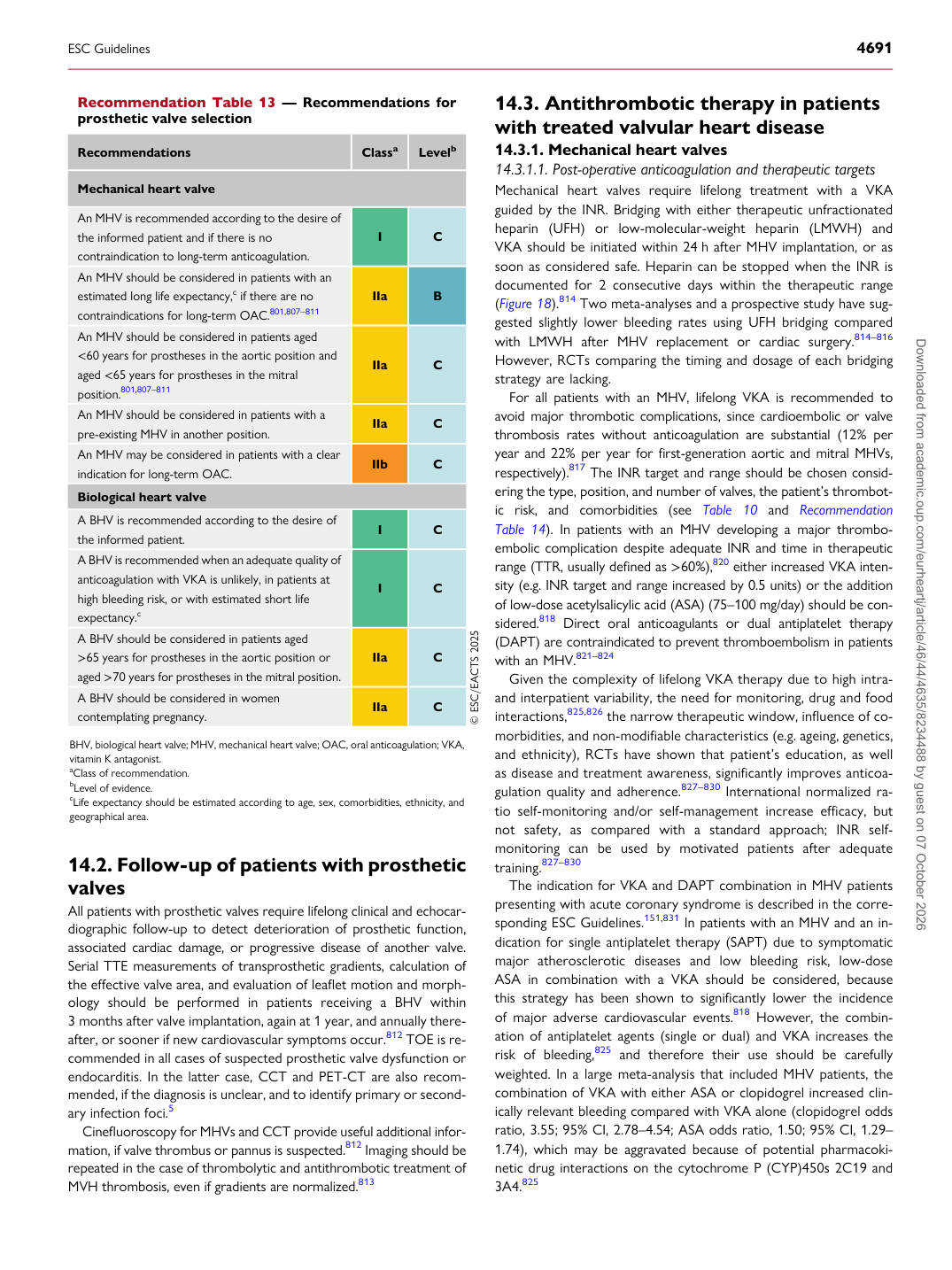
Recommendation Table 13 — Recommendations for prosthetic valve selection

Recommendations Classa Levelb

Mechanical heart valve

An MHV is recommended according to the desire of the informed patient and if there is no contraindication to long-term anticoagulation. I C An MHV should be considered in patients with an estimated long life expectancy,c if there are no contraindications for long-term OAC.801,807–811 IIa B An MHV should be considered in patients aged <60 years for prostheses in the aortic position and aged <65 years for prostheses in the mitral position.801,807–811 IIa C An MHV should be considered in patients with a pre-existing MHV in another position. IIa C An MHV may be considered in patients with a clear indication for long-term OAC. IIb C Biological heart valve A BHV is recommended according to the desire of the informed patient. I C A BHV is recommended when an adequate quality of anticoagulation with VKA is unlikely, in patients at high bleeding risk, or with estimated short life expectancy.c I C A BHV should be considered in patients aged >65 years for prostheses in the aortic position or aged >70 years for prostheses in the mitral position. IIa C A BHV should be considered in women contemplating pregnancy. IIa C © ESC/EACTS 2025

BHV, biological heart valve; MHV, mechanical heart valve; OAC, oral anticoagulation; VKA, vitamin K antagonist. aClass of recommendation. bLevel of evidence. cLife expectancy should be estimated according to age, sex, comorbidities, ethnicity, and geographical area.

ESC Guidelines                                                                                                                                                                                          4691

Downloaded from academic.oup.com/eurheartj/article/46/44/4635/8234488 by guest on 07 October 2026