p.56 抽出テキスト
(often TR > MR). While surgery aims to address all relevant valve lesions in a single procedure, a stepwise transcatheter strategy offers the possibility of reassessing the upstream valve(s) under altered loading conditions, usually 3 months after the initial intervention. In very selected cases simultaneous transcatheter valve treatment may be considered.788,789 However, evidence is limited and primarily derived from modestly sized observational studies.786–789

13.3.2 Mixed aortic valve disease

The severity of mixed AV disease is often underestimated and patients with balanced moderate AR and AS show adverse event rates comparable to patients with severe isolated AS.790,791 Transvalvular gradients measured by Doppler reflect the overall haemodynamic burden of both regurgitation and stenosis, and are strongly associated with adverse outcomes.765,791–793 Therefore, the presence of high transvalvular gradients justifies valve intervention in patients with moderate mixed AV disease, even if regurgitation is graded as moderate and the calculated or planimetric AVA is >1 cm2 (Recommendation Table 12). Patients presenting with mixed AV disease, but with gradients below thresholds for intervention, should undergo careful multimodality diagnostics including assessment of cardiac damage to inform individual treatment strategies. Global longitudinal strain and natriuretic peptides have shown incremental prognostic value beyond symptom status and single lesion severity in patients with preserved LVEF.762,794–796

13.3.3 Mixed mitral valve disease

Mixed MV disease is usually present in patients with rheumatic valve disease or MAC. If MVA is ≤1.5 cm2, recommendations for isolated MS apply. However, patients with an MVA of >1.5 cm2 and moderate MR may be evaluated for valve replacement based on symptoms, anatomical characteristics, transmitral gradient, and signs of cardiac damage such as LA dilatation, AF, or PH.529,674,776,797 13.4 Follow-up

Due to the cumulative haemodynamic impact of MVHD or mixed VHD, progression of its severity and the development of cardiac damage may be faster than in single VHD.761 Therefore, follow-up intervals should be adjusted according to individual patient characteristics.

14 Management of patients with

prosthetic valves or valve repair

14.1 Choice of prosthetic valve

When choosing between an MHV and a BHV prosthesis for an individual patient, age, life expectancy, lifestyle, bleeding and thromboembolic risks, possibility of pregnancy, and patient preference should be considered. Life expectancy is estimated according to age, sex, comorbidities, ethnicity, and geographical area.798 An MHV is preferred in younger patients with longer life expectancy and in those with a pre-existing indication for longterm OAC (Recommendation Table 13). Generally, a BHV is implanted in patients with shorter life expectancy, increased bleeding risk due to frailty or comorbidities, in women contemplating pregnancy, and in patients in whom stable INRs with adequate times in therapeutic range are unlikely.799 Importantly, the performance of different BHV prostheses can vary considerably.800 The impact of the aetiology of the native valve disease, if any, on the choice between an MHV and a BHV remains unexplored. Several large observational studies, smaller RCTs, and meta-analyses have compared long-term mortality with BHV and MHV prostheses in patients aged 50–70 years.376,801–805 Some of the studies showed lower mortality with an MHV in AV patients <60 years and MV patients <65 years old,801,804 while others failed to show any differences.376,802,803 Most of these studies were limited by their observational nature and missing information on the type of prostheses implanted. RCTs with sufficient statistical power comparing biological and mechanical prostheses are warranted. Replacement of the AV using an autograft (Ross procedure) is an alternative to an MHV in young patients that should be performed at experienced centres by operators with dedicated expertise (see also Section 8).806 General recommendations are summarized in Recommendation Table 13.

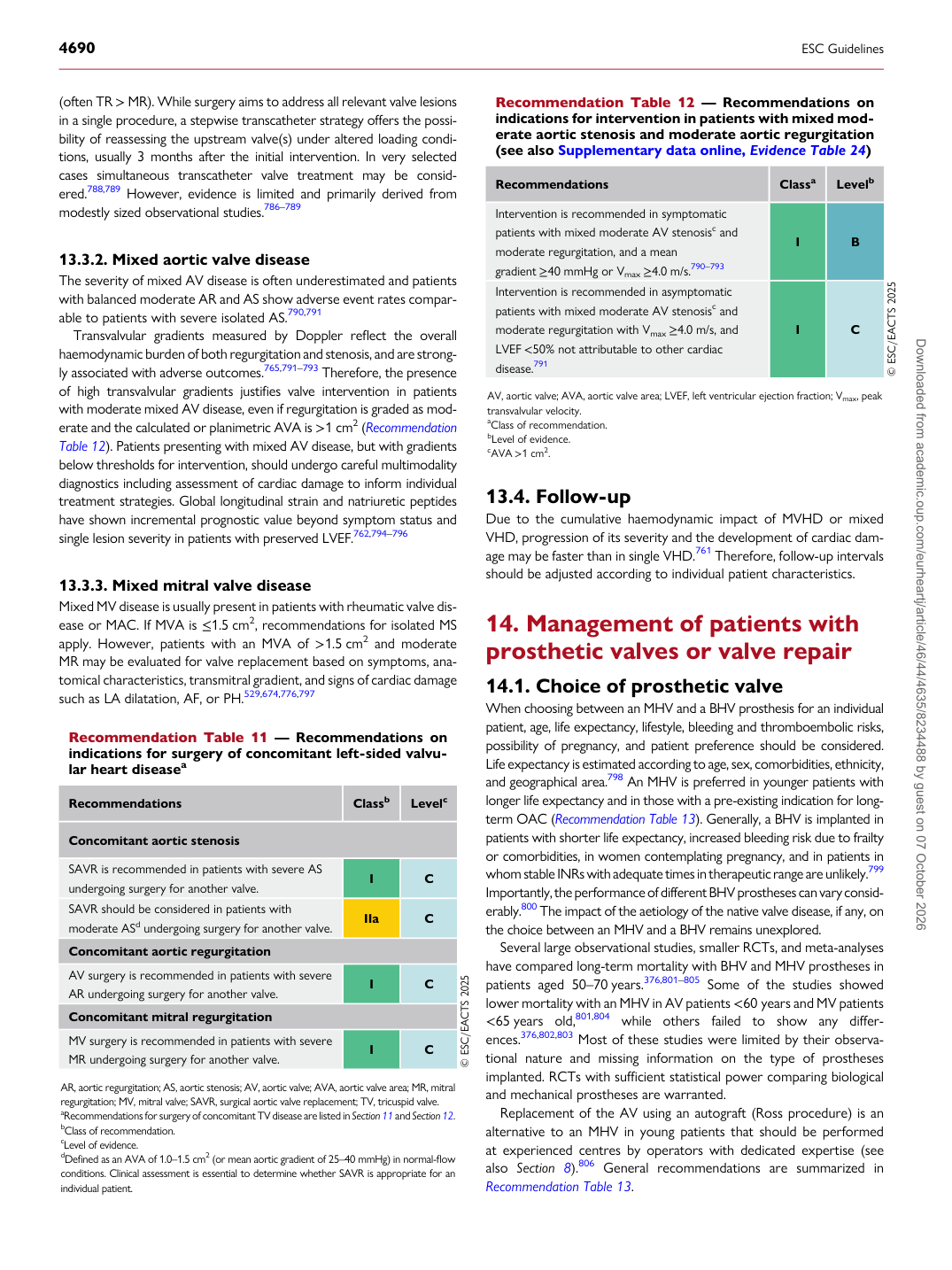
Recommendation Table 11 — Recommendations on indications for surgery of concomitant left-sided valvular heart diseasea

Recommendations Classb Levelc

Concomitant aortic stenosis

SAVR is recommended in patients with severe AS undergoing surgery for another valve. I C SAVR should be considered in patients with moderate ASd undergoing surgery for another valve. IIa C Concomitant aortic regurgitation AV surgery is recommended in patients with severe AR undergoing surgery for another valve. I C Concomitant mitral regurgitation MV surgery is recommended in patients with severe MR undergoing surgery for another valve. I C © ESC/EACTS 2025

AR, aortic regurgitation; AS, aortic stenosis; AV, aortic valve; AVA, aortic valve area; MR, mitral regurgitation; MV, mitral valve; SAVR, surgical aortic valve replacement; TV, tricuspid valve. aRecommendations for surgery of concomitant TV disease are listed in Section 11 and Section 12. bClass of recommendation. cLevel of evidence. dDefined as an AVA of 1.0–1.5 cm2 (or mean aortic gradient of 25–40 mmHg) in normal-flow conditions. Clinical assessment is essential to determine whether SAVR is appropriate for an individual patient. Recommendation Table 12 — Recommendations on indications for intervention in patients with mixed moderate aortic stenosis and moderate aortic regurgitation (see also Supplementary data online, Evidence Table 24)

Recommendations Classa Levelb

Intervention is recommended in symptomatic patients with mixed moderate AV stenosisc and moderate regurgitation, and a mean gradient ≥40 mmHg or Vmax ≥4.0 m/s.790–793 I B Intervention is recommended in asymptomatic patients with mixed moderate AV stenosisc and moderate regurgitation with Vmax ≥4.0 m/s, and LVEF <50% not attributable to other cardiac disease.791 I C © ESC/EACTS 2025

AV, aortic valve; AVA, aortic valve area; LVEF, left ventricular ejection fraction; Vmax, peak transvalvular velocity. aClass of recommendation. bLevel of evidence. cAVA >1 cm2. Downloaded from academic.oup.com/eurheartj/article/46/44/4635/8234488 by guest on 07 October 2026