p.54 抽出テキスト
commissural fusions are pathognomonic findings of rheumatic involvement. A mean diastolic transvalvular gradient of >5 mmHg at a normal heart rate indicates severe TS.649

12.3 Medical therapy

Medical therapy is a bridge to surgical or transcatheter intervention. Intensive sodium restriction and concomitant diuretic therapy can lead to symptom improvement and diminish hepatic congestion.

12.4 Indications for intervention

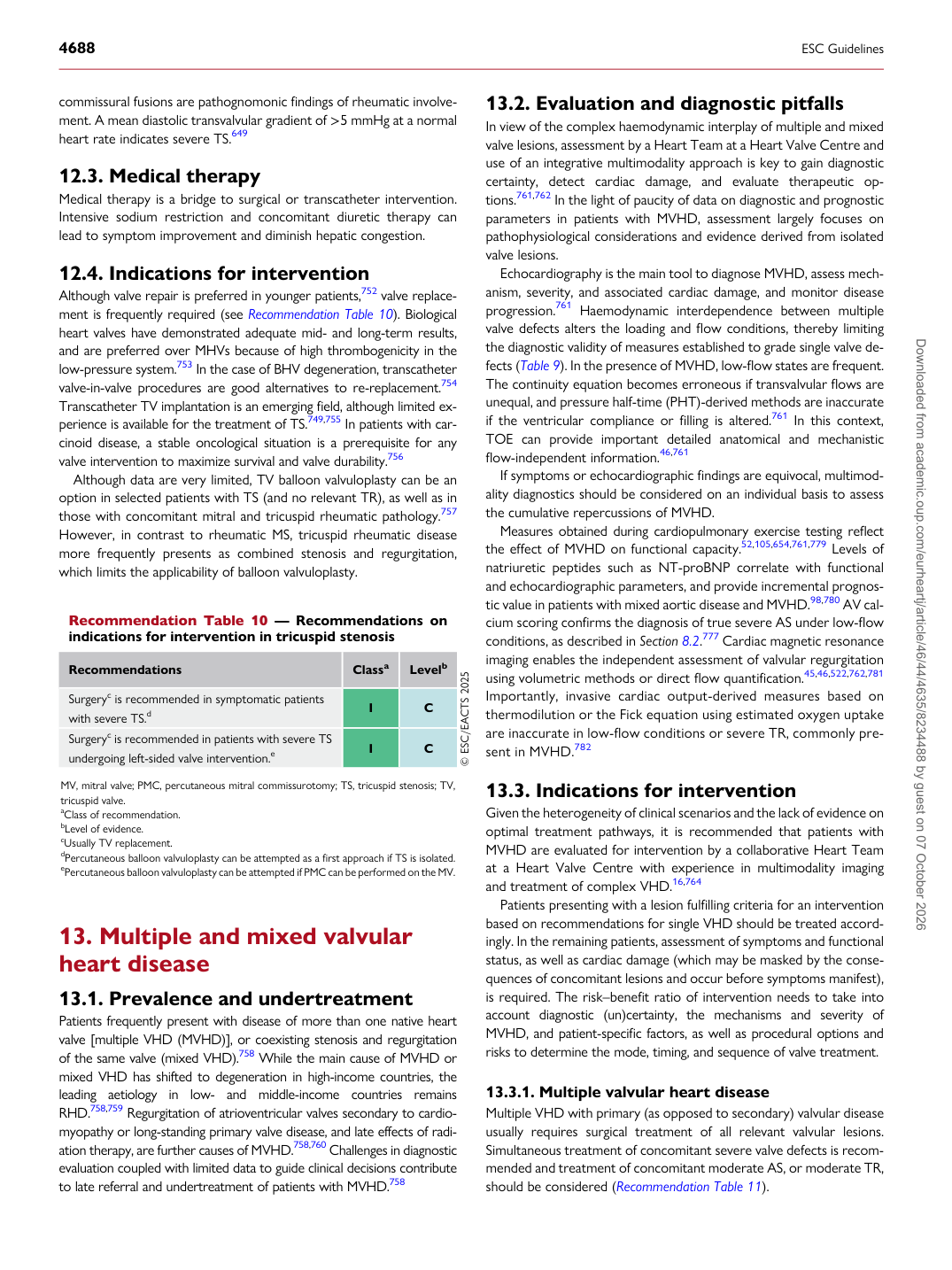
Although valve repair is preferred in younger patients,752 valve replacement is frequently required (see Recommendation Table 10). Biological heart valves have demonstrated adequate mid- and long-term results, and are preferred over MHVs because of high thrombogenicity in the low-pressure system.753 In the case of BHV degeneration, transcatheter valve-in-valve procedures are good alternatives to re-replacement.754 Transcatheter TV implantation is an emerging field, although limited experience is available for the treatment of TS.749,755 In patients with carcinoid disease, a stable oncological situation is a prerequisite for any valve intervention to maximize survival and valve durability.756 Although data are very limited, TV balloon valvuloplasty can be an option in selected patients with TS (and no relevant TR), as well as in those with concomitant mitral and tricuspid rheumatic pathology.757 However, in contrast to rheumatic MS, tricuspid rheumatic disease more frequently presents as combined stenosis and regurgitation, which limits the applicability of balloon valvuloplasty.

13 Multiple and mixed valvular

heart disease

13.1 Prevalence and undertreatment

Patients frequently present with disease of more than one native heart valve [multiple VHD (MVHD)], or coexisting stenosis and regurgitation of the same valve (mixed VHD).758 While the main cause of MVHD or mixed VHD has shifted to degeneration in high-income countries, the leading aetiology in low- and middle-income countries remains RHD.758,759 Regurgitation of atrioventricular valves secondary to cardiomyopathy or long-standing primary valve disease, and late effects of radiation therapy, are further causes of MVHD.758,760 Challenges in diagnostic evaluation coupled with limited data to guide clinical decisions contribute to late referral and undertreatment of patients with MVHD.758 13.2 Evaluation and diagnostic pitfalls

In view of the complex haemodynamic interplay of multiple and mixed valve lesions, assessment by a Heart Team at a Heart Valve Centre and use of an integrative multimodality approach is key to gain diagnostic certainty, detect cardiac damage, and evaluate therapeutic options.761,762 In the light of paucity of data on diagnostic and prognostic parameters in patients with MVHD, assessment largely focuses on pathophysiological considerations and evidence derived from isolated valve lesions. Echocardiography is the main tool to diagnose MVHD, assess mechanism, severity, and associated cardiac damage, and monitor disease progression.761 Haemodynamic interdependence between multiple valve defects alters the loading and flow conditions, thereby limiting the diagnostic validity of measures established to grade single valve defects (Table 9). In the presence of MVHD, low-flow states are frequent. The continuity equation becomes erroneous if transvalvular flows are unequal, and pressure half-time (PHT)-derived methods are inaccurate if the ventricular compliance or filling is altered.761 In this context, TOE can provide important detailed anatomical and mechanistic flow-independent information.46,761 If symptoms or echocardiographic findings are equivocal, multimodality diagnostics should be considered on an individual basis to assess the cumulative repercussions of MVHD. Measures obtained during cardiopulmonary exercise testing reflect the effect of MVHD on functional capacity.52,105,654,761,779 Levels of natriuretic peptides such as NT-proBNP correlate with functional and echocardiographic parameters, and provide incremental prognostic value in patients with mixed aortic disease and MVHD.98,780 AV calcium scoring confirms the diagnosis of true severe AS under low-flow conditions, as described in Section 8.2.777 Cardiac magnetic resonance imaging enables the independent assessment of valvular regurgitation using volumetric methods or direct flow quantification.45,46,522,762,781 Importantly, invasive cardiac output-derived measures based on thermodilution or the Fick equation using estimated oxygen uptake are inaccurate in low-flow conditions or severe TR, commonly present in MVHD.782

13.3 Indications for intervention

Given the heterogeneity of clinical scenarios and the lack of evidence on optimal treatment pathways, it is recommended that patients with MVHD are evaluated for intervention by a collaborative Heart Team at a Heart Valve Centre with experience in multimodality imaging and treatment of complex VHD.16,764 Patients presenting with a lesion fulfilling criteria for an intervention based on recommendations for single VHD should be treated accordingly. In the remaining patients, assessment of symptoms and functional status, as well as cardiac damage (which may be masked by the consequences of concomitant lesions and occur before symptoms manifest), is required. The risk–benefit ratio of intervention needs to take into account diagnostic (un)certainty, the mechanisms and severity of MVHD, and patient-specific factors, as well as procedural options and risks to determine the mode, timing, and sequence of valve treatment.

13.3.1 Multiple valvular heart disease

Multiple VHD with primary (as opposed to secondary) valvular disease usually requires surgical treatment of all relevant valvular lesions. Simultaneous treatment of concomitant severe valve defects is recommended and treatment of concomitant moderate AS, or moderate TR, should be considered (Recommendation Table 11).

Recommendation Table 10 — Recommendations on indications for intervention in tricuspid stenosis

Recommendations Classa Levelb Surgeryc is recommended in symptomatic patients with severe TS.d I C Surgeryc is recommended in patients with severe TS undergoing left-sided valve intervention.e I C © ESC/EACTS 2025

MV, mitral valve; PMC, percutaneous mitral commissurotomy; TS, tricuspid stenosis; TV, tricuspid valve. aClass of recommendation. bLevel of evidence. cUsually TV replacement. dPercutaneous balloon valvuloplasty can be attempted as a first approach if TS is isolated. ePercutaneous balloon valvuloplasty can be attempted if PMC can be performed on the MV. Downloaded from academic.oup.com/eurheartj/article/46/44/4635/8234488 by guest on 07 October 2026