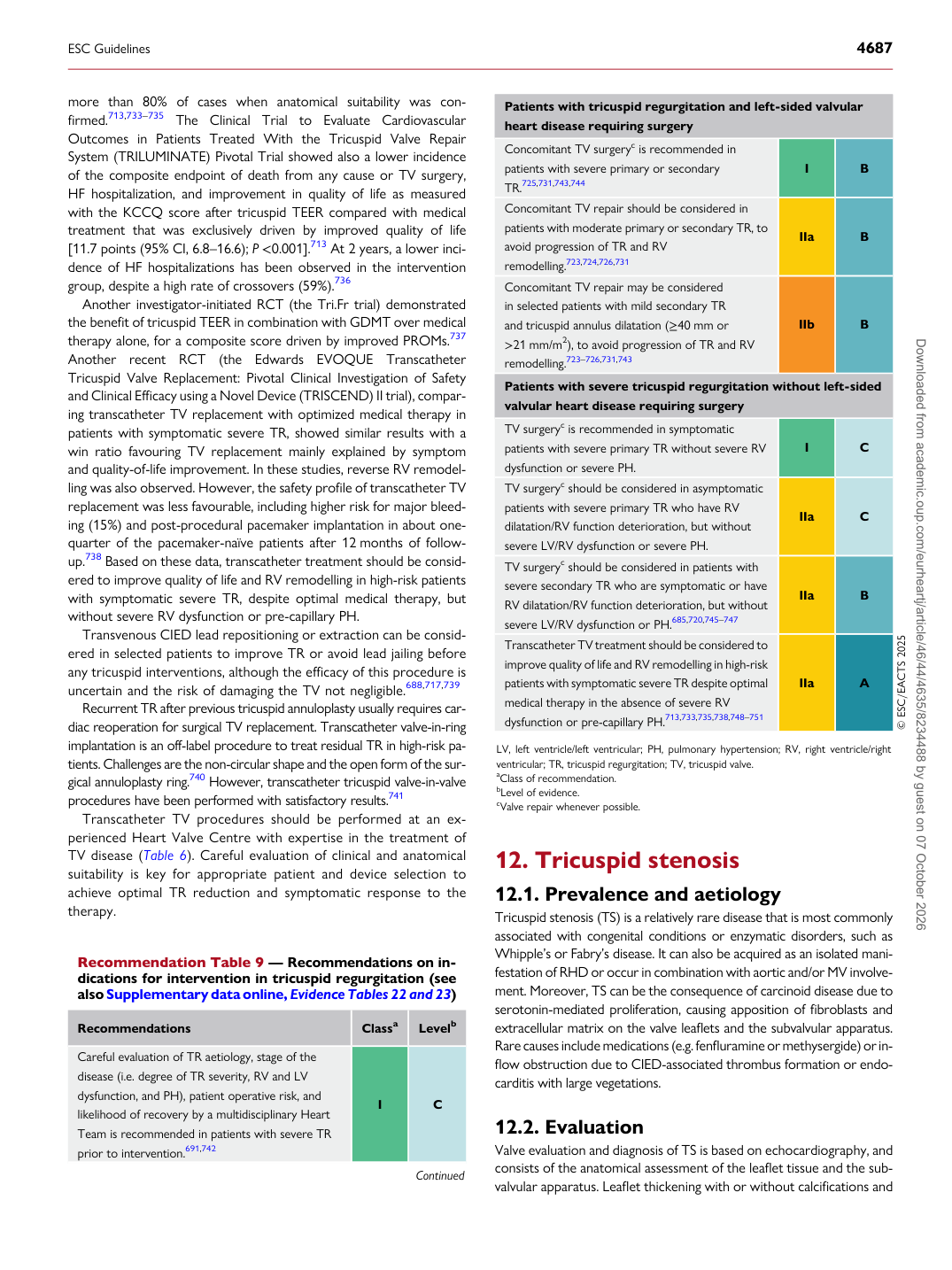
p.53 抽出テキスト
more than 80% of cases when anatomical suitability was confirmed.713,733–735 The Clinical Trial to Evaluate Cardiovascular Outcomes in Patients Treated With the Tricuspid Valve Repair System (TRILUMINATE) Pivotal Trial showed also a lower incidence of the composite endpoint of death from any cause or TV surgery, HF hospitalization, and improvement in quality of life as measured with the KCCQ score after tricuspid TEER compared with medical treatment that was exclusively driven by improved quality of life [11.7 points (95% CI, 6.8–16.6); P <0.001].713 At 2 years, a lower incidence of HF hospitalizations has been observed in the intervention group, despite a high rate of crossovers (59%).736 Another investigator-initiated RCT (the Tri.Fr trial) demonstrated the benefit of tricuspid TEER in combination with GDMT over medical therapy alone, for a composite score driven by improved PROMs.737 Another recent RCT (the Edwards EVOQUE Transcatheter Tricuspid Valve Replacement: Pivotal Clinical Investigation of Safety and Clinical Efficacy using a Novel Device (TRISCEND) II trial), comparing transcatheter TV replacement with optimized medical therapy in patients with symptomatic severe TR, showed similar results with a win ratio favouring TV replacement mainly explained by symptom and quality-of-life improvement. In these studies, reverse RV remodelling was also observed. However, the safety profile of transcatheter TV replacement was less favourable, including higher risk for major bleeding (15%) and post-procedural pacemaker implantation in about onequarter of the pacemaker-naïve patients after 12 months of followup.738 Based on these data, transcatheter treatment should be considered to improve quality of life and RV remodelling in high-risk patients with symptomatic severe TR, despite optimal medical therapy, but without severe RV dysfunction or pre-capillary PH. Transvenous CIED lead repositioning or extraction can be considered in selected patients to improve TR or avoid lead jailing before any tricuspid interventions, although the efficacy of this procedure is uncertain and the risk of damaging the TV not negligible.688,717,739 Recurrent TR after previous tricuspid annuloplasty usually requires cardiac reoperation for surgical TV replacement. Transcatheter valve-in-ring implantation is an off-label procedure to treat residual TR in high-risk patients. Challenges are the non-circular shape and the open form of the surgical annuloplasty ring.740 However, transcatheter tricuspid valve-in-valve procedures have been performed with satisfactory results.741 Transcatheter TV procedures should be performed at an experienced Heart Valve Centre with expertise in the treatment of TV disease (Table 6). Careful evaluation of clinical and anatomical suitability is key for appropriate patient and device selection to achieve optimal TR reduction and symptomatic response to the therapy. 12 Tricuspid stenosis

12.1 Prevalence and aetiology

Tricuspid stenosis (TS) is a relatively rare disease that is most commonly associated with congenital conditions or enzymatic disorders, such as Whipple’s or Fabry’s disease. It can also be acquired as an isolated manifestation of RHD or occur in combination with aortic and/or MV involvement. Moreover, TS can be the consequence of carcinoid disease due to serotonin-mediated proliferation, causing apposition of fibroblasts and extracellular matrix on the valve leaflets and the subvalvular apparatus. Rare causes include medications (e.g. fenfluramine or methysergide) or inflow obstruction due to CIED-associated thrombus formation or endocarditis with large vegetations.

12.2 Evaluation

Valve evaluation and diagnosis of TS is based on echocardiography, and consists of the anatomical assessment of the leaflet tissue and the subvalvular apparatus. Leaflet thickening with or without calcifications and

Recommendation Table 9 — Recommendations on indications for intervention in tricuspid regurgitation (see also Supplementary data online, Evidence Tables 22 and 23)

Recommendations Classa Levelb

Careful evaluation of TR aetiology, stage of the disease (i.e. degree of TR severity, RV and LV dysfunction, and PH), patient operative risk, and likelihood of recovery by a multidisciplinary Heart Team is recommended in patients with severe TR prior to intervention.691,742 I C

Continued Patients with tricuspid regurgitation and left-sided valvular

heart disease requiring surgery Concomitant TV surgeryc is recommended in patients with severe primary or secondary TR.725,731,743,744 I B Concomitant TV repair should be considered in patients with moderate primary or secondary TR, to avoid progression of TR and RV remodelling.723,724,726,731 IIa B Concomitant TV repair may be considered in selected patients with mild secondary TR and tricuspid annulus dilatation (≥40 mm or >21 mm/m2), to avoid progression of TR and RV remodelling.723–726,731,743 IIb B Patients with severe tricuspid regurgitation without left-sided valvular heart disease requiring surgery TV surgeryc is recommended in symptomatic patients with severe primary TR without severe RV dysfunction or severe PH. I C TV surgeryc should be considered in asymptomatic patients with severe primary TR who have RV dilatation/RV function deterioration, but without severe LV/RV dysfunction or severe PH. IIa C TV surgeryc should be considered in patients with severe secondary TR who are symptomatic or have RV dilatation/RV function deterioration, but without severe LV/RV dysfunction or PH.685,720,745–747 IIa B Transcatheter TV treatment should be considered to improve quality of life and RV remodelling in high-risk patients with symptomatic severe TR despite optimal medical therapy in the absence of severe RV dysfunction or pre-capillary PH.713,733,735,738,748–751 IIa A © ESC/EACTS 2025

LV, left ventricle/left ventricular; PH, pulmonary hypertension; RV, right ventricle/right ventricular; TR, tricuspid regurgitation; TV, tricuspid valve. aClass of recommendation. bLevel of evidence. cValve repair whenever possible.

ESC Guidelines                                                                                                                                                                                          4687

Downloaded from academic.oup.com/eurheartj/article/46/44/4635/8234488 by guest on 07 October 2026