p.45 抽出テキスト
9.2.5 Management of atrial secondary mitral

regurgitation 9.2.5.1. Medical therapy and rhythm management In patients with atrial SMR, underlying causes need to be recognized and treated. Associated HFpEF and AF should be managed according to the relevant Guidelines.7,340 The use of SGLT2is should be encouraged in patients with HFpEF due to their proven efficacy in reducing cardiovascular death and HF hospitalization.625 Limited data show that rhythm control may contribute to reduce atrial SMR severity and reverse LA dilatation.626

9.2.5.2 Indications for intervention

Registry data demonstrate that patients with atrial SMR are typically elderly with associated AF. Mitral valve surgery has been recently associated with lower rates of HF hospitalizations and mortality compared with GDMT in a matched population, despite a higher risk profile in the surgical arm at baseline.627 Data from several observational studies also suggest that surgical annuloplasty is effective and durable in patients with atrial SMR, because it counteracts the main mechanism of MR progression.628–630 Its combination with surgical AF ablation (Maze procedure) and concomitant LAAO may have further advantages,630,631 while the frequently associated relevant TR can also be addressed during the same procedure.627 Transcatheter edge-to-edge repair may also be considered because observational studies have demonstrated high safety and procedural success,588–590,632,633 as well as compared with surgery in a small subgroup (n = 34) of the MATTERHORN RCT.634 However, the risk of increased gradient due to planar leaflet coaptation, large regurgitant jet, and limited MV area (MVA) needs to be taken into consideration.592,635 Further studies are warranted to investigate the treatment modalities of patients with atrial SMR.

9.2.5.3 Follow-up

Patients with atrial SMR undergoing surgical or transcatheter intervention should be followed up on a yearly basis, including clinical and echocardiographic evaluation. In cases of HFpEF, as an underlying cause of atrial SMR, consultation with an HF specialist is necessary. Asymptomatic patients with severe atrial SMR not fulfilling the criteria for an intervention should undergo clinical and echocardiographic follow-up at least once per year. 10 Mitral stenosis

10.1 Prevalence and aetiology

The aetiology of MS is most frequently rheumatic or degenerative, while rare forms can be drug-induced, inflammatory, or carcinoid-related. Rheumatic fever is the most common cause of MS and death due to VHD worldwide. Its prevalence has decreased in high- and middle-income countries, but remains a major healthcare problem in low-income countries, where it predominantly affects young patients.12,187,644 Degenerative MS related to MAC is a distinct age-dependent pathology requiring different treatment strategies.645–647 Both aetiologies are more frequent in females.648

10.2 Rheumatic mitral stenosis

10.2.1. Evaluation Echocardiography is the preferred method for screening in endemic regions and the assessment of the severity, extent of anatomical lesions, and haemodynamic consequences of MS. Involvement of other valves, particularly secondary TR, should be identified. Mitral valve area using

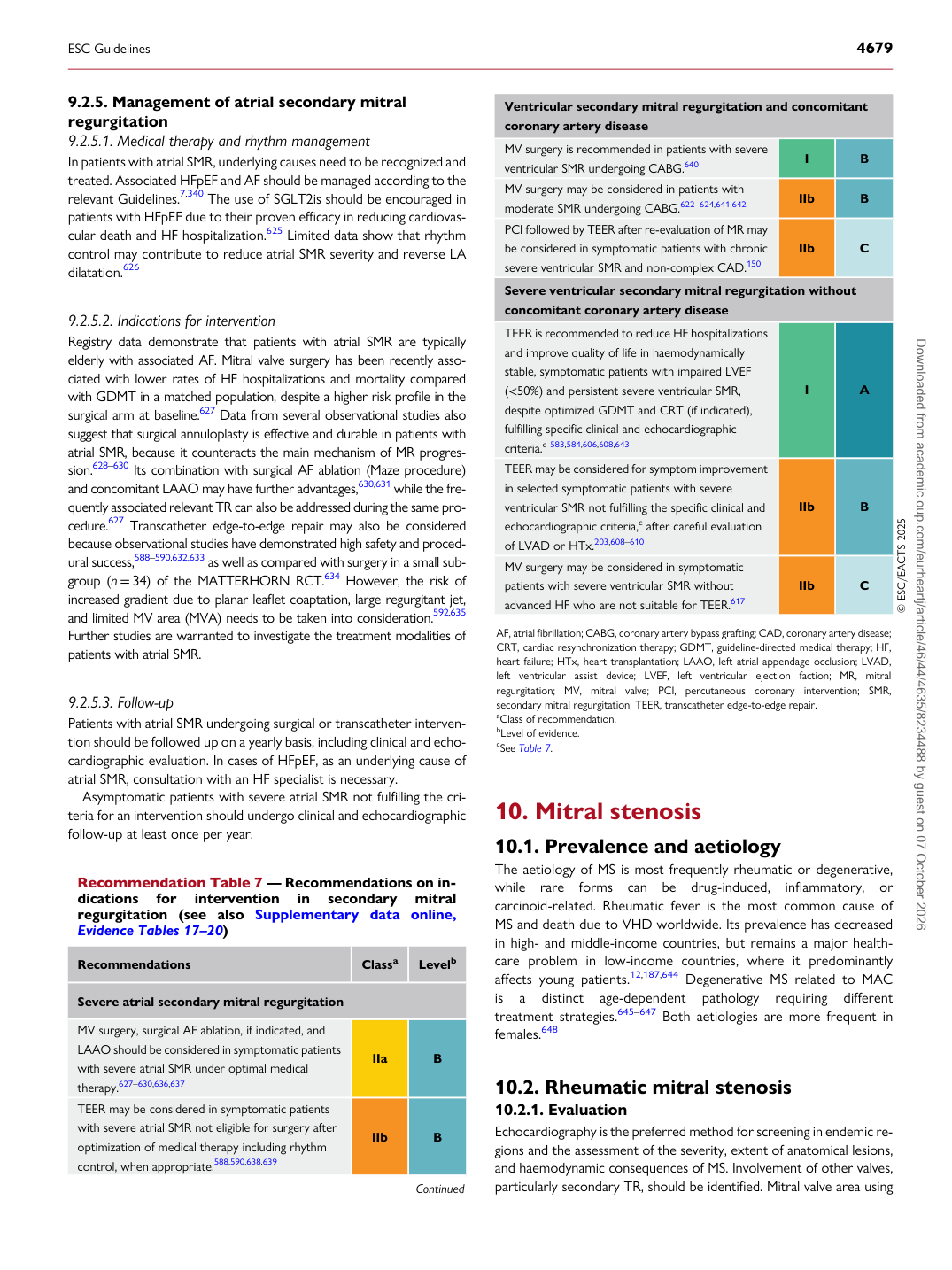
Recommendation Table 7 — Recommendations on indications for intervention in secondary mitral regurgitation (see also Supplementary data online, Evidence Tables 17–20)

Recommendations Classa Levelb

Severe atrial secondary mitral regurgitation

MV surgery, surgical AF ablation, if indicated, and LAAO should be considered in symptomatic patients with severe atrial SMR under optimal medical therapy.627–630,636,637 IIa B TEER may be considered in symptomatic patients with severe atrial SMR not eligible for surgery after optimization of medical therapy including rhythm control, when appropriate.588,590,638,639 IIb B

Continued Ventricular secondary mitral regurgitation and concomitant

coronary artery disease MV surgery is recommended in patients with severe ventricular SMR undergoing CABG.640 I B MV surgery may be considered in patients with moderate SMR undergoing CABG.622–624,641,642 IIb B PCI followed by TEER after re-evaluation of MR may be considered in symptomatic patients with chronic severe ventricular SMR and non-complex CAD.150 IIb C Severe ventricular secondary mitral regurgitation without concomitant coronary artery disease TEER is recommended to reduce HF hospitalizations and improve quality of life in haemodynamically stable, symptomatic patients with impaired LVEF (<50%) and persistent severe ventricular SMR, despite optimized GDMT and CRT (if indicated), fulfilling specific clinical and echocardiographic criteria.c 583,584,606,608,643 I A TEER may be considered for symptom improvement in selected symptomatic patients with severe ventricular SMR not fulfilling the specific clinical and echocardiographic criteria,c after careful evaluation of LVAD or HTx.203,608–610 IIb B MV surgery may be considered in symptomatic patients with severe ventricular SMR without advanced HF who are not suitable for TEER.617 IIb C © ESC/EACTS 2025

AF, atrial fibrillation; CABG, coronary artery bypass grafting; CAD, coronary artery disease; CRT, cardiac resynchronization therapy; GDMT, guideline-directed medical therapy; HF, heart failure; HTx, heart transplantation; LAAO, left atrial appendage occlusion; LVAD, left ventricular assist device; LVEF, left ventricular ejection faction; MR, mitral regurgitation; MV, mitral valve; PCI, percutaneous coronary intervention; SMR, secondary mitral regurgitation; TEER, transcatheter edge-to-edge repair. aClass of recommendation. bLevel of evidence. cSee Table 7.

ESC Guidelines                                                                                                                                                                                          4679

Downloaded from academic.oup.com/eurheartj/article/46/44/4635/8234488 by guest on 07 October 2026