p.44 抽出テキスト
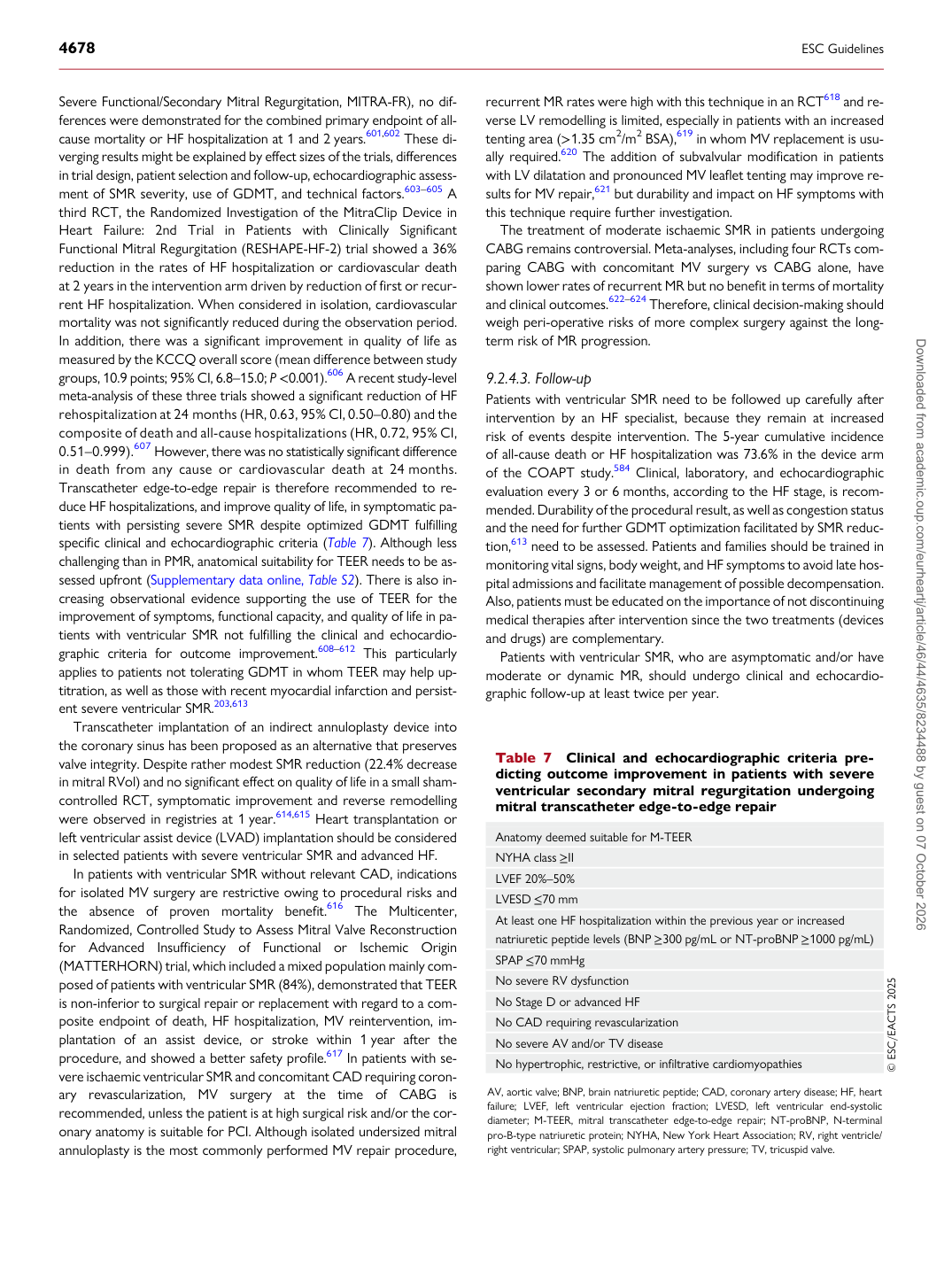
Severe Functional/Secondary Mitral Regurgitation, MITRA-FR), no differences were demonstrated for the combined primary endpoint of allcause mortality or HF hospitalization at 1 and 2 years.601,602 These diverging results might be explained by effect sizes of the trials, differences in trial design, patient selection and follow-up, echocardiographic assessment of SMR severity, use of GDMT, and technical factors.603–605 A third RCT, the Randomized Investigation of the MitraClip Device in Heart Failure: 2nd Trial in Patients with Clinically Significant Functional Mitral Regurgitation (RESHAPE-HF-2) trial showed a 36% reduction in the rates of HF hospitalization or cardiovascular death at 2 years in the intervention arm driven by reduction of first or recurrent HF hospitalization. When considered in isolation, cardiovascular mortality was not significantly reduced during the observation period. In addition, there was a significant improvement in quality of life as measured by the KCCQ overall score (mean difference between study groups, 10.9 points; 95% CI, 6.8–15.0; P <0.001).606 A recent study-level meta-analysis of these three trials showed a significant reduction of HF rehospitalization at 24 months (HR, 0.63, 95% CI, 0.50–0.80) and the composite of death and all-cause hospitalizations (HR, 0.72, 95% CI, 0.51–0.999).607 However, there was no statistically significant difference in death from any cause or cardiovascular death at 24 months. Transcatheter edge-to-edge repair is therefore recommended to reduce HF hospitalizations, and improve quality of life, in symptomatic patients with persisting severe SMR despite optimized GDMT fulfilling specific clinical and echocardiographic criteria (Table 7). Although less challenging than in PMR, anatomical suitability for TEER needs to be assessed upfront (Supplementary data online, Table S2). There is also increasing observational evidence supporting the use of TEER for the improvement of symptoms, functional capacity, and quality of life in patients with ventricular SMR not fulfilling the clinical and echocardiographic criteria for outcome improvement.608–612 This particularly applies to patients not tolerating GDMT in whom TEER may help uptitration, as well as those with recent myocardial infarction and persistent severe ventricular SMR.203,613 Transcatheter implantation of an indirect annuloplasty device into the coronary sinus has been proposed as an alternative that preserves valve integrity. Despite rather modest SMR reduction (22.4% decrease in mitral RVol) and no significant effect on quality of life in a small shamcontrolled RCT, symptomatic improvement and reverse remodelling were observed in registries at 1 year.614,615 Heart transplantation or left ventricular assist device (LVAD) implantation should be considered in selected patients with severe ventricular SMR and advanced HF. In patients with ventricular SMR without relevant CAD, indications for isolated MV surgery are restrictive owing to procedural risks and the absence of proven mortality benefit.616 The Multicenter, Randomized, Controlled Study to Assess Mitral Valve Reconstruction for Advanced Insufficiency of Functional or Ischemic Origin (MATTERHORN) trial, which included a mixed population mainly composed of patients with ventricular SMR (84%), demonstrated that TEER is non-inferior to surgical repair or replacement with regard to a composite endpoint of death, HF hospitalization, MV reintervention, implantation of an assist device, or stroke within 1 year after the procedure, and showed a better safety profile.617 In patients with severe ischaemic ventricular SMR and concomitant CAD requiring coronary revascularization, MV surgery at the time of CABG is recommended, unless the patient is at high surgical risk and/or the coronary anatomy is suitable for PCI. Although isolated undersized mitral annuloplasty is the most commonly performed MV repair procedure, recurrent MR rates were high with this technique in an RCT618 and reverse LV remodelling is limited, especially in patients with an increased tenting area (>1.35 cm2/m2 BSA),619 in whom MV replacement is usually required.620 The addition of subvalvular modification in patients with LV dilatation and pronounced MV leaflet tenting may improve results for MV repair,621 but durability and impact on HF symptoms with this technique require further investigation.

The treatment of moderate ischaemic SMR in patients undergoing CABG remains controversial. Meta-analyses, including four RCTs comparing CABG with concomitant MV surgery vs CABG alone, have shown lower rates of recurrent MR but no benefit in terms of mortality and clinical outcomes.622–624 Therefore, clinical decision-making should weigh peri-operative risks of more complex surgery against the longterm risk of MR progression.

9.2.4.3 Follow-up

Patients with ventricular SMR need to be followed up carefully after intervention by an HF specialist, because they remain at increased risk of events despite intervention. The 5-year cumulative incidence of all-cause death or HF hospitalization was 73.6% in the device arm of the COAPT study.584 Clinical, laboratory, and echocardiographic evaluation every 3 or 6 months, according to the HF stage, is recommended. Durability of the procedural result, as well as congestion status and the need for further GDMT optimization facilitated by SMR reduction,613 need to be assessed. Patients and families should be trained in monitoring vital signs, body weight, and HF symptoms to avoid late hospital admissions and facilitate management of possible decompensation. Also, patients must be educated on the importance of not discontinuing medical therapies after intervention since the two treatments (devices and drugs) are complementary. Patients with ventricular SMR, who are asymptomatic and/or have moderate or dynamic MR, should undergo clinical and echocardiographic follow-up at least twice per year.

Table 7 Clinical and echocardiographic criteria predicting outcome improvement in patients with severe ventricular secondary mitral regurgitation undergoing mitral transcatheter edge-to-edge repair

Anatomy deemed suitable for M-TEER NYHA class ≥II LVEF 20%–50% LVESD ≤70 mm At least one HF hospitalization within the previous year or increased natriuretic peptide levels (BNP ≥300 pg/mL or NT-proBNP ≥1000 pg/mL) SPAP ≤70 mmHg No severe RV dysfunction No Stage D or advanced HF No CAD requiring revascularization No severe AV and/or TV disease No hypertrophic, restrictive, or infiltrative cardiomyopathies © ESC/EACTS 2025

AV, aortic valve; BNP, brain natriuretic peptide; CAD, coronary artery disease; HF, heart failure; LVEF, left ventricular ejection fraction; LVESD, left ventricular end-systolic diameter; M-TEER, mitral transcatheter edge-to-edge repair; NT-proBNP, N-terminal pro-B-type natriuretic protein; NYHA, New York Heart Association; RV, right ventricle/ right ventricular; SPAP, systolic pulmonary artery pressure; TV, tricuspid valve. Downloaded from academic.oup.com/eurheartj/article/46/44/4635/8234488 by guest on 07 October 2026