p.40 抽出テキスト
Due its high sensitivity for detection of calcifications, CCT is instrumental for procedural planning (surgical and transcatheter) in patients with MAC.529

9.1.2.4 Genetic evaluation

There is increasing evidence that specific mitral pathologies may be associated with genetic conditions. A meta-analysis of six genome-wide association studies identified 14 potential genetic loci associated with primary MR. By comprising epigenetic, transcriptional, and proteomic data, the following genes could be identified as potential genetic sources of the pathology: LMCD1, SPTBN1, LTBP2, TGFB2, NMB, and ALPK3.530 However, genetic testing is not recommended in routine practice.

9.1.3 Medical therapy

Medical therapy has a limited role in patients with PMR. Afterload reduction with sodium nitroprusside has been used as a bridge to an intervention in patients with acute severe PMR without signs of hypotension. Inotropic agents and diuretics are usually indicated to reduce filling pressures and control pulmonary congestion, while the implantation of an intra-aortic balloon pump helps to further reduce afterload in exceptional cases of acute PMR. In chronic PMR without signs of LV dysfunction or criteria for an intervention, there is no evidence supporting prophylactic afterload reduction. Patients with PMR and impaired LV function should receive GDMT according to HF Guidelines.340

9.1.4 Indications for intervention

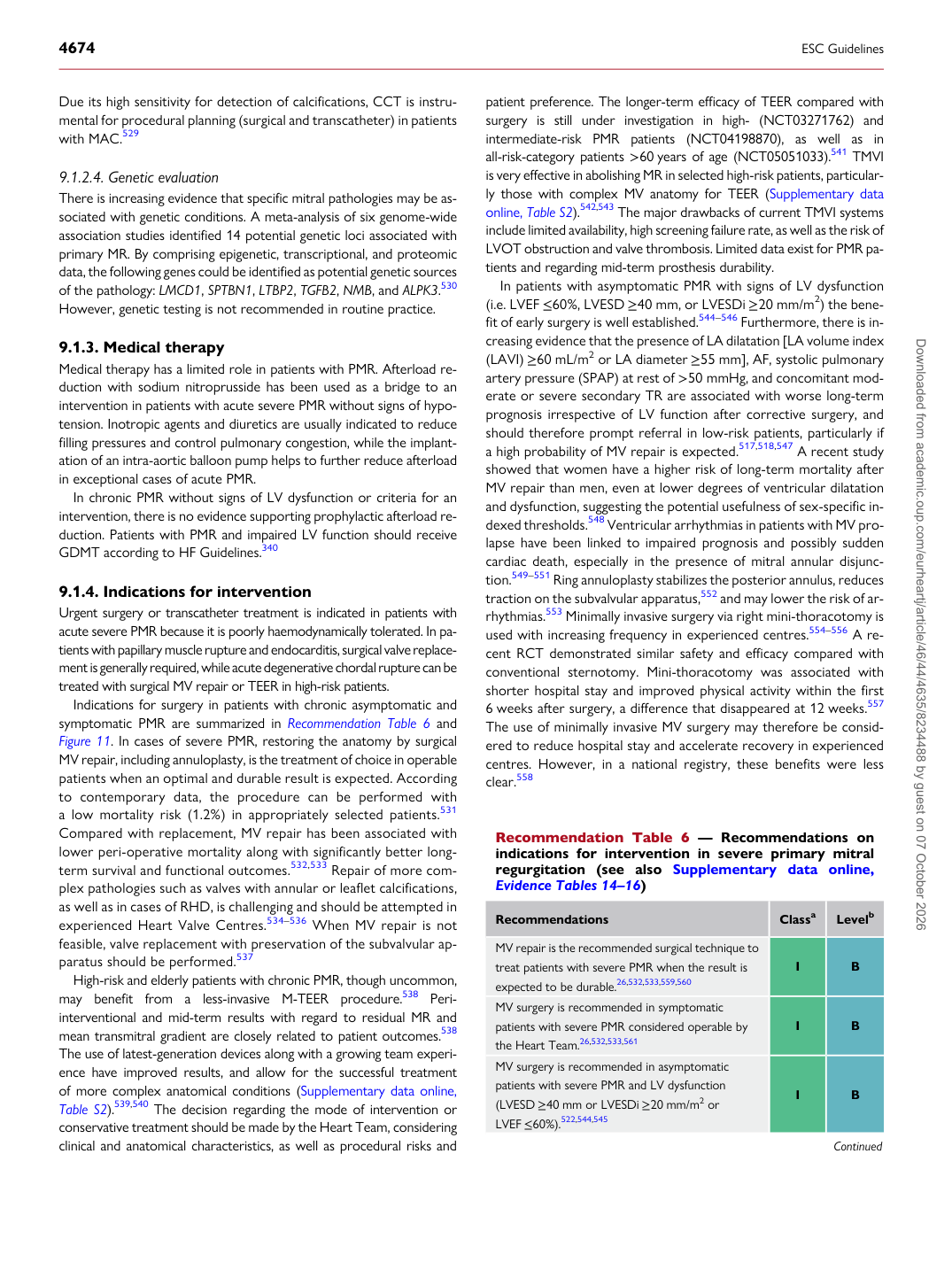
Urgent surgery or transcatheter treatment is indicated in patients with acute severe PMR because it is poorly haemodynamically tolerated. In patients with papillary muscle rupture and endocarditis, surgical valve replacement is generally required, while acute degenerative chordal rupture can be treated with surgical MV repair or TEER in high-risk patients. Indications for surgery in patients with chronic asymptomatic and symptomatic PMR are summarized in Recommendation Table 6 and Figure 11. In cases of severe PMR, restoring the anatomy by surgical MV repair, including annuloplasty, is the treatment of choice in operable patients when an optimal and durable result is expected. According to contemporary data, the procedure can be performed with a low mortality risk (1.2%) in appropriately selected patients.531 Compared with replacement, MV repair has been associated with lower peri-operative mortality along with significantly better longterm survival and functional outcomes.532,533 Repair of more complex pathologies such as valves with annular or leaflet calcifications, as well as in cases of RHD, is challenging and should be attempted in experienced Heart Valve Centres.534–536 When MV repair is not feasible, valve replacement with preservation of the subvalvular apparatus should be performed.537 High-risk and elderly patients with chronic PMR, though uncommon, may benefit from a less-invasive M-TEER procedure.538 Periinterventional and mid-term results with regard to residual MR and mean transmitral gradient are closely related to patient outcomes.538 The use of latest-generation devices along with a growing team experience have improved results, and allow for the successful treatment of more complex anatomical conditions (Supplementary data online, Table S2).539,540 The decision regarding the mode of intervention or conservative treatment should be made by the Heart Team, considering clinical and anatomical characteristics, as well as procedural risks and patient preference. The longer-term efficacy of TEER compared with surgery is still under investigation in high- (NCT03271762) and intermediate-risk PMR patients (NCT04198870), as well as in all-risk-category patients >60 years of age (NCT05051033).541 TMVI is very effective in abolishing MR in selected high-risk patients, particularly those with complex MV anatomy for TEER (Supplementary data online, Table S2).542,543 The major drawbacks of current TMVI systems include limited availability, high screening failure rate, as well as the risk of LVOT obstruction and valve thrombosis. Limited data exist for PMR patients and regarding mid-term prosthesis durability.

In patients with asymptomatic PMR with signs of LV dysfunction (i.e. LVEF ≤60%, LVESD ≥40 mm, or LVESDi ≥20 mm/m2) the benefit of early surgery is well established.544–546 Furthermore, there is increasing evidence that the presence of LA dilatation [LA volume index (LAVI) ≥60 mL/m2 or LA diameter ≥55 mm], AF, systolic pulmonary artery pressure (SPAP) at rest of >50 mmHg, and concomitant moderate or severe secondary TR are associated with worse long-term prognosis irrespective of LV function after corrective surgery, and should therefore prompt referral in low-risk patients, particularly if a high probability of MV repair is expected.517,518,547 A recent study showed that women have a higher risk of long-term mortality after MV repair than men, even at lower degrees of ventricular dilatation and dysfunction, suggesting the potential usefulness of sex-specific indexed thresholds.548 Ventricular arrhythmias in patients with MV prolapse have been linked to impaired prognosis and possibly sudden cardiac death, especially in the presence of mitral annular disjunction.549–551 Ring annuloplasty stabilizes the posterior annulus, reduces traction on the subvalvular apparatus,552 and may lower the risk of arrhythmias.553 Minimally invasive surgery via right mini-thoracotomy is used with increasing frequency in experienced centres.554–556 A recent RCT demonstrated similar safety and efficacy compared with conventional sternotomy. Mini-thoracotomy was associated with shorter hospital stay and improved physical activity within the first 6 weeks after surgery, a difference that disappeared at 12 weeks.557 The use of minimally invasive MV surgery may therefore be considered to reduce hospital stay and accelerate recovery in experienced centres. However, in a national registry, these benefits were less clear.558

Recommendation Table 6 — Recommendations on indications for intervention in severe primary mitral regurgitation (see also Supplementary data online, Evidence Tables 14–16)

Recommendations Classa Levelb

MV repair is the recommended surgical technique to treat patients with severe PMR when the result is expected to be durable.26,532,533,559,560 I B MV surgery is recommended in symptomatic patients with severe PMR considered operable by the Heart Team.26,532,533,561 I B MV surgery is recommended in asymptomatic patients with severe PMR and LV dysfunction (LVESD ≥40 mm or LVESDi ≥20 mm/m2 or LVEF ≤60%).522,544,545 I B

Continued Downloaded from academic.oup.com/eurheartj/article/46/44/4635/8234488 by guest on 07 October 2026