p.36 抽出テキスト
• Anticipation of the feasibility and risks of a possible future TAV-in-TAV procedure considering related technical aspects at the index TAVI (device choice, neo-skirt height, commissural alignment, and implantation depth).456,470

Considering life-time management aspects and the scarcity of randomized data in patients younger than 70 years, SAVR remains the preferred treatment in patients <70 years of age if surgical risk is low. TAVI is recommended as the primary treatment modality in elderly patients ≥70 years of age with a tricuspid AV, if anatomy is suitable and transfemoral access is feasible, to reduce the risk of early adverse outcomes and accelerate recovery.

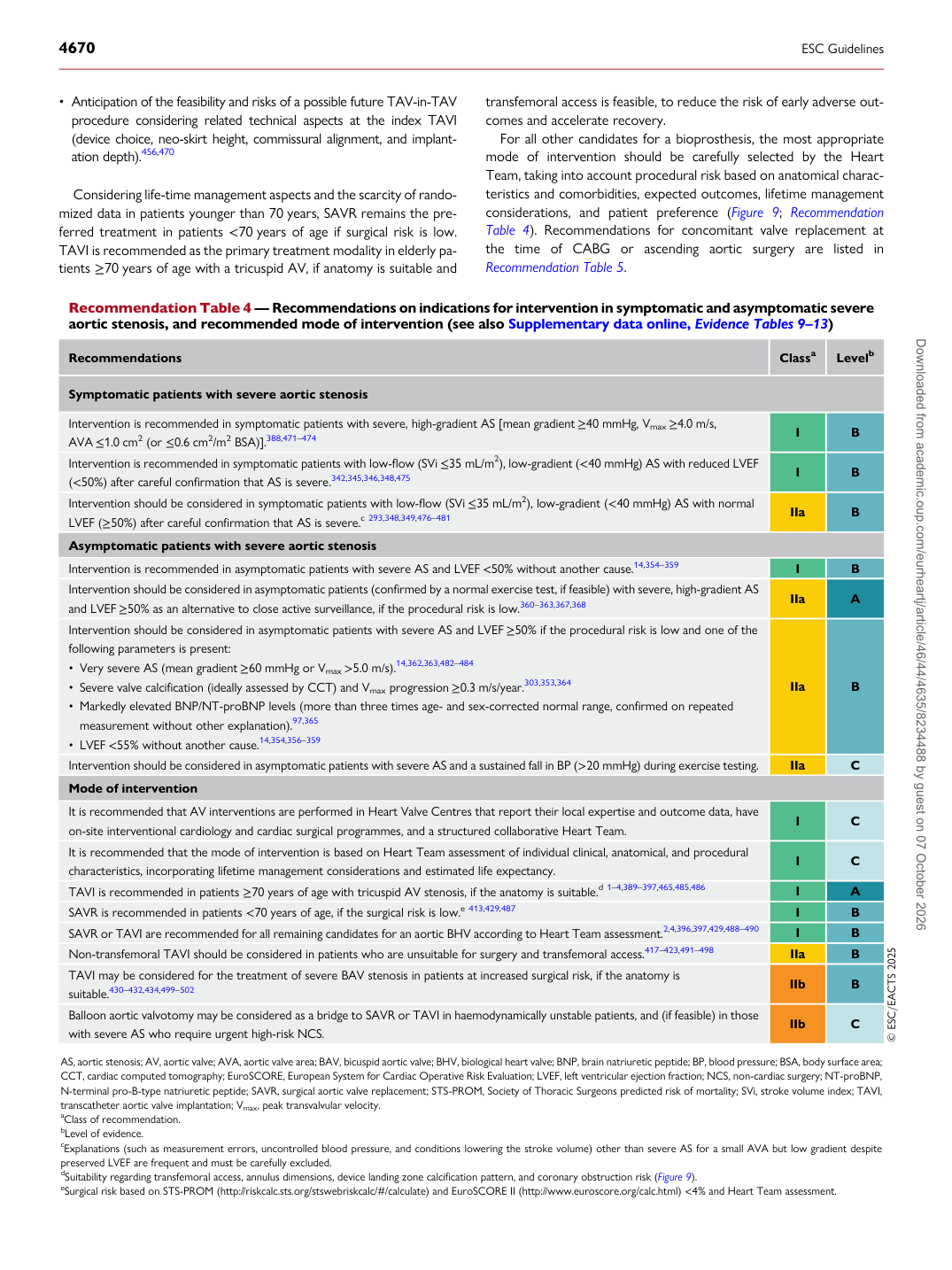
For all other candidates for a bioprosthesis, the most appropriate mode of intervention should be carefully selected by the Heart Team, taking into account procedural risk based on anatomical characteristics and comorbidities, expected outcomes, lifetime management considerations, and patient preference (Figure 9; Recommendation Table 4). Recommendations for concomitant valve replacement at the time of CABG or ascending aortic surgery are listed in Recommendation Table 5.

Recommendation Table 4 — Recommendations on indications for intervention in symptomatic and asymptomatic severe aortic stenosis, and recommended mode of intervention (see also Supplementary data online, Evidence Tables 9–13)

Recommendations Classa Levelb

Symptomatic patients with severe aortic stenosis

Intervention is recommended in symptomatic patients with severe, high-gradient AS [mean gradient ≥40 mmHg, Vmax ≥4.0 m/s, AVA ≤1.0 cm2 (or ≤0.6 cm2/m2 BSA)].388,471–474 I B Intervention is recommended in symptomatic patients with low-flow (SVi ≤35 mL/m2), low-gradient (<40 mmHg) AS with reduced LVEF (<50%) after careful confirmation that AS is severe.342,345,346,348,475 I B Intervention should be considered in symptomatic patients with low-flow (SVi ≤35 mL/m2), low-gradient (<40 mmHg) AS with normal LVEF (≥50%) after careful confirmation that AS is severe.c 293,348,349,476–481 IIa B Asymptomatic patients with severe aortic stenosis Intervention is recommended in asymptomatic patients with severe AS and LVEF <50% without another cause.14,354–359 I B Intervention should be considered in asymptomatic patients (confirmed by a normal exercise test, if feasible) with severe, high-gradient AS and LVEF ≥50% as an alternative to close active surveillance, if the procedural risk is low.360–363,367,368 IIa A Intervention should be considered in asymptomatic patients with severe AS and LVEF ≥50% if the procedural risk is low and one of the following parameters is present: • Very severe AS (mean gradient ≥60 mmHg or Vmax >5.0 m/s).14,362,363,482–484 • Severe valve calcification (ideally assessed by CCT) and Vmax progression ≥0.3 m/s/year.303,353,364 • Markedly elevated BNP/NT-proBNP levels (more than three times age- and sex-corrected normal range, confirmed on repeated

measurement without other explanation).97,365 • LVEF <55% without another cause.14,354,356–359 IIa B Intervention should be considered in asymptomatic patients with severe AS and a sustained fall in BP (>20 mmHg) during exercise testing. IIa C Mode of intervention It is recommended that AV interventions are performed in Heart Valve Centres that report their local expertise and outcome data, have on-site interventional cardiology and cardiac surgical programmes, and a structured collaborative Heart Team. I C It is recommended that the mode of intervention is based on Heart Team assessment of individual clinical, anatomical, and procedural characteristics, incorporating lifetime management considerations and estimated life expectancy. I C TAVI is recommended in patients ≥70 years of age with tricuspid AV stenosis, if the anatomy is suitable.d 1–4,389–397,465,485,486 I A SAVR is recommended in patients <70 years of age, if the surgical risk is low.e 413,429,487 I B SAVR or TAVI are recommended for all remaining candidates for an aortic BHV according to Heart Team assessment.2,4,396,397,429,488–490 I B Non-transfemoral TAVI should be considered in patients who are unsuitable for surgery and transfemoral access.417–423,491–498 IIa B TAVI may be considered for the treatment of severe BAV stenosis in patients at increased surgical risk, if the anatomy is suitable.430–432,434,499–502 IIb B Balloon aortic valvotomy may be considered as a bridge to SAVR or TAVI in haemodynamically unstable patients, and (if feasible) in those with severe AS who require urgent high-risk NCS. IIb C © ESC/EACTS 2025

AS, aortic stenosis; AV, aortic valve; AVA, aortic valve area; BAV, bicuspid aortic valve; BHV, biological heart valve; BNP, brain natriuretic peptide; BP, blood pressure; BSA, body surface area; CCT, cardiac computed tomography; EuroSCORE, European System for Cardiac Operative Risk Evaluation; LVEF, left ventricular ejection fraction; NCS, non-cardiac surgery; NT-proBNP, N-terminal pro-B-type natriuretic peptide; SAVR, surgical aortic valve replacement; STS-PROM, Society of Thoracic Surgeons predicted risk of mortality; SVi, stroke volume index; TAVI, transcatheter aortic valve implantation; Vmax, peak transvalvular velocity. aClass of recommendation. bLevel of evidence. cExplanations (such as measurement errors, uncontrolled blood pressure, and conditions lowering the stroke volume) other than severe AS for a small AVA but low gradient despite preserved LVEF are frequent and must be carefully excluded. dSuitability regarding transfemoral access, annulus dimensions, device landing zone calcification pattern, and coronary obstruction risk (Figure 9). eSurgical risk based on STS-PROM (http://riskcalc.sts.org/stswebriskcalc/#/calculate) and EuroSCORE II (http://www.euroscore.org/calc.html) <4% and Heart Team assessment. Downloaded from academic.oup.com/eurheartj/article/46/44/4635/8234488 by guest on 07 October 2026