p.28 抽出テキスト
to confirm maximal diameter, rule out isolated single sinus dilatation, and provide a baseline reference. When the baseline aortic diameter is >45 mm, a second TTE examination is recommended at 6 months to confirm the stability of the finding, followed by serial examinations on a yearly basis thereafter.275 Any increase of >3 mm should be validated by CT angiography/CMR and compared with baseline data.275 After repair of the ascending aorta, patients with Marfan syndrome and other connective tissue diseases remain at risk for dissection of untreated portions of the aorta, and require lifelong regular multidisciplinary follow-up at an expert centre.8

7.6 Special patient populations

Patients with concomitant VHD and those with AS combined with AR are discussed in Section 13.3.3. In patients with moderate AR and indication for CABG or MV surgery, the decision to treat the AV should be discussed by the Heart Team based on the aetiology of AR and other clinical factors, like the estimated life expectancy and the operative risk, as data show that progression of moderate AR may be very slow.276 The presence of aortic dilation and AR in asymptomatic patients poses the problem of limiting the level of physical activity, but consistent data are lacking. Current recommendations for participation in competitive sport are restrictive, especially regarding isometric exercise in patients with connective tissue disease,277 while a more liberal approach is likely to be appropriate in other patients. Given the familial risk of thoracic aortic aneurysms, screening with appropriate imaging studies and testing for genetic abnormalities in first-degree relatives is indicated in patients with connective tissue disease.278 Since aortic dilation is present in ∼10% of first-degree relatives of patients with a BAV, it is also considered appropriate to encourage echocardiographic screening in this specific population.275,279 8 Aortic stenosis

8.1 Prevalence and aetiology

Even if AS is the most common primary valve lesion referred for intervention in Europe and North America,12 underdiagnosis and undertreatment remain relevant concerns.10 Degenerative pathogenesis with cusps calcification is most common in developed countries and prevalence is rising rapidly because of the ageing population.11,12,187 BAVs, or more rarely unicuspid AVs, are prone to earlier degeneration, constitute the dominant valve morphology in younger patients requiring AV replacement, and are frequently associated with dilatation of the aortic root or ascending aorta.280,281 In low- and middle-income countries, rheumatic aetiology remains frequent and AS usually presents combined with rheumatic MV disease.282

8.2 Evaluation

8.2.1. Echocardiography and cardiac computed tomography Aortic stenosis is a disease slowly evolving from mild to severe valve obstruction as a consequence of increasing valve fibrosis and calcification, although progression accelerates as haemodynamic severity increases.283 Echocardiography is key to confirm the diagnosis and allows comprehensive assessment of the anatomy and severity of stenosis. Evaluation of the haemodynamic consequences on cardiac function and geometry, and the detection of aortic pathology or concomitant valve disease, provide important prognostic information that may influence management.284 Staging of extravalvular damage has been proposed,53 but it may be difficult to attribute other cardiac abnormalities to AS itself, because comorbidities are frequent in patients with AS and the observed damage may not occur in the expected chronological sequence. However, the detection of concomitant cardiac conditions [e.g. HF with preserved EF (HFpEF), amyloidosis, or hypertrophic

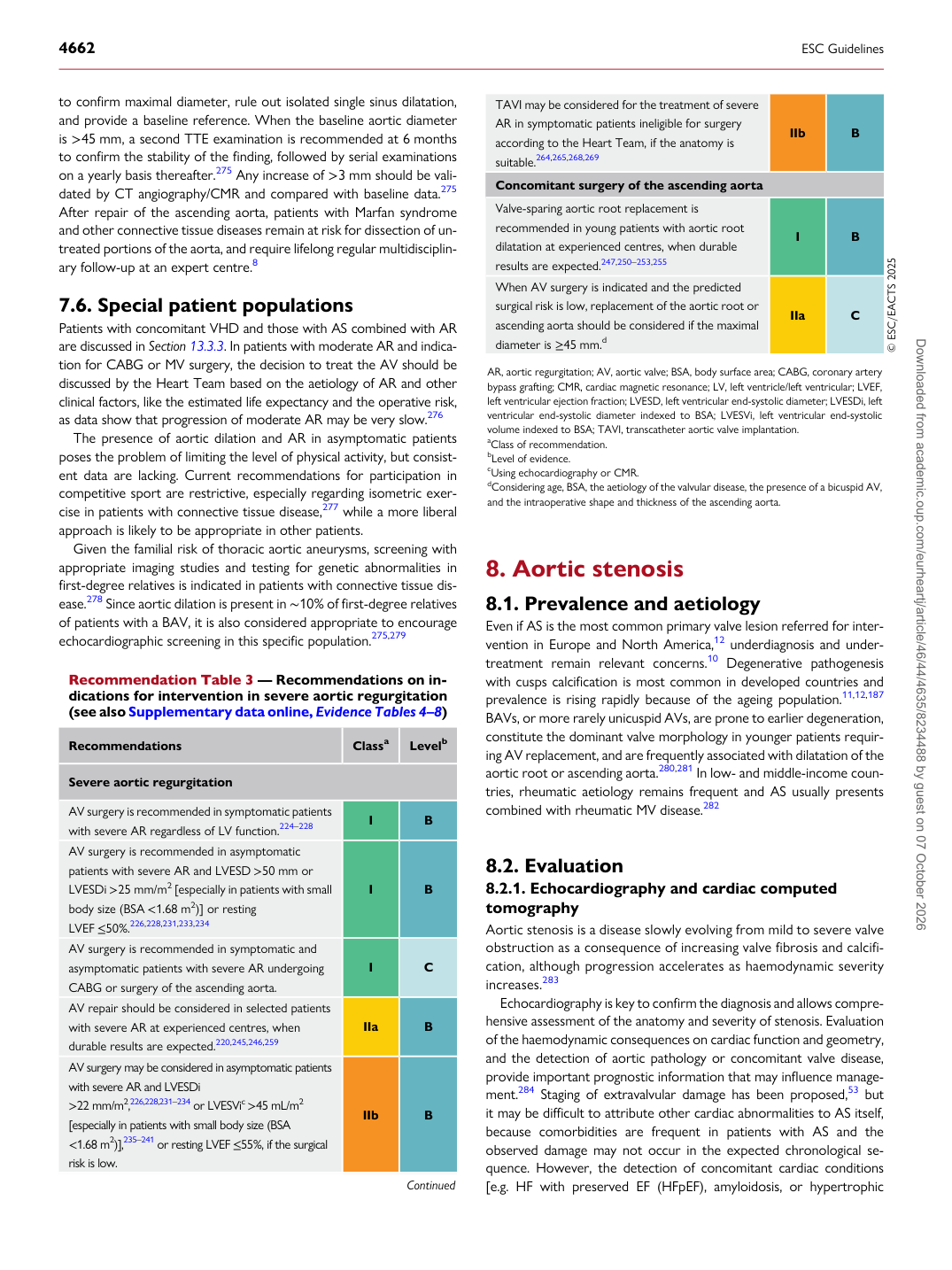
Recommendation Table 3 — Recommendations on indications for intervention in severe aortic regurgitation (see also Supplementary data online, Evidence Tables 4–8)

Recommendations Classa Levelb

Severe aortic regurgitation

AV surgery is recommended in symptomatic patients with severe AR regardless of LV function.224–228 I B AV surgery is recommended in asymptomatic patients with severe AR and LVESD >50 mm or LVESDi >25 mm/m2 [especially in patients with small body size (BSA <1.68 m2)] or resting LVEF ≤50%.226,228,231,233,234 I B AV surgery is recommended in symptomatic and asymptomatic patients with severe AR undergoing CABG or surgery of the ascending aorta. I C AV repair should be considered in selected patients with severe AR at experienced centres, when durable results are expected.220,245,246,259 IIa B AV surgery may be considered in asymptomatic patients with severe AR and LVESDi >22 mm/m2,226,228,231–234 or LVESVic >45 mL/m2 [especially in patients with small body size (BSA <1.68 m2)],235–241 or resting LVEF ≤55%, if the surgical risk is low. IIb B

Continued TAVI may be considered for the treatment of severe

AR in symptomatic patients ineligible for surgery according to the Heart Team, if the anatomy is suitable.264,265,268,269 IIb B Concomitant surgery of the ascending aorta Valve-sparing aortic root replacement is recommended in young patients with aortic root dilatation at experienced centres, when durable results are expected.247,250–253,255 I B When AV surgery is indicated and the predicted surgical risk is low, replacement of the aortic root or ascending aorta should be considered if the maximal diameter is ≥45 mm.d IIa C © ESC/EACTS 2025

AR, aortic regurgitation; AV, aortic valve; BSA, body surface area; CABG, coronary artery bypass grafting; CMR, cardiac magnetic resonance; LV, left ventricle/left ventricular; LVEF, left ventricular ejection fraction; LVESD, left ventricular end-systolic diameter; LVESDi, left ventricular end-systolic diameter indexed to BSA; LVESVi, left ventricular end-systolic volume indexed to BSA; TAVI, transcatheter aortic valve implantation. aClass of recommendation. bLevel of evidence. cUsing echocardiography or CMR. dConsidering age, BSA, the aetiology of the valvular disease, the presence of a bicuspid AV, and the intraoperative shape and thickness of the ascending aorta. Downloaded from academic.oup.com/eurheartj/article/46/44/4635/8234488 by guest on 07 October 2026