p.23 抽出テキスト
6.2 Atrial fibrillation

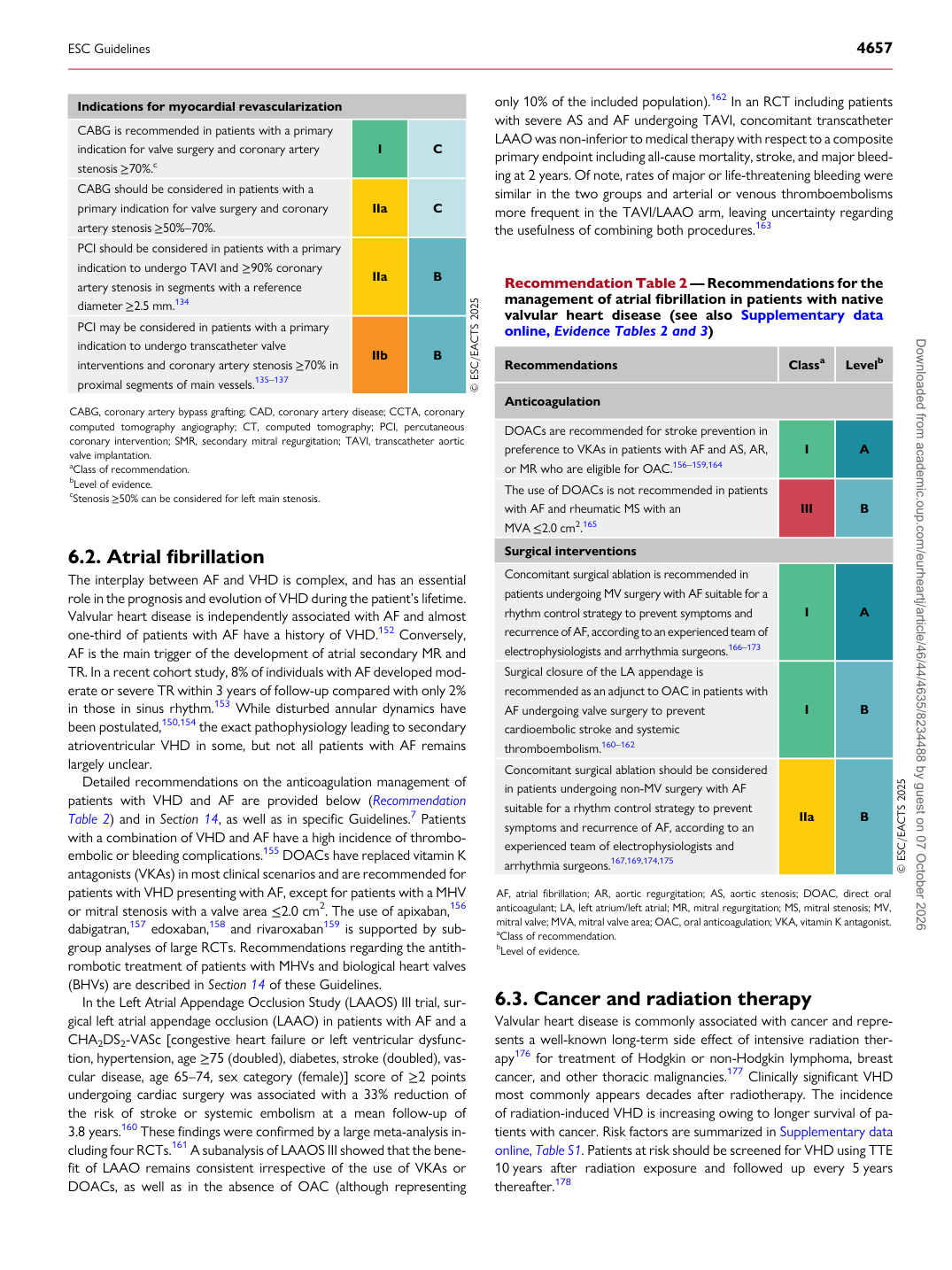
The interplay between AF and VHD is complex, and has an essential role in the prognosis and evolution of VHD during the patient’s lifetime. Valvular heart disease is independently associated with AF and almost one-third of patients with AF have a history of VHD.152 Conversely, AF is the main trigger of the development of atrial secondary MR and TR. In a recent cohort study, 8% of individuals with AF developed moderate or severe TR within 3 years of follow-up compared with only 2% in those in sinus rhythm.153 While disturbed annular dynamics have been postulated,150,154 the exact pathophysiology leading to secondary atrioventricular VHD in some, but not all patients with AF remains largely unclear. Detailed recommendations on the anticoagulation management of patients with VHD and AF are provided below (Recommendation Table 2) and in Section 14, as well as in specific Guidelines.7 Patients with a combination of VHD and AF have a high incidence of thromboembolic or bleeding complications.155 DOACs have replaced vitamin K antagonists (VKAs) in most clinical scenarios and are recommended for patients with VHD presenting with AF, except for patients with a MHV or mitral stenosis with a valve area ≤2.0 cm2. The use of apixaban,156 dabigatran,157 edoxaban,158 and rivaroxaban159 is supported by subgroup analyses of large RCTs. Recommendations regarding the antithrombotic treatment of patients with MHVs and biological heart valves (BHVs) are described in Section 14 of these Guidelines. In the Left Atrial Appendage Occlusion Study (LAAOS) III trial, surgical left atrial appendage occlusion (LAAO) in patients with AF and a CHA2DS2-VASc [congestive heart failure or left ventricular dysfunction, hypertension, age ≥75 (doubled), diabetes, stroke (doubled), vascular disease, age 65–74, sex category (female)] score of ≥2 points undergoing cardiac surgery was associated with a 33% reduction of the risk of stroke or systemic embolism at a mean follow-up of 3.8 years.160 These findings were confirmed by a large meta-analysis including four RCTs.161 A subanalysis of LAAOS III showed that the benefit of LAAO remains consistent irrespective of the use of VKAs or DOACs, as well as in the absence of OAC (although representing only 10% of the included population).162 In an RCT including patients with severe AS and AF undergoing TAVI, concomitant transcatheter LAAO was non-inferior to medical therapy with respect to a composite primary endpoint including all-cause mortality, stroke, and major bleeding at 2 years. Of note, rates of major or life-threatening bleeding were similar in the two groups and arterial or venous thromboembolisms more frequent in the TAVI/LAAO arm, leaving uncertainty regarding the usefulness of combining both procedures.163

6.3 Cancer and radiation therapy

Valvular heart disease is commonly associated with cancer and represents a well-known long-term side effect of intensive radiation therapy176 for treatment of Hodgkin or non-Hodgkin lymphoma, breast cancer, and other thoracic malignancies.177 Clinically significant VHD most commonly appears decades after radiotherapy. The incidence of radiation-induced VHD is increasing owing to longer survival of patients with cancer. Risk factors are summarized in Supplementary data online, Table S1. Patients at risk should be screened for VHD using TTE 10 years after radiation exposure and followed up every 5 years thereafter.178

Indications for myocardial revascularization CABG is recommended in patients with a primary indication for valve surgery and coronary artery stenosis ≥70%.c I C CABG should be considered in patients with a primary indication for valve surgery and coronary artery stenosis ≥50%–70%. IIa C PCI should be considered in patients with a primary indication to undergo TAVI and ≥90% coronary artery stenosis in segments with a reference diameter ≥2.5 mm.134 IIa B PCI may be considered in patients with a primary indication to undergo transcatheter valve interventions and coronary artery stenosis ≥70% in proximal segments of main vessels.135–137 IIb B © ESC/EACTS 2025

CABG, coronary artery bypass grafting; CAD, coronary artery disease; CCTA, coronary computed tomography angiography; CT, computed tomography; PCI, percutaneous coronary intervention; SMR, secondary mitral regurgitation; TAVI, transcatheter aortic valve implantation. aClass of recommendation. bLevel of evidence. cStenosis ≥50% can be considered for left main stenosis. Recommendation Table 2 — Recommendations for the management of atrial fibrillation in patients with native valvular heart disease (see also Supplementary data online, Evidence Tables 2 and 3)

Recommendations Classa Levelb

Anticoagulation

DOACs are recommended for stroke prevention in preference to VKAs in patients with AF and AS, AR, or MR who are eligible for OAC.156–159,164 I A The use of DOACs is not recommended in patients with AF and rheumatic MS with an MVA ≤2.0 cm2.165 III B Surgical interventions Concomitant surgical ablation is recommended in patients undergoing MV surgery with AF suitable for a rhythm control strategy to prevent symptoms and recurrence of AF, according to an experienced team of electrophysiologists and arrhythmia surgeons.166–173 I A Surgical closure of the LA appendage is recommended as an adjunct to OAC in patients with AF undergoing valve surgery to prevent cardioembolic stroke and systemic thromboembolism.160–162 I B Concomitant surgical ablation should be considered in patients undergoing non-MV surgery with AF suitable for a rhythm control strategy to prevent symptoms and recurrence of AF, according to an experienced team of electrophysiologists and arrhythmia surgeons.167,169,174,175 IIa B © ESC/EACTS 2025

AF, atrial fibrillation; AR, aortic regurgitation; AS, aortic stenosis; DOAC, direct oral anticoagulant; LA, left atrium/left atrial; MR, mitral regurgitation; MS, mitral stenosis; MV, mitral valve; MVA, mitral valve area; OAC, oral anticoagulation; VKA, vitamin K antagonist. aClass of recommendation. bLevel of evidence.

ESC Guidelines                                                                                                                                                                                          4657

Downloaded from academic.oup.com/eurheartj/article/46/44/4635/8234488 by guest on 07 October 2026