p.22 抽出テキスト
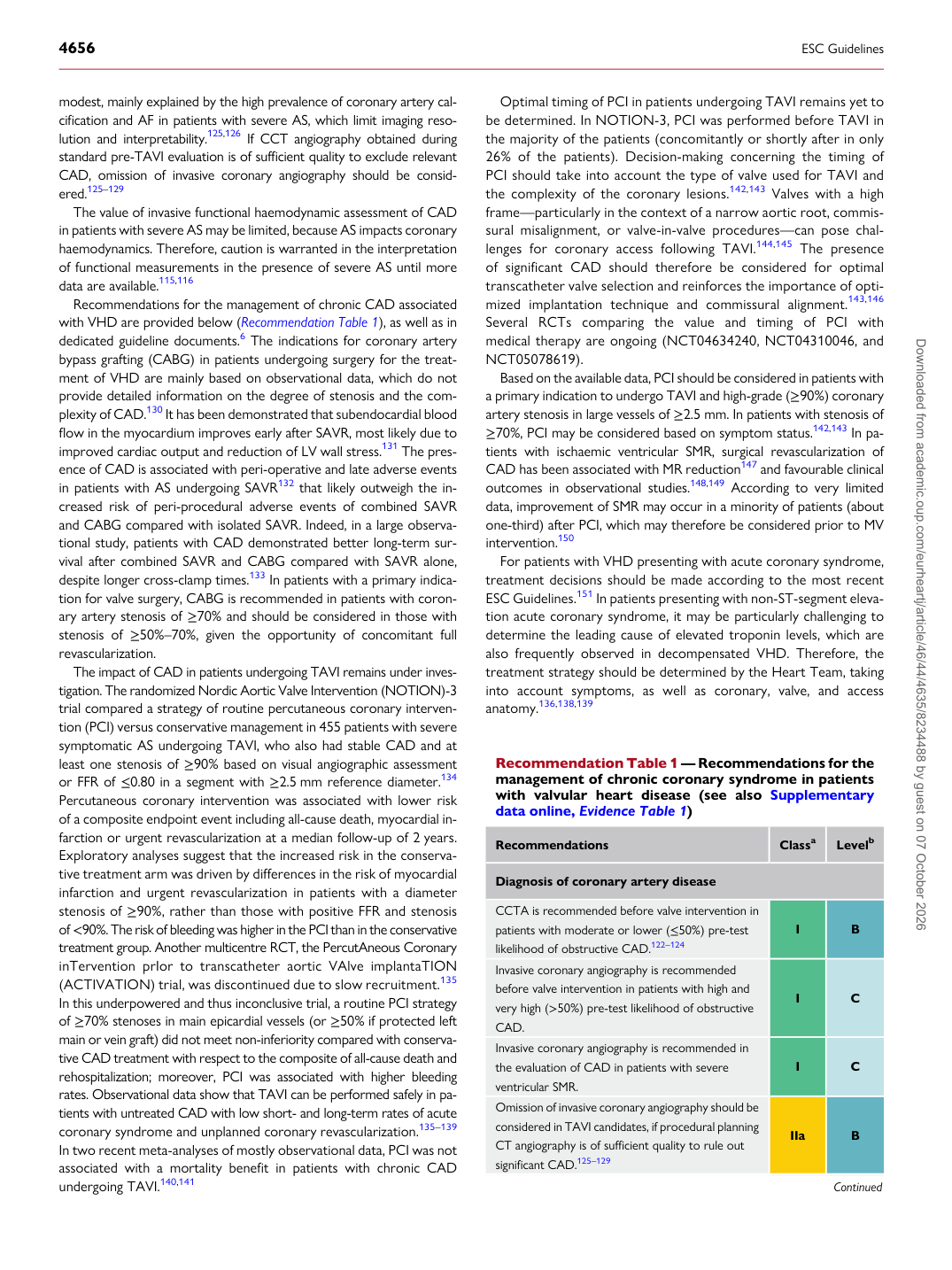
modest, mainly explained by the high prevalence of coronary artery calcification and AF in patients with severe AS, which limit imaging resolution and interpretability.125,126 If CCT angiography obtained during standard pre-TAVI evaluation is of sufficient quality to exclude relevant CAD, omission of invasive coronary angiography should be considered.125–129 The value of invasive functional haemodynamic assessment of CAD in patients with severe AS may be limited, because AS impacts coronary haemodynamics. Therefore, caution is warranted in the interpretation of functional measurements in the presence of severe AS until more data are available.115,116 Recommendations for the management of chronic CAD associated with VHD are provided below (Recommendation Table 1), as well as in dedicated guideline documents.6 The indications for coronary artery bypass grafting (CABG) in patients undergoing surgery for the treatment of VHD are mainly based on observational data, which do not provide detailed information on the degree of stenosis and the complexity of CAD.130 It has been demonstrated that subendocardial blood flow in the myocardium improves early after SAVR, most likely due to improved cardiac output and reduction of LV wall stress.131 The presence of CAD is associated with peri-operative and late adverse events in patients with AS undergoing SAVR132 that likely outweigh the increased risk of peri-procedural adverse events of combined SAVR and CABG compared with isolated SAVR. Indeed, in a large observational study, patients with CAD demonstrated better long-term survival after combined SAVR and CABG compared with SAVR alone, despite longer cross-clamp times.133 In patients with a primary indication for valve surgery, CABG is recommended in patients with coronary artery stenosis of ≥70% and should be considered in those with stenosis of ≥50%–70%, given the opportunity of concomitant full revascularization. The impact of CAD in patients undergoing TAVI remains under investigation. The randomized Nordic Aortic Valve Intervention (NOTION)-3 trial compared a strategy of routine percutaneous coronary intervention (PCI) versus conservative management in 455 patients with severe symptomatic AS undergoing TAVI, who also had stable CAD and at least one stenosis of ≥90% based on visual angiographic assessment or FFR of ≤0.80 in a segment with ≥2.5 mm reference diameter.134 Percutaneous coronary intervention was associated with lower risk of a composite endpoint event including all-cause death, myocardial infarction or urgent revascularization at a median follow-up of 2 years. Exploratory analyses suggest that the increased risk in the conservative treatment arm was driven by differences in the risk of myocardial infarction and urgent revascularization in patients with a diameter stenosis of ≥90%, rather than those with positive FFR and stenosis of <90%. The risk of bleeding was higher in the PCI than in the conservative treatment group. Another multicentre RCT, the PercutAneous Coronary inTervention prIor to transcatheter aortic VAlve implantaTION (ACTIVATION) trial, was discontinued due to slow recruitment.135 In this underpowered and thus inconclusive trial, a routine PCI strategy of ≥70% stenoses in main epicardial vessels (or ≥50% if protected left main or vein graft) did not meet non-inferiority compared with conservative CAD treatment with respect to the composite of all-cause death and rehospitalization; moreover, PCI was associated with higher bleeding rates. Observational data show that TAVI can be performed safely in patients with untreated CAD with low short- and long-term rates of acute coronary syndrome and unplanned coronary revascularization.135–139 In two recent meta-analyses of mostly observational data, PCI was not associated with a mortality benefit in patients with chronic CAD undergoing TAVI.140,141 Optimal timing of PCI in patients undergoing TAVI remains yet to be determined. In NOTION-3, PCI was performed before TAVI in the majority of the patients (concomitantly or shortly after in only 26% of the patients). Decision-making concerning the timing of PCI should take into account the type of valve used for TAVI and the complexity of the coronary lesions.142,143 Valves with a high frame—particularly in the context of a narrow aortic root, commissural misalignment, or valve-in-valve procedures—can pose challenges for coronary access following TAVI.144,145 The presence of significant CAD should therefore be considered for optimal transcatheter valve selection and reinforces the importance of optimized implantation technique and commissural alignment.143,146

Several RCTs comparing the value and timing of PCI with medical therapy are ongoing (NCT04634240, NCT04310046, and NCT05078619). Based on the available data, PCI should be considered in patients with a primary indication to undergo TAVI and high-grade (≥90%) coronary artery stenosis in large vessels of ≥2.5 mm. In patients with stenosis of ≥70%, PCI may be considered based on symptom status.142,143 In patients with ischaemic ventricular SMR, surgical revascularization of CAD has been associated with MR reduction147 and favourable clinical outcomes in observational studies.148,149 According to very limited data, improvement of SMR may occur in a minority of patients (about one-third) after PCI, which may therefore be considered prior to MV intervention.150 For patients with VHD presenting with acute coronary syndrome, treatment decisions should be made according to the most recent ESC Guidelines.151 In patients presenting with non-ST-segment elevation acute coronary syndrome, it may be particularly challenging to determine the leading cause of elevated troponin levels, which are also frequently observed in decompensated VHD. Therefore, the treatment strategy should be determined by the Heart Team, taking into account symptoms, as well as coronary, valve, and access anatomy.136,138,139

Recommendation Table 1 — Recommendations for the management of chronic coronary syndrome in patients with valvular heart disease (see also Supplementary data online, Evidence Table 1)

Recommendations Classa Levelb

Diagnosis of coronary artery disease

CCTA is recommended before valve intervention in patients with moderate or lower (≤50%) pre-test likelihood of obstructive CAD.122–124 I B Invasive coronary angiography is recommended before valve intervention in patients with high and very high (>50%) pre-test likelihood of obstructive CAD. I C Invasive coronary angiography is recommended in the evaluation of CAD in patients with severe ventricular SMR. I C Omission of invasive coronary angiography should be considered in TAVI candidates, if procedural planning CT angiography is of sufficient quality to rule out significant CAD.125–129 IIa B

Continued Downloaded from academic.oup.com/eurheartj/article/46/44/4635/8234488 by guest on 07 October 2026