p.17 抽出テキスト
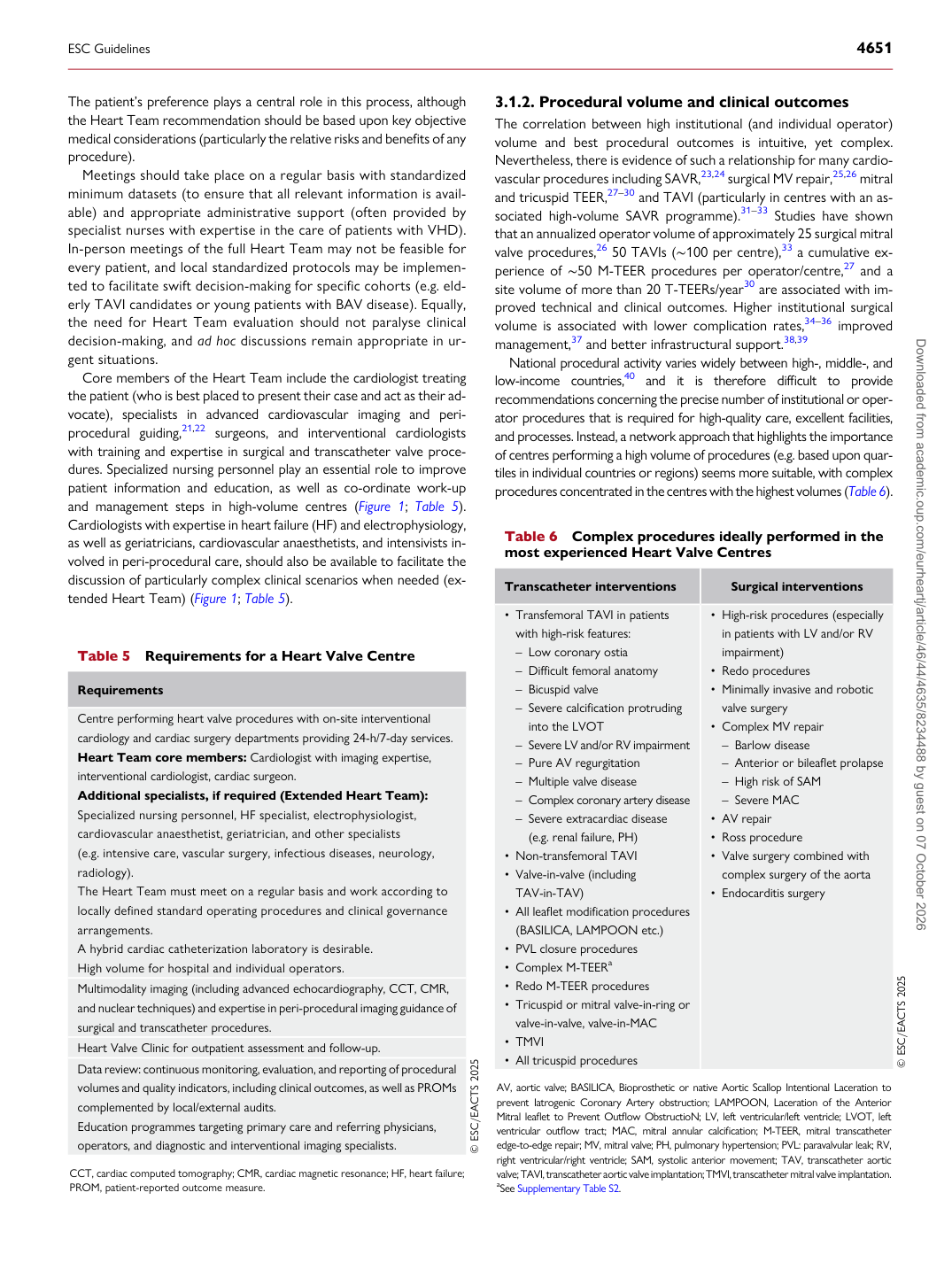
The patient’s preference plays a central role in this process, although the Heart Team recommendation should be based upon key objective medical considerations (particularly the relative risks and benefits of any procedure). Meetings should take place on a regular basis with standardized minimum datasets (to ensure that all relevant information is available) and appropriate administrative support (often provided by specialist nurses with expertise in the care of patients with VHD). In-person meetings of the full Heart Team may not be feasible for every patient, and local standardized protocols may be implemented to facilitate swift decision-making for specific cohorts (e.g. elderly TAVI candidates or young patients with BAV disease). Equally, the need for Heart Team evaluation should not paralyse clinical decision-making, and ad hoc discussions remain appropriate in urgent situations. Core members of the Heart Team include the cardiologist treating the patient (who is best placed to present their case and act as their advocate), specialists in advanced cardiovascular imaging and periprocedural guiding,21,22 surgeons, and interventional cardiologists with training and expertise in surgical and transcatheter valve procedures. Specialized nursing personnel play an essential role to improve patient information and education, as well as co-ordinate work-up and management steps in high-volume centres (Figure 1; Table 5). Cardiologists with expertise in heart failure (HF) and electrophysiology, as well as geriatricians, cardiovascular anaesthetists, and intensivists involved in peri-procedural care, should also be available to facilitate the discussion of particularly complex clinical scenarios when needed (extended Heart Team) (Figure 1; Table 5). 3.1.2 Procedural volume and clinical outcomes

The correlation between high institutional (and individual operator) volume and best procedural outcomes is intuitive, yet complex. Nevertheless, there is evidence of such a relationship for many cardiovascular procedures including SAVR,23,24 surgical MV repair,25,26 mitral and tricuspid TEER,27–30 and TAVI (particularly in centres with an associated high-volume SAVR programme).31–33 Studies have shown that an annualized operator volume of approximately 25 surgical mitral valve procedures,26 50 TAVIs (∼100 per centre),33 a cumulative experience of ∼50 M-TEER procedures per operator/centre,27 and a site volume of more than 20 T-TEERs/year30 are associated with improved technical and clinical outcomes. Higher institutional surgical volume is associated with lower complication rates,34–36 improved management,37 and better infrastructural support.38,39 National procedural activity varies widely between high-, middle-, and low-income countries,40 and it is therefore difficult to provide recommendations concerning the precise number of institutional or operator procedures that is required for high-quality care, excellent facilities, and processes. Instead, a network approach that highlights the importance of centres performing a high volume of procedures (e.g. based upon quartiles in individual countries or regions) seems more suitable, with complex procedures concentrated in the centres with the highest volumes (Table 6).

Table 5 Requirements for a Heart Valve Centre

Requirements

Centre performing heart valve procedures with on-site interventional cardiology and cardiac surgery departments providing 24-h/7-day services. Heart Team core members: Cardiologist with imaging expertise, interventional cardiologist, cardiac surgeon. Additional specialists, if required (Extended Heart Team): Specialized nursing personnel, HF specialist, electrophysiologist, cardiovascular anaesthetist, geriatrician, and other specialists (e.g. intensive care, vascular surgery, infectious diseases, neurology, radiology). The Heart Team must meet on a regular basis and work according to locally defined standard operating procedures and clinical governance arrangements. A hybrid cardiac catheterization laboratory is desirable. High volume for hospital and individual operators. Multimodality imaging (including advanced echocardiography, CCT, CMR, and nuclear techniques) and expertise in peri-procedural imaging guidance of surgical and transcatheter procedures. Heart Valve Clinic for outpatient assessment and follow-up. Data review: continuous monitoring, evaluation, and reporting of procedural volumes and quality indicators, including clinical outcomes, as well as PROMs complemented by local/external audits. Education programmes targeting primary care and referring physicians, operators, and diagnostic and interventional imaging specialists. © ESC/EACTS 2025

CCT, cardiac computed tomography; CMR, cardiac magnetic resonance; HF, heart failure; PROM, patient-reported outcome measure. Table 6 Complex procedures ideally performed in the most experienced Heart Valve Centres

Transcatheter interventions Surgical interventions

• Transfemoral TAVI in patients with high-risk features: – Low coronary ostia – Difficult femoral anatomy – Bicuspid valve – Severe calcification protruding

into the LVOT – Severe LV and/or RV impairment – Pure AV regurgitation – Multiple valve disease – Complex coronary artery disease – Severe extracardiac disease (e.g. renal failure, PH) • Non-transfemoral TAVI • Valve-in-valve (including TAV-in-TAV) • All leaflet modification procedures (BASILICA, LAMPOON etc.) • PVL closure procedures • Complex M-TEERa • Redo M-TEER procedures • Tricuspid or mitral valve-in-ring or valve-in-valve, valve-in-MAC • TMVI • All tricuspid procedures • High-risk procedures (especially in patients with LV and/or RV impairment) • Redo procedures • Minimally invasive and robotic valve surgery • Complex MV repair – Barlow disease – Anterior or bileaflet prolapse – High risk of SAM – Severe MAC • AV repair • Ross procedure • Valve surgery combined with complex surgery of the aorta • Endocarditis surgery © ESC/EACTS 2025

AV, aortic valve; BASILICA, Bioprosthetic or native Aortic Scallop Intentional Laceration to prevent Iatrogenic Coronary Artery obstruction; LAMPOON, Laceration of the Anterior Mitral leaflet to Prevent Outflow ObstructioN; LV, left ventricular/left ventricle; LVOT, left ventricular outflow tract; MAC, mitral annular calcification; M-TEER, mitral transcatheter edge-to-edge repair; MV, mitral valve; PH, pulmonary hypertension; PVL: paravalvular leak; RV, right ventricular/right ventricle; SAM, systolic anterior movement; TAV, transcatheter aortic valve; TAVI, transcatheter aortic valve implantation; TMVI, transcatheter mitral valve implantation. aSee Supplementary Table S2.

ESC Guidelines                                                                                                                                                                                          4651

Downloaded from academic.oup.com/eurheartj/article/46/44/4635/8234488 by guest on 07 October 2026