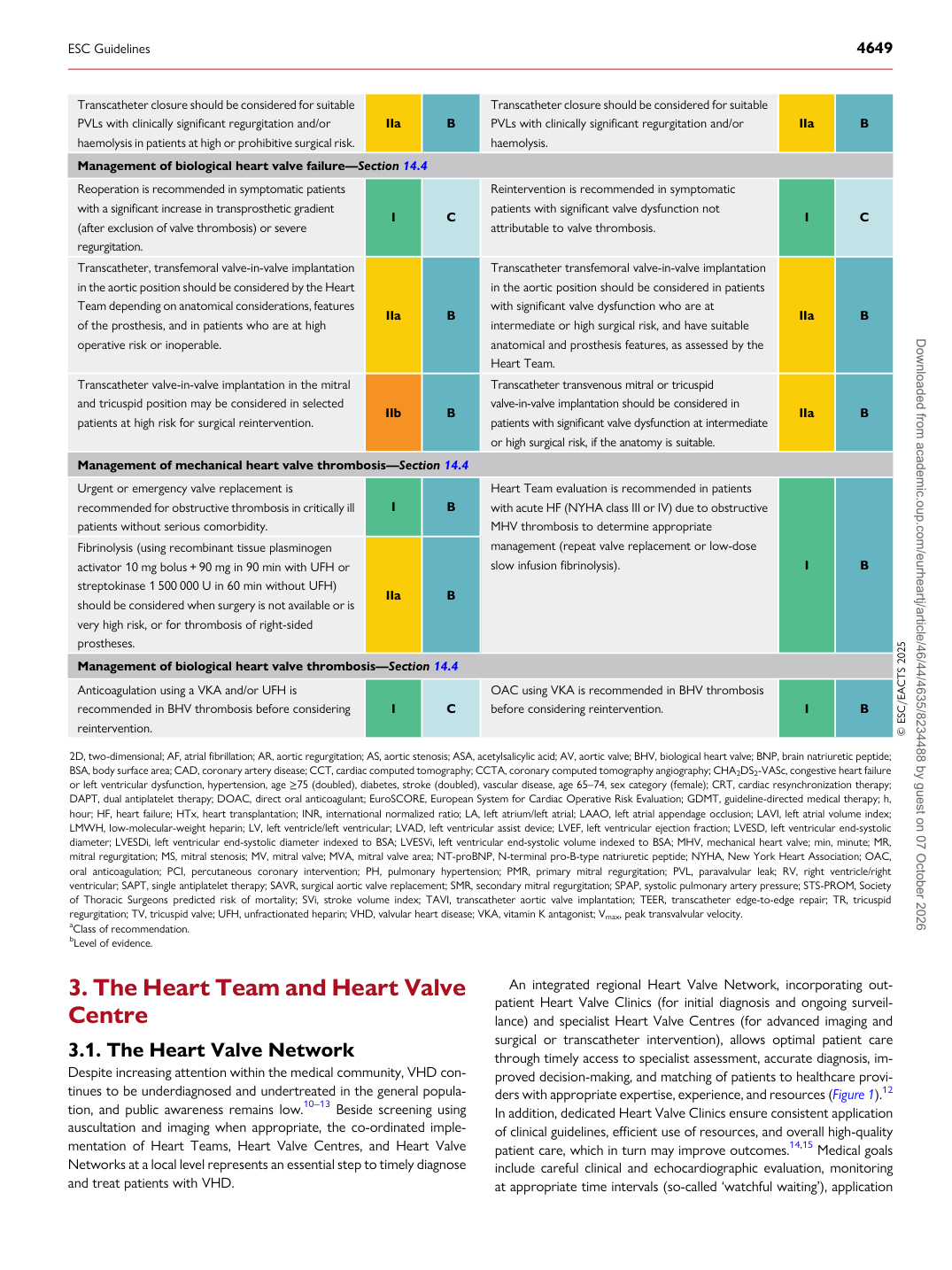
p.15 抽出テキスト
3 The Heart Team and Heart Valve

Centre

3.1 The Heart Valve Network

Despite increasing attention within the medical community, VHD continues to be underdiagnosed and undertreated in the general population, and public awareness remains low.10–13 Beside screening using auscultation and imaging when appropriate, the co-ordinated implementation of Heart Teams, Heart Valve Centres, and Heart Valve Networks at a local level represents an essential step to timely diagnose and treat patients with VHD. An integrated regional Heart Valve Network, incorporating outpatient Heart Valve Clinics (for initial diagnosis and ongoing surveillance) and specialist Heart Valve Centres (for advanced imaging and surgical or transcatheter intervention), allows optimal patient care through timely access to specialist assessment, accurate diagnosis, improved decision-making, and matching of patients to healthcare providers with appropriate expertise, experience, and resources (Figure 1).12

In addition, dedicated Heart Valve Clinics ensure consistent application of clinical guidelines, efficient use of resources, and overall high-quality patient care, which in turn may improve outcomes.14,15 Medical goals include careful clinical and echocardiographic evaluation, monitoring at appropriate time intervals (so-called ‘watchful waiting’), application

Transcatheter closure should be considered for suitable PVLs with clinically significant regurgitation and/or haemolysis in patients at high or prohibitive surgical risk. IIa B Transcatheter closure should be considered for suitable

PVLs with clinically significant regurgitation and/or haemolysis. IIa B

Management of biological heart valve failure—Section 14.4 Reoperation is recommended in symptomatic patients with a significant increase in transprosthetic gradient (after exclusion of valve thrombosis) or severe regurgitation. I C Reintervention is recommended in symptomatic

patients with significant valve dysfunction not attributable to valve thrombosis. I C

Transcatheter, transfemoral valve-in-valve implantation in the aortic position should be considered by the Heart Team depending on anatomical considerations, features of the prosthesis, and in patients who are at high operative risk or inoperable. IIa B Transcatheter transfemoral valve-in-valve implantation in the aortic position should be considered in patients

with significant valve dysfunction who are at intermediate or high surgical risk, and have suitable anatomical and prosthesis features, as assessed by the Heart Team. IIa B

Transcatheter valve-in-valve implantation in the mitral and tricuspid position may be considered in selected patients at high risk for surgical reintervention. IIb B Transcatheter transvenous mitral or tricuspid

valve-in-valve implantation should be considered in patients with significant valve dysfunction at intermediate or high surgical risk, if the anatomy is suitable. IIa B

Management of mechanical heart valve thrombosis—Section 14.4 Urgent or emergency valve replacement is recommended for obstructive thrombosis in critically ill patients without serious comorbidity. I B Heart Team evaluation is recommended in patients with acute HF (NYHA class III or IV) due to obstructive

MHV thrombosis to determine appropriate

management (repeat valve replacement or low-dose slow infusion fibrinolysis). I B Fibrinolysis (using recombinant tissue plasminogen activator 10 mg bolus + 90 mg in 90 min with UFH or streptokinase 1 500 000 U in 60 min without UFH) should be considered when surgery is not available or is very high risk, or for thrombosis of right-sided prostheses. IIa B Management of biological heart valve thrombosis—Section 14.4 Anticoagulation using a VKA and/or UFH is recommended in BHV thrombosis before considering reintervention. I C OAC using VKA is recommended in BHV thrombosis

before considering reintervention. I B © ESC/EACTS 2025

2D, two-dimensional; AF, atrial fibrillation; AR, aortic regurgitation; AS, aortic stenosis; ASA, acetylsalicylic acid; AV, aortic valve; BHV, biological heart valve; BNP, brain natriuretic peptide; BSA, body surface area; CAD, coronary artery disease; CCT, cardiac computed tomography; CCTA, coronary computed tomography angiography; CHA2DS2-VASc, congestive heart failure or left ventricular dysfunction, hypertension, age ≥75 (doubled), diabetes, stroke (doubled), vascular disease, age 65–74, sex category (female); CRT, cardiac resynchronization therapy; DAPT, dual antiplatelet therapy; DOAC, direct oral anticoagulant; EuroSCORE, European System for Cardiac Operative Risk Evaluation; GDMT, guideline-directed medical therapy; h, hour; HF, heart failure; HTx, heart transplantation; INR, international normalized ratio; LA, left atrium/left atrial; LAAO, left atrial appendage occlusion; LAVI, left atrial volume index; LMWH, low-molecular-weight heparin; LV, left ventricle/left ventricular; LVAD, left ventricular assist device; LVEF, left ventricular ejection fraction; LVESD, left ventricular end-systolic diameter; LVESDi, left ventricular end-systolic diameter indexed to BSA; LVESVi, left ventricular end-systolic volume indexed to BSA; MHV, mechanical heart valve; min, minute; MR, mitral regurgitation; MS, mitral stenosis; MV, mitral valve; MVA, mitral valve area; NT-proBNP, N-terminal pro-B-type natriuretic peptide; NYHA, New York Heart Association; OAC, oral anticoagulation; PCI, percutaneous coronary intervention; PH, pulmonary hypertension; PMR, primary mitral regurgitation; PVL, paravalvular leak; RV, right ventricle/right ventricular; SAPT, single antiplatelet therapy; SAVR, surgical aortic valve replacement; SMR, secondary mitral regurgitation; SPAP, systolic pulmonary artery pressure; STS-PROM, Society of Thoracic Surgeons predicted risk of mortality; SVi, stroke volume index; TAVI, transcatheter aortic valve implantation; TEER, transcatheter edge-to-edge repair; TR, tricuspid regurgitation; TV, tricuspid valve; UFH, unfractionated heparin; VHD, valvular heart disease; VKA, vitamin K antagonist; Vmax, peak transvalvular velocity. aClass of recommendation. bLevel of evidence.

ESC Guidelines                                                                                                                                                                                          4649

Downloaded from academic.oup.com/eurheartj/article/46/44/4635/8234488 by guest on 07 October 2026