p.14 抽出テキスト
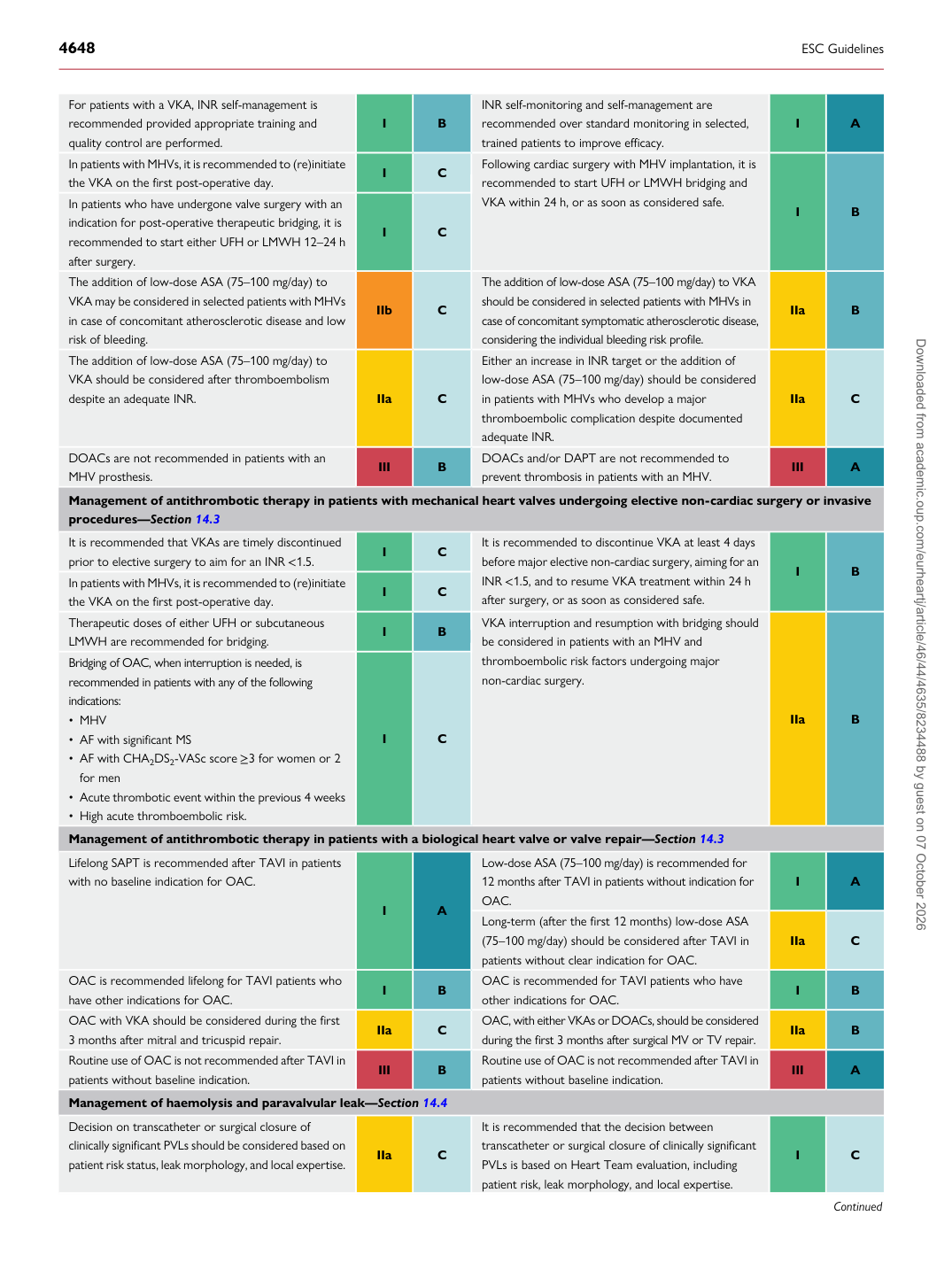
For patients with a VKA, INR self-management is recommended provided appropriate training and quality control are performed. I B INR self-monitoring and self-management are

recommended over standard monitoring in selected, trained patients to improve efficacy. I A

In patients with MHVs, it is recommended to (re)initiate

the VKA on the first post-operative day. I C Following cardiac surgery with MHV implantation, it is

recommended to start UFH or LMWH bridging and VKA within 24 h, or as soon as considered safe. I B In patients who have undergone valve surgery with an indication for post-operative therapeutic bridging, it is recommended to start either UFH or LMWH 12–24 h after surgery. I C The addition of low-dose ASA (75–100 mg/day) to VKA may be considered in selected patients with MHVs in case of concomitant atherosclerotic disease and low risk of bleeding. IIb C The addition of low-dose ASA (75–100 mg/day) to VKA

should be considered in selected patients with MHVs in case of concomitant symptomatic atherosclerotic disease, considering the individual bleeding risk profile. IIa B

The addition of low-dose ASA (75–100 mg/day) to VKA should be considered after thromboembolism despite an adequate INR. IIa C Either an increase in INR target or the addition of low-dose ASA (75–100 mg/day) should be considered

in patients with MHVs who develop a major thromboembolic complication despite documented adequate INR. IIa C

DOACs are not recommended in patients with an MHV prosthesis. III B DOACs and/or DAPT are not recommended to prevent thrombosis in patients with an MHV. III A Management of antithrombotic therapy in patients with mechanical heart valves undergoing elective non-cardiac surgery or invasive procedures—Section 14.3 It is recommended that VKAs are timely discontinued

prior to elective surgery to aim for an INR <1.5. I C It is recommended to discontinue VKA at least 4 days

before major elective non-cardiac surgery, aiming for an INR <1.5, and to resume VKA treatment within 24 h after surgery, or as soon as considered safe.

I B In patients with MHVs, it is recommended to (re)initiate the VKA on the first post-operative day. I C Therapeutic doses of either UFH or subcutaneous

LMWH are recommended for bridging. I B VKA interruption and resumption with bridging should

be considered in patients with an MHV and thromboembolic risk factors undergoing major non-cardiac surgery.

IIa B

Bridging of OAC, when interruption is needed, is recommended in patients with any of the following indications: • MHV • AF with significant MS • AF with CHA2DS2-VASc score ≥3 for women or 2 for men • Acute thrombotic event within the previous 4 weeks • High acute thromboembolic risk. I C Management of antithrombotic therapy in patients with a biological heart valve or valve repair—Section 14.3 Lifelong SAPT is recommended after TAVI in patients with no baseline indication for OAC.

I A Low-dose ASA (75–100 mg/day) is recommended for

12 months after TAVI in patients without indication for OAC. I A Long-term (after the first 12 months) low-dose ASA (75–100 mg/day) should be considered after TAVI in patients without clear indication for OAC. IIa C

OAC is recommended lifelong for TAVI patients who have other indications for OAC. I B OAC is recommended for TAVI patients who have

other indications for OAC. I B

OAC with VKA should be considered during the first 3 months after mitral and tricuspid repair. IIa C OAC, with either VKAs or DOACs, should be considered

during the first 3 months after surgical MV or TV repair. IIa B

Routine use of OAC is not recommended after TAVI in patients without baseline indication. III B Routine use of OAC is not recommended after TAVI in

patients without baseline indication. III A

Management of haemolysis and paravalvular leak—Section 14.4 Decision on transcatheter or surgical closure of clinically significant PVLs should be considered based on patient risk status, leak morphology, and local expertise. IIa C It is recommended that the decision between transcatheter or surgical closure of clinically significant

PVLs is based on Heart Team evaluation, including patient risk, leak morphology, and local expertise. I C

Continued Downloaded from academic.oup.com/eurheartj/article/46/44/4635/8234488 by guest on 07 October 2026