p.13 抽出テキスト
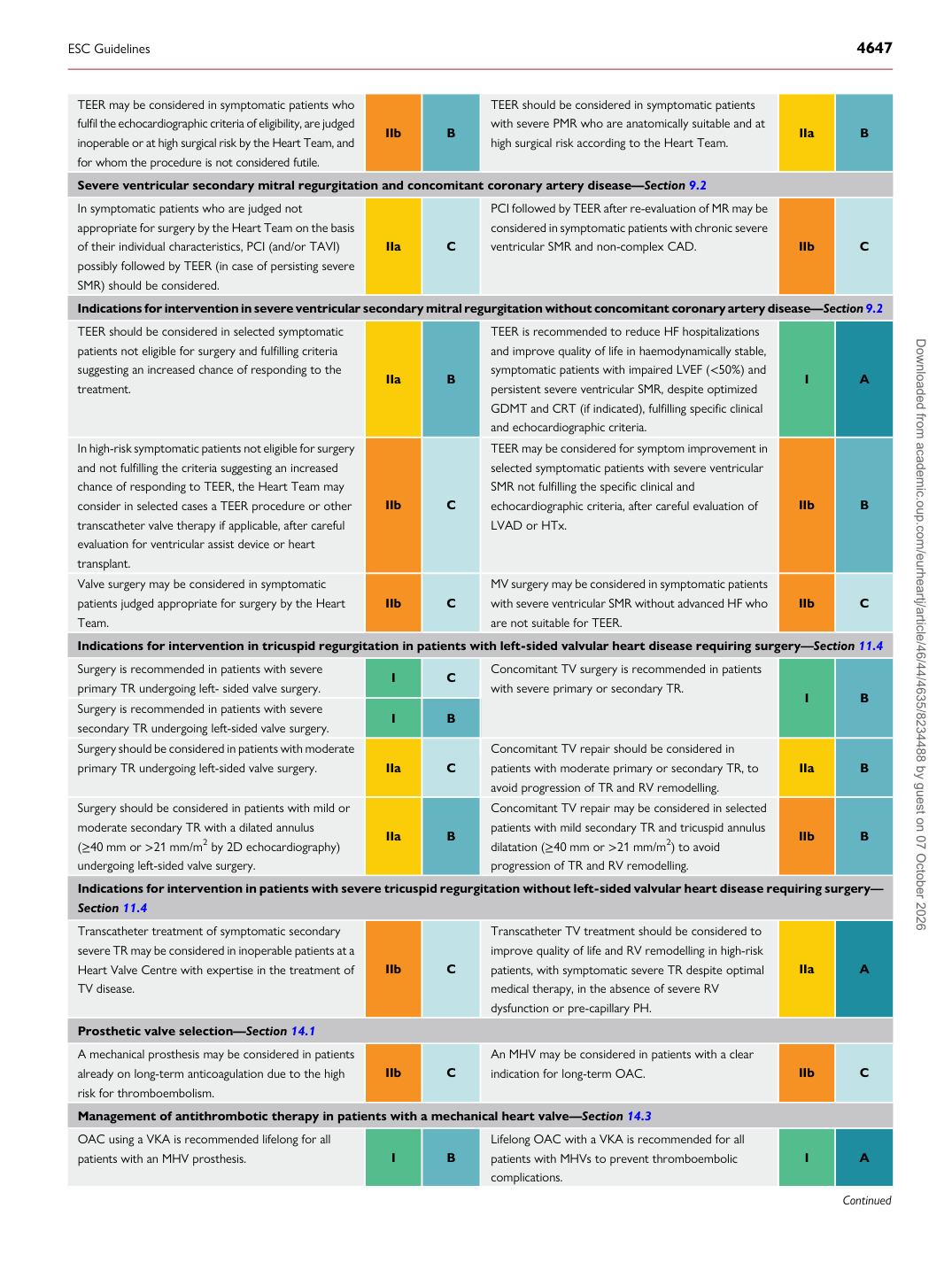
TEER may be considered in symptomatic patients who fulfil the echocardiographic criteria of eligibility, are judged inoperable or at high surgical risk by the Heart Team, and for whom the procedure is not considered futile. IIb B TEER should be considered in symptomatic patients

with severe PMR who are anatomically suitable and at high surgical risk according to the Heart Team. IIa B

Severe ventricular secondary mitral regurgitation and concomitant coronary artery disease—Section 9.2 In symptomatic patients who are judged not appropriate for surgery by the Heart Team on the basis of their individual characteristics, PCI (and/or TAVI) possibly followed by TEER (in case of persisting severe SMR) should be considered. IIa C PCI followed by TEER after re-evaluation of MR may be

considered in symptomatic patients with chronic severe ventricular SMR and non-complex CAD. IIb C

Indications for intervention in severe ventricular secondary mitral regurgitation without concomitant coronary artery disease—Section 9.2 TEER should be considered in selected symptomatic patients not eligible for surgery and fulfilling criteria suggesting an increased chance of responding to the treatment. IIa B TEER is recommended to reduce HF hospitalizations

and improve quality of life in haemodynamically stable, symptomatic patients with impaired LVEF (<50%) and persistent severe ventricular SMR, despite optimized GDMT and CRT (if indicated), fulfilling specific clinical and echocardiographic criteria. I A

In high-risk symptomatic patients not eligible for surgery and not fulfilling the criteria suggesting an increased chance of responding to TEER, the Heart Team may consider in selected cases a TEER procedure or other transcatheter valve therapy if applicable, after careful evaluation for ventricular assist device or heart transplant. IIb C TEER may be considered for symptom improvement in selected symptomatic patients with severe ventricular

SMR not fulfilling the specific clinical and echocardiographic criteria, after careful evaluation of LVAD or HTx. IIb B

Valve surgery may be considered in symptomatic patients judged appropriate for surgery by the Heart Team. IIb C MV surgery may be considered in symptomatic patients

with severe ventricular SMR without advanced HF who are not suitable for TEER. IIb C

Indications for intervention in tricuspid regurgitation in patients with left-sided valvular heart disease requiring surgery—Section 11.4 Surgery is recommended in patients with severe

primary TR undergoing left- sided valve surgery. I C Concomitant TV surgery is recommended in patients

with severe primary or secondary TR. I B Surgery is recommended in patients with severe secondary TR undergoing left-sided valve surgery. I B Surgery should be considered in patients with moderate primary TR undergoing left-sided valve surgery. IIa C Concomitant TV repair should be considered in

patients with moderate primary or secondary TR, to avoid progression of TR and RV remodelling. IIa B

Surgery should be considered in patients with mild or moderate secondary TR with a dilated annulus (≥40 mm or >21 mm/m2 by 2D echocardiography) undergoing left-sided valve surgery. IIa B Concomitant TV repair may be considered in selected patients with mild secondary TR and tricuspid annulus

dilatation (≥40 mm or >21 mm/m2) to avoid progression of TR and RV remodelling. IIb B

Indications for intervention in patients with severe tricuspid regurgitation without left-sided valvular heart disease requiring surgery— Section 11.4 Transcatheter treatment of symptomatic secondary severe TR may be considered in inoperable patients at a Heart Valve Centre with expertise in the treatment of TV disease. IIb C Transcatheter TV treatment should be considered to improve quality of life and RV remodelling in high-risk

patients, with symptomatic severe TR despite optimal medical therapy, in the absence of severe RV dysfunction or pre-capillary PH. IIa A

Prosthetic valve selection—Section 14.1 A mechanical prosthesis may be considered in patients already on long-term anticoagulation due to the high risk for thromboembolism. IIb C An MHV may be considered in patients with a clear

indication for long-term OAC. IIb C

Management of antithrombotic therapy in patients with a mechanical heart valve—Section 14.3 OAC using a VKA is recommended lifelong for all patients with an MHV prosthesis. I B Lifelong OAC with a VKA is recommended for all patients with MHVs to prevent thromboembolic

complications. I A

Continued

ESC Guidelines                                                                                                                                                                                          4647

Downloaded from academic.oup.com/eurheartj/article/46/44/4635/8234488 by guest on 07 October 2026